Industries
High Tech

High Tech Solutions to Drive Business Transformation through Technology
Highlights
- As organizations give AI agents greater decision-making authority, the challenge shifts from model performance to determining which decisions may be delegated, under what conditions, and who remains accountable.
- The eight governing questions help enterprises assess context, intent, boundaries, data, policy, auditability, learning and human accountability before delegating consequential decisions.
- Dependable agent operations require controlled intervention, safe operating limits, defined fallback, decision-level visibility, version discipline and clear operational accountability, enabling organizations to expand decision rights with confidence and trust.
On this page
On this pageinpage
From capability to accountable decisions
As AI agents move from assistance to action, decision governance becomes a business discipline.
In communications, media and technology services enterprises, agents already diagnose faults, schedule content, validate sources and resolve customer requests. These actions can create value, but errors may carry financial, contractual, regulatory or reputational consequences.
Existing controls for applications, infrastructure, identity and data remain essential, yet they do not fully answer whether a decision was appropriate. An agent assembles its next step at runtime from signals, retrieved context, tools and interactions with other agents. A technically permitted action may still be wrong for the service condition, editorial context, customer obligation or contract in force.
The practical questions are therefore broader: Was the agent entitled to decide? Was the evidence current and sufficient? Did the action remain within approved boundaries? Can the enterprise explain the outcome, intervene when necessary and recover if it proves wrong? Oversight must follow the decision, not only the model or platform. This shifts governance from checking whether a system is technically compliant to determining whether each consequential action is justified in its business context.
Determining what can be delegated
The question is not whether an agent can decide. It is whether the enterprise should allow it to decide alone.
Decisions are often suitable for agent-led execution when they produce an assessment rather than an external outcome, are corrected through normal downstream workflows, remain subject to review before reaching a customer or audience, or can be reversed within defined limits. What these decisions share is not simplicity but recoverability: errors are visible early and inexpensive to correct.
Human approval should remain where consequences are harder to contain. Four conditions matter most: irreversibility, external reach, commercial or licensing rights, and regulatory exposure. When any applies, the agent should usually shift from decision-maker to advisor. The governing principle is straightforward: decision authority should be determined by consequence, not complexity. A complex diagnosis may be safe to automate, while a simple customer credit may require approval because it creates an external and potentially cumulative effect. Decision authority is therefore not a fixed attribute of an agent. It is a decision-specific responsibility shaped by reach, reversibility, rights, evidence quality and the enterprise ability to recover.
Eight questions before delegating a decision
Every consequential agentic decision should answer eight governing questions.
These are not maturity levels or a proprietary framework. They are recurring tests of whether sufficient evidence, accountability and control exist before decision rights are expanded.
- Context
What did the agent know, from which sources, and how current was that information?
Context should be authorized, attributable, timestamped and reconstructable - Intent
Was the decision based on a valid instruction rather than an observed signal or inference?
Observation, inference, request and authorization should remain distinguishable. - Boundaries
What may the agent diagnose, recommend, approve, publish or execute?
Decision rights should be explicit, enforced and preserved through delegation - Data
Was the underlying data current, permitted and sufficient?
Freshness, lineage, quality and usage rights should be checked when the decision is made. - Policy
Were relevant policies applied before action?
Change, privacy, editorial, licensing and release rules should operate as runtime controls. - Auditability
Can the enterprise reconstruct and explain the decision afterwards?
Evidence should connect the initiating signal, context, policy checks, action and outcome. - Learning
How will outcomes, corrections and overrides influence future behaviour?
Change should be tested, governed and auditable rather than silently absorbed. - Human accountability
Who remains accountable, and who can intervene?
Escalation, suspension, reversal and recovery mechanisms should be explicit and tested.

Fig 1:
Eight governing questions for delegating consequential AI agent decisions.
Fig 1:
What governance failures teach
Many agent failures are governance failures before they are technology failures.
A fault-remediation agent may correctly identify and restart shared equipment yet rely on outdated service-impact data, affecting customers with stricter commitments. A scheduling agent may choose content shown as available while missing geographic licensing restrictions stored elsewhere. A customer-service agent may issue a valid goodwill credit without seeing that another channel has already granted one.
In each case, the model can behave as intended while the enterprise still receives the wrong outcome. The gaps are different: incomplete context, absent runtime policy and limited cross-channel visibility. Stronger models would not necessarily prevent them. Better evidence, decision rights, policy enforcement and auditability would. These examples also show why decision quality cannot be assessed only one action at a time. Patterns across customers, channels and operational domains may reveal cumulative harm or loss that appears reasonable at the individual transaction level.
Governing decisions across agents
Accountability becomes harder when several agents, tools and systems contribute to one outcome.
Enterprise workflows rarely involve one agent in isolation. A network diagnosis may trigger remediation and customer communication; a content decision may affect metadata, scheduling and distribution; a customer interaction may span service, billing and knowledge systems. Across these hand-offs, identity should remain visible, decision rights should survive delegation, and evidence should connect the full path to the business outcome.
This remains an evolving area. Authentication can establish which agent is acting and what permissions it holds, but not whether it continues to pursue its intended purpose. Standards for identity, authorization, interoperability and auditability are also maturing. Governance anchored to enterprise decision rights, evidence and accountable ownership is therefore more durable than governance tied to a particular platform. The test is whether the enterprise can explain how a decision was reached and who remains answerable for it. As decision chains grow, enterprises should keep them as short and observable as practical, revalidate authority at important hand-offs and avoid assuming that permissions or context will transfer correctly by default.
From pilot to dependable service
A successful pilot proves that an agent can perform a task. A dependable service proves that the enterprise can rely on it.
The distance between the two is rarely limited by technology. It depends on operating commitments agreed before decision-making moves beyond a controlled environment: how decisions are validated, who owns outcomes, how exceptions are handled, what evidence is retained and how actions can be stopped, reversed or contained.
Enterprises that settle these commitments early can often scale with greater confidence because ownership, evidence and intervention paths do not have to be renegotiated under pressure. Dependable services typically demonstrate six capabilities:
- Controlled intervention: Operations teams can suspend or limit agent decision-making without specialist engineering support.
- Safe operating limits: Boundaries prevent an isolated failure from becoming a systemic incident.
- Defined fallback: The agent degrades safely, escalates or refuses when evidence or dependent services are unavailable.
- Decision-level visibility: Monitoring covers outcomes, overrides, exceptions and business impact, not infrastructure alone.
- Version discipline: The enterprise can identify which models, instructions, tools and policies influenced a past decision.
- Operational accountability: Ownership, escalation and incident-response paths reflect the consequence of the decision.
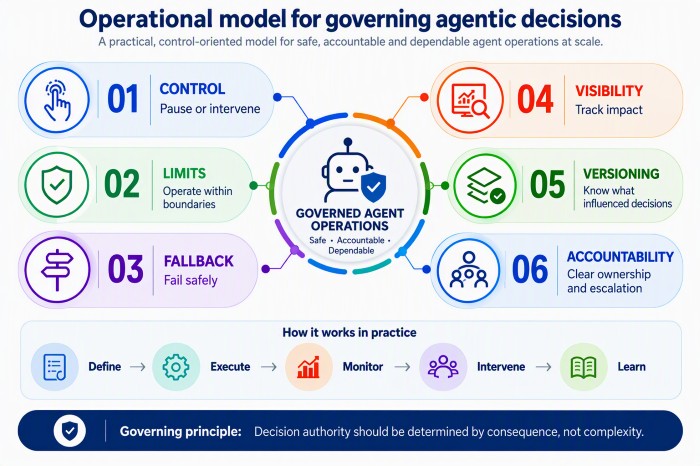
Fig 2:
Operational model for governing agentic decisions at scale.
Fig 2:
Making governance practical
Governance must balance delegated decision-making, assurance and operating cost, then become part of normal practice.
Delegating more decisions can improve speed and scale, while deeper verification improves confidence but adds latency and cost. Human review is essential for consequential decisions, yet it cannot scale indefinitely; routing everything to a person creates a queue rather than meaningful oversight. Human attention should be concentrated where impact, irreversibility or uncertainty justify intervention.
Organizations do not need a new committee to begin. Existing risk, change, operational, editorial and data-governance forums can establish ownership for each production agent, including purpose, data scope and decision rights. Teams can then examine a small number of high-consequence decisions against the eight questions, close the most material gaps and re-review after significant change, incidents or shifts in business risk.
Decision rights should widen only as evidence accumulates, and they should be reduced when conditions deteriorate. This makes delegated decision-making a managed operating privilege rather than a one-time technical approval. The same discipline supports portability: decision rights, accountability records and evidence should remain anchored in enterprise controls rather than embedded only within a particular agent platform.
Conclusion
The future of enterprise AI will be shaped not only by what agents can do, but by what organizations choose to let them decide.
Agentic systems can shorten the path from signal to action and improve productivity, responsiveness and innovation. Their enterprise value, however, depends on the quality and governability of the decisions they make. The organizations that move fastest will not be those that remove oversight, but those that make oversight proportionate, evidence-based and operationally usable.
The central challenge is determining which decisions may be delegated, under what conditions, with what evidence and who remains accountable for the outcome. Organizations that make decision rights explicit, connect evidence to outcomes and delegate broader decision rights only when trust is earned can move faster while retaining the control, transparency and accountability that consequential decisions require.