Industry
Retail

Omnichannel CX and Intelligent Innovation – The Future of Retail
HIGHLIGHTS
- Countries in the Middle East region are bound by several common cultural and geographical strings despite their varying fiscal approaches, customs regulations, and government compliance standards.
- Handling distinct invoices per brand, dual-language (Arabic and English) documentation, variable packaging, engraving, and boutique experiences is de rigueur.
- The next chapter of luxury retail will be defined by players who embrace complexity and those who can effectively operationalize innovation.
On this page
Overview
The luxury retail sector in the Middle East is at a crucial juncture.
Global retail players are seeking to harmonise their operations in the region to deliver elevated customer experiences while navigating cultural diversity, regulatory complexity, and rapid digitalisation.
While there are many common cultural and geographical strings that bind the countries in this region, aspects like fiscal approaches, customs regulations, and government compliance standards vary from one country to another. In a vibrant market, a blend of global best practices and local realities is the best way forward.
This paper outlines actionable insights and strategic guidelines based on first-hand view of a transformation journey in luxury retail and highlights strategic areas of focus for tuning global best practices to regional needs to pave the way for efficient business growth with the help of appropriately engineered solutions.
A new mandate
The world today is interconnected in multifarious ways.
Delivering seamless, personalised experiences while managing legal, linguistic, and operational complexities, is a non-negotiable metric for luxury retailers. The Middle East, with its dual-zone logistics, multilingual requirements, and evolving compliance mandates, can be particularly challenging for them.
Retailers looking to expand presence across the Middle East often need to move quickly between taxfree and taxed territories to maintain a seamless and efficient supply chain. However, legacy manual processes can often lead to delays, noncompliance, or misalignment of ownership transfer. In addition, luxury houses with multiple brands planning to expand across multiple countries in this region face challenges in the form of multi-layered operational scenarios not found in the typical retail markets.
Further, regulatory requirements in some countries change rapidly and frequently, especially those relating to invoice structure, QR code, and data attributes, disrupting operations. In essence, while customers expect world-class experience without any compromise on the local cultural sensibilities, many Gulf Cooperation Council (GCC) and Middle Eastern subsidiaries of luxury retailers continue to operate older, heavily customised enterprise resource planning (ERP) systems, leading to poor integration with global core‑model standards, migration challenges, extensive redesign of processes, difficulty in mapping local behaviors to global templates and resultant gaps in cross-country, cross-culture stakeholder alignment.
The focus
We outline five focus areas for businesses to successfully undertake the much-needed transformation to be in sync with the changing consumer and regulatory landscape in the ME.
Retailers can adopt this framework (see Figure 1) to transform operations to navigate these myriad challenges and succeed in the region.
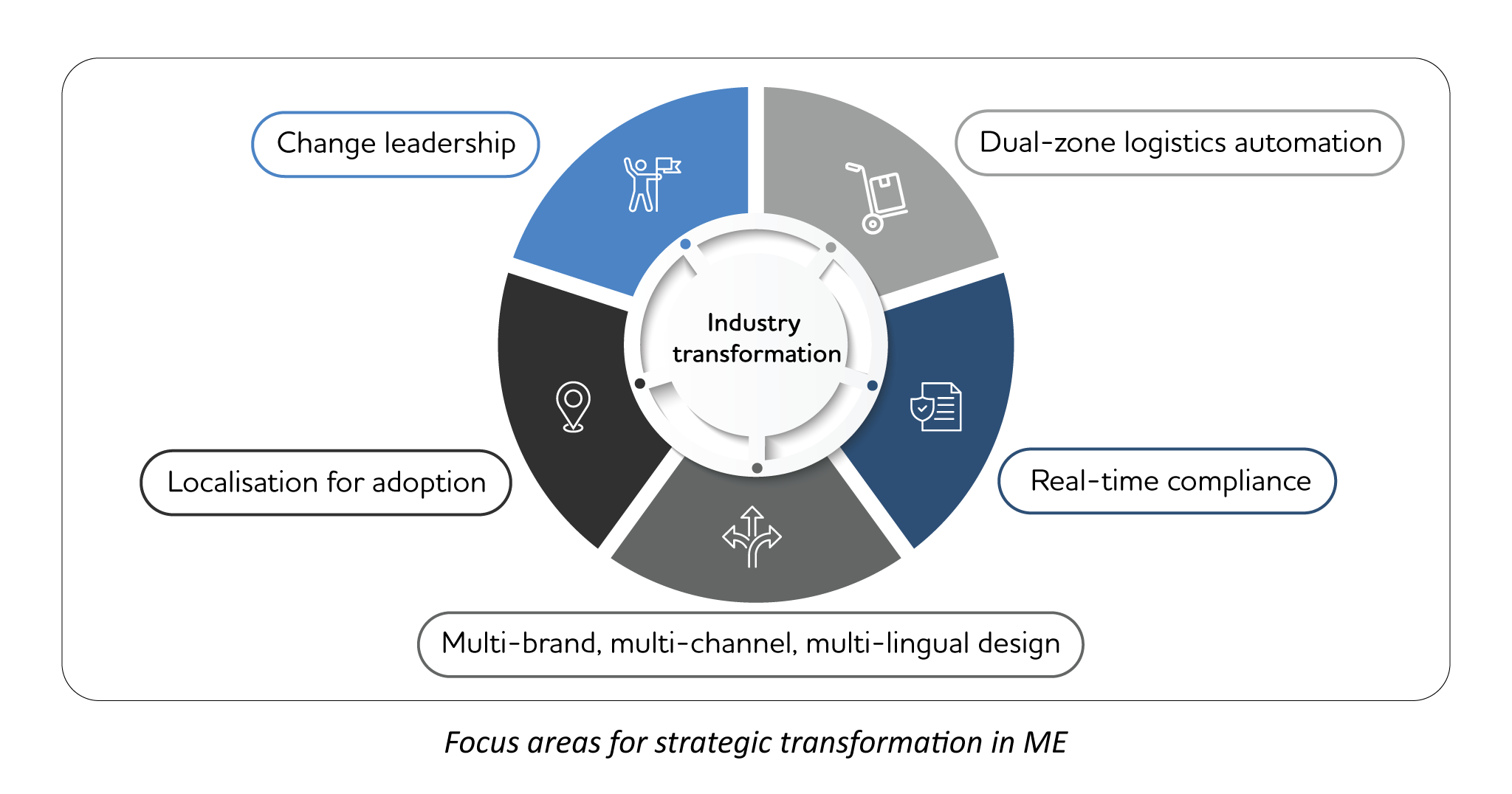
Figure 1
Focus areas for strategic transformation in the Middle East
Figure 1
Modern retail supply chains need to look beyond traditional playbooks. In the Middle East, new approaches are needed to juggle between duty-free and tax zones, especially when customs processes are at the heart of the business. Automation can help keep things compliant, nimble, and scalable. This can minimise manual intervention, ensure regulatory alignment, and pave the way for smarter operations.
Use case: A leading luxury retailer in the region faced the challenge of integrating operations in duty-free and tax zones, each with distinct customs and tax requirements. By automating the generation of customs documents and syncing clearance with delivery deadlines, the retailer not only reduced manual workload but also ensured seamless compliance. This approach gave them a playbook for similar multi-zone operations, demonstrating that intelligent automation is a strategic enabler, not just a technical fix.
Retailers can adopt this framework (see Figure 1) to transform operations to navigate these myriad challenges and succeed in the region.
(eg, Zakat, Tax, and Customs Authority, or ZATCA, in Saudi Arabia) is a paradigm shift. Compliance is no longer confined to just another back-office function, it is front and centre. Retailers must create platforms that seamlessly integrate with external authorities, embedding compliance into every transaction and future-proofing operations, with an eye on regulatory flux.
Use case: When Saudi Arabia mandated real-time B2B invoice clearance through ZATCA, retailers had to move fast. One transformation journey took a smart approach by using a third-party cloud service to handle everything—sending invoice data, generating QR codes, and obtaining clearance confirmation, all in real time. While it ensured legal compliance on the one hand, on the other, it prepared the business to stay flexible and competitive, setting a new benchmark for regulatory integration in the region.
Retailers who successfully navigate complexity, whether by managing a diverse portfolio of brands, orchestrating seamless omnichannel experiences, or communicating effectively across multiple languages, consistently have an edge over the competition. Scaling such sophistication goes beyond simply adopting the latest tools or technologies. Intelligent process automation that streamlines repetitive tasks, reusable integration frameworks that help connect disparate systems, flexible billing solutions that adapt as per compliance requirements, all go towards building an intelligent foundation that fosters agility and innovation.
Use case: Across the Middle East, the luxury goods market is characterised by unique distribution models, where a single distributor often represents multiple high-end brands. This arrangement brings significant operational complexities like managing a large volume of invoices in multiple languages, synchronising transactions from physical boutiques with those originating online, channel specific demands such as personalised engraving and a myriad bespoke customer requests that go far beyond a standard retail transaction. In this multifaceted environment, traditional one-size-fits-all invoicing and sales processes quickly become cumbersome and inefficient. To stay competitive, retailers are increasingly turning to advanced solutions like building custom invoice logic and tightly integrating their e-commerce platforms with ERP systems. The result is a unified, frictionless experience for customers, regardless of which brand they’re purchasing or how they choose to shop.
Real transformation respects the language, culture, and expectations of every stakeholder. Enabling right-to-left Arabic support, bilingual documentation, and localised user training is not just checking compliance boxes; they are steps that create the groundwork for meaningful user engagement and long-term success.
Use case: Legal requirements in Saudi Arabia and the United Arab Emirates (UAE) mandate that invoices, and product labels be available in Arabic. Implementing right-to-left script support and engaging Arabic-speaking testers ensured that business documents are both compliant and user-friendly. This focus on localisation not only met regulatory needs but also improved user acceptance and satisfaction, proving that cultural alignment is a driver of transformation success.
Change management in the digital era is about finding the right people to champion the changes, creating space for honest feedback, and helping users feel confident enough to spread the word themselves. For retailers, this means putting real effort and resources into local, hands-on engagement. This can develop trust among colleagues about the changes, ensuring they on board.
Use case: A successful transformation journey in the region included over 40 mini-workshops, done twice over to ensure stakeholders were keeping up with the changing times as the journey progressed. Involving stakeholders early and providing precise support helped minimise resistance to change and build user confidence. This approach ensured a smooth transition and long-term sustainability.
The rollout
The overall strategic analysis needs to be followed up with operational considerations to ensure a successful transformation journey.
Here are the steps necessary to transition from theory to practice to set the stage for effective execution.
Recommendations for future rollouts
| Aspect | Recommendation |
Design and change management |
Secure early design signoffs. Reinforce change strategy with contextual training and clear RACI (Responsible, Accountable, Consulted, and Informed) matrix. |
Master data and localisation |
Start data prep early, assign ownership, use a ‘golden dataset’ for consistency. |
Project governance |
Establish inclusive governance, deploy full-time project management office (PMO), manage scope with arbitration committees. |
Testing and rollout |
Empower test teams, improve user acceptance testing (UAT) structure, conduct mock cutovers, ensure hyper-care readiness. |
Design and change management: Early alignment on design and change strategy is critical along with contextual training, clear roles and responsibilities (RACI), and iterative feedback loops to ensure that transformation is embraced at every level.
Master data and localisation: Data quality is the foundation of successful transformation. That means data preparation needs to start early with ownership clearly assigned. In addition, a ‘golden dataset’ must be used to maintain consistency across regions and brands.
Project governance: Inclusive governance structures, supported by a dedicated PMO, enable proactive risk management and agile decision-making. Arbitration committees help manage scope and resolve conflicts efficiently.
Testing and rollout: Robust testing, including mock cutovers and structured UAT can help build confidence and ensure readiness, while hypercare support post launch can address issues quickly, minimising disruption and accelerating value realisation.
Shaping the future
Even the most complex regional challenges can be overcome with the right strategy.
The TCS Global Retail Outlook indicates retailers are pursuing mission-critical objectives to optimise operations, and striving for greater customer loyalty, agility, and resilience. In the ME region, there’s a need for a unified, efficient system that respects local needs while achieving global standards.
Our framework offers a view for future ERP transformations, combining digital synergy with operational excellence.
It is evident that transformation is an ongoing process rather than a final destination. The next era of luxury retail will be defined by players who embrace complexity, operationalise innovation, and lead with vision in the Middle East and on the global stage.