Industry
Retail

Omnichannel CX and Intelligent Innovation – The Future of Retail
HIGHLIGHTS
- Returns and subsequent refunds have been considered a cost centre for retailers. However, a returns centric customer experience operating system offers an opportunity to turn the refunds process into loyalty, even growth.
- Retailers can unify, customer profiles with express consent for purchase, returns, and preferences. Capturing the reasons for returnsand operational events will help make evidence-based decisions for a returns led experience.
- The objective is to offer a balanced approach by reducing friction for most customers while retaining control where it matters to deliver experiences that convert returns to loyalty.
On this page
Overview
The word ‘returns’ alone makes CFOs twitch and customers sigh.
Traditionally, returns have been seen as a cost centre and a necessary evil. However, what if we turn the refund queue into a loyalty engine, or even better, returns as a growth lever? Done wrong, they bleed margin and goodwill. Done right, they can delight customers, build trust, and accelerate profitability. About 31% of the retailers polled for the TCS Retail Outlook say improving customer experience and loyalty is a mission-critical objective for them.
The good news is, a perceived “necessary evil” can be engineered into a delight and a growth engine.
There’s a need for a radical, domain-led stance: make returns the operational spine of an Intelligent Experience Supply Chain (IXS). By leveraging persona-adaptive policies, instant settlement with guardrails, AR/AI fit technology, and policy-as-code precision, businesses can turn refund anxiety into trust—and trust into repeat purchase. It’s not just about fixing a process; it’s about rewriting loyalty economics.
In essence, returns are not the end of the story—they’re the start of the next sale.
The reality check
Omnichannel customers expect post‑purchase to be just as delightful as the purchase - easy initiation, clear choices (exchange, credit, refund), and visible status.
On the other hand, it is also a fact that return volumes are high, online rates outpace stores, and there are fraudulent actors in the space. That means, several firms respond by tightening policy for everyone—fees, paperwork, extra steps. While these steps might be necessary, they can often be counterproductive. Optimising for 5% of risky cases at the expense of frustrating the other 95% would be false economy. We believe retailers need to make speed the norm, make scrutiny the exception, and do both with transparent guardrails.
When speed must be normal and scrutiny exceptional, the differentiator is no longer policy intent, but the system that makes those decisions consistently at scale.
Talking returns
What’s changing is not the complexity of returns, but how decisions are made.
As the TCS Global Retail Outlook describes, the next phase of retail is about embedding intelligence into everyday decisions, not bolting it on as tools or dashboards. Returns exposes this shift earlier than most journeys—because here, speed, risk, and customer trust collide in real time.
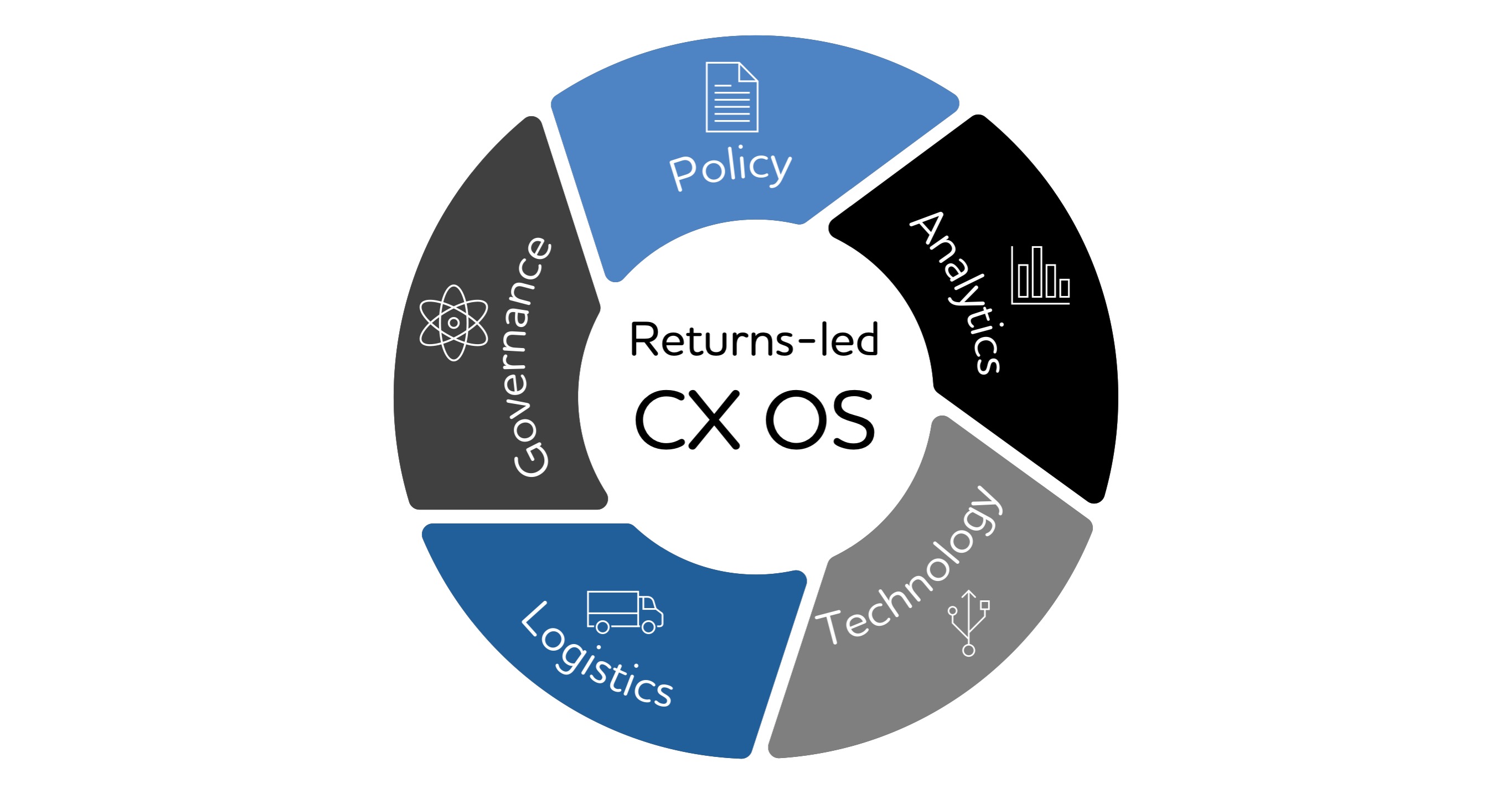
Figure 1
A returns led customer experience operating system (CX OS)
Figure 1
Retailers need to think of the solution not as another initiative but as an operating system for the post‑purchase moment—a returns‑centric CX OS that stitches together policy, technology, analytics, logistics, and governance so the customer journey experience is fast, fair, and auditable across channels and geographies. No faff, but an intelligent spine. It is the execution layer of the IXS — where insight, policy, and operations finally meet in the moment of truth.
Beginning with unifying customer profiles (purchase, returns, preferences) with explicit consent.In addition, consistently capture the reasons for returns and operational events so that decisions can be made based on evidence rather than hunches.
Policy is a deterministic rules engine. So, encode persona and market nuance and expose three settlement routes at the edge.
- Instant store credit (low risk, low value SKUs)
- Instant refund (where risk and value allow)
- Refund on scan (auto-triggered at drop off or store counter)
Set the guardrails: Stock keeping unit (SKU) risk tiers, fraud score thresholds, documentation checks,and log decisions for auditability. This would help customers see the reasons behind the outcomes, while retailers can demonstrate governance.
This would entail self‑service portals, QR codes, exchange‑first prompts, and refund trackers—patterns increasingly associated with Perceptive Retail, where intelligence is embedded into the flow of everyday decisions. In turn, this ensures the right kind of communication for customers: those in need of reassurance recive simple, effective explanations. At the same time, those in a rush are guided to curated exchanges with zero friction. The experience feels deliberate rather than reactive, because decisions are made in the moment, not explained after the fact.
Instant settlement is an effective way of dealing with anxiety as well as logistics costs for low-risk items. Refund on scan halves the needless waiting. Manual reviews can be applied for high-risk cases - speed where you can, prudence where you must.
Enable buy online return in store (BORIS) for quick processing. Additionally, use hub-and-spokeflows so small formats feed regional hubs for same-day inspection and refund initiation. Offer no-box/no-label drop-offs where feasible.
If fit issues drive returns, aim the tech at fit. Roll out AR/AI sizing for priority lines, standardise size charts and model notes, enforce true colour image standards, and update content weekly using return reason data.
Use ML scoring to flag anomalies, not punish normal behaviour. For high-risk SKUs, deploy item authenticity methods. Refresh thresholds, keep fairness reviews, and retain a manual path for contested cases.
Invite reviews post refund, repair social chatter, refresh AI summary presence, and measure upstream impact—conversion lift, basket health, referral velocity.
A word on fraud
There will always be those who’d take advantage by any means.
However, any policy that treats everyone alike - designed to catch the 5% while punishing the 95% - will be disadvantageous to the retailers. It is better to score risk and route accordingly. That means instant settlement for trustworthy, low-value transactions, refunds on scans for borderline cases, and manual review for genuinely suspicious flows.
Fraud is not a reason to slow everyone down; it is a reason to be more precise at scale. The real failure mode is blunt control—policies that trade customer trust for a false sense of safety while still leaking value at the edges. A returns strategy that cannot distinguish intent at scale will always end up optimising for fear rather than economics.
Economic case
A sensible twelve‑month target set will do (illustrative estimations):
- Refund Service Level Agreement (SLA): 90% of refunds completed in <5 days; instant for low‑risk flows.
- Operational calm: “Where is my refund?” contacts down sharply; hub‑and‑spoke restocking time measured in days, not weeks.
- Return‑rate reduction: Two to four points via fit/content fixes, exchange‑first design, and better pre‑purchase information.
- Fraud loss: 30–50% down via ML scoring + item verification without choking honest customers.
- Behavioural loyalty: repeat purchase up in 30/90‑day cohorts; exchange‑first rescue rate goes up while Customer Lifetime Value (CLV) uplift is visible.
Short version: fewer returns, faster refunds, happier customers, healthier P&L. Not rocket science—just good engineering and a dash of properly brewed service.
These targets are deliberately pragmatic, not aspirational outliers. They prioritise speed where trust is earned, intervention where risk is real, and prevention where returns are avoidable—reflecting how well‑run omnichannel retailers already operate when refund speed, prevention, and risk controls are engineered as one system. The objective is not perfection, but balance: reducing friction for most customers while retaining control precisely where it matters.
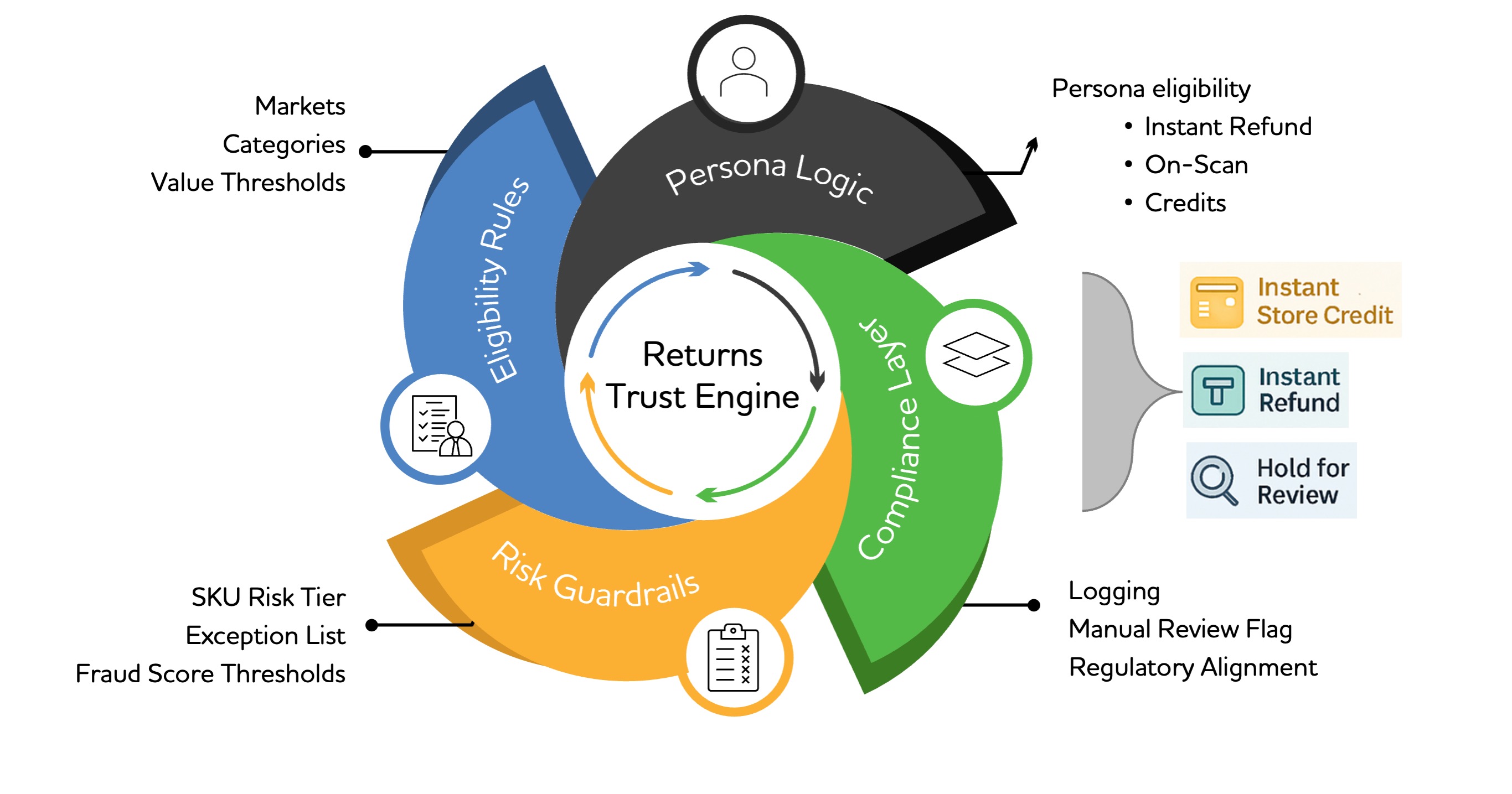
Figure 2
Policy-As-Code, depicting the algorithmic refinement to build and continuously improve Returns Trust
Figure 2
0–90 days: BORIS everywhere; self‑serve portal & refund tracker; ≤48h refund SLAs; auto‑approve low‑risk items; fix content on top‑return SKUs.
3–12 months: Returnless pilot (categories; capped values; excluded SKUs); AR/AI fit rollout; unified returns platform; policy‑as‑code by persona/market.
12–24 months: Scale persona‑adaptive policy across markets; mature fraud Machine Learning (ML) along with item authenticity (RFID/tamper tags where ROI is clear); justify refund-speed / exchange-rescue to discovery spend (reviews/social sentiment nuances and analysis).
Risk and Governance:
- Privacy/trust: Consumers share data for smoother CX, but 93% lose trust if mishandled — favour low‑intrusion data; explicit value exchange.
- Fraud: Keep returnless flows for low‑risk tiers; maintain explainable ML, audit logs, and manual review channels; publish fairness audits.
- Fee sensitivity: In markets like the US, where 57% avoid retailers due to return fees, use hybrid models (free in‑store; nominal postal) only alongside speed & transparency.
Returns from returns
When refunds are executed with clarity, speed, and fairness, they become a powerful act of loyalty-building.
They signal that the brand stands behind the customer beyond the transaction, reinforcing confidence at the moment it matters most. That confidence travels—through repeat purchases, advocacy, and enduring preference. In omnichannel retail, returns are not the end of the journey; they are a defining loyalty inflexion point. The organisations that lead will treat returns as a deliberate, governed capability—where trust is earned systematically, and loyalty is compounded transaction by transaction.
In the end, loyalty is not declared at purchase; it is proven at the moment of return.
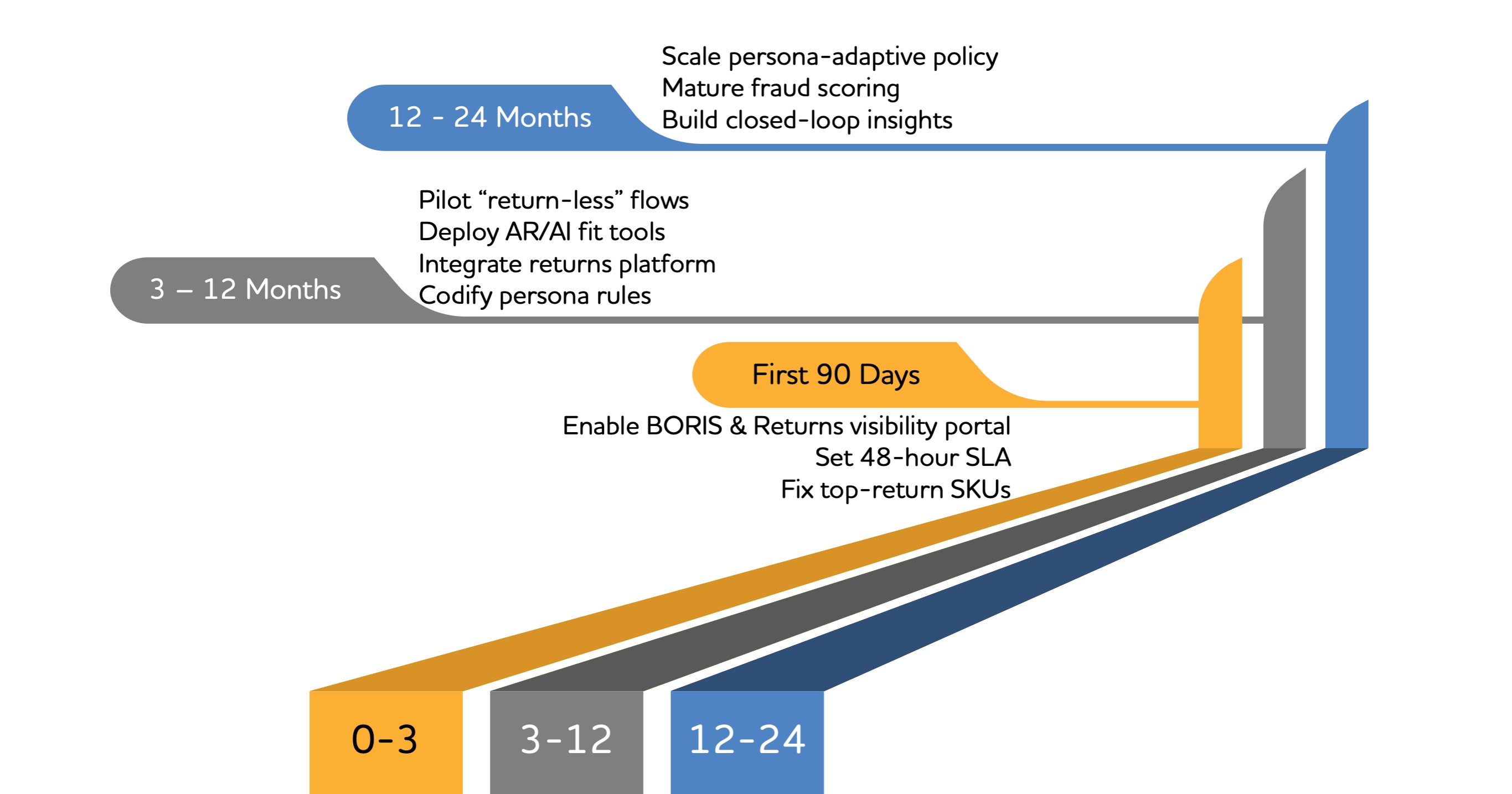
Figure 3
Illustrative roadmap (do different things, fast)
Figure 3