Service
Artificial Intelligence

Building a Smarter, Connected Tomorrow with AI-first and Agentic AI
Highlights
- Enterprises are increasingly adopting self‑hosted artificial intelligence (AI) architectures to retain control over sensitive data and models, driven by sovereignty, privacy, and security obligations that restrict the use of centrally hosted platforms.
- They struggle to move beyond pilots for self-hosted AI due to fragmented ownership and regulatory pressure. A unified adoption approach that aligns leadership, governance, and key performance indicators (KPIs) will create clear accountability to scale AI across units.
- Self‑hosted AI in air‑gapped environments also often leads to long lead times and inconsistent execution. Standardised decision pathways and operating discipline accelerate progress while staying aligned to sovereignty and compliance requirements.
- AI programmes underperform when capability gaps and weak operating discipline persist. Embedding people, process and accountability into the adoption journey ensures repeatable, measurable business impact at enterprise scale.
On this page
On this pageinpage
Framework overview
Enterprises are turning to self‑hosted artificial intelligence (AI) because sovereignty, privacy and security requirements increasingly restrict the use of public cloud for sensitive data and models. Many programmes stall at the pilot stage due to fragmented ownership, inconsistent decisions, and the effort of rebuilding cloud‑grade capabilities inside air‑gapped environments.
This creates long lead times, audit risk, and limited business impact. Self‑hosting can solve these issues by keeping data, models, and telemetry within controlled boundaries while enabling AI‑infused and AI‑driven use cases to scale across units. However, doing so requires a structured, enterprise approach that aligns leadership, technology and operations, standardises decisions, and embeds responsible‑AI guardrails from the outset.
This demands a clear, repeatable method to plan, build, and run AI safely and consistently at scale.
The AI adoption framework provides a structured approach for organisations establishing self‑hosted and private artificial intelligence (AI) within air‑gapped environments, aligned to sovereignty, regulatory, and security requirements. It acts as a north star, guiding enterprises in building AI capabilities ground up to reliably scale across organisational units.
Self‑hosted AI requires organisations to establish foundational capabilities typically available in public cloud environments.
The framework emphasises on the following:
- Scaling AI beyond pilot and happy‑path production
- Enabling AI‑infused, enabled, embedded, powered, and driven use cases
- Managing people, process, and technology through workflow‑driven interaction models
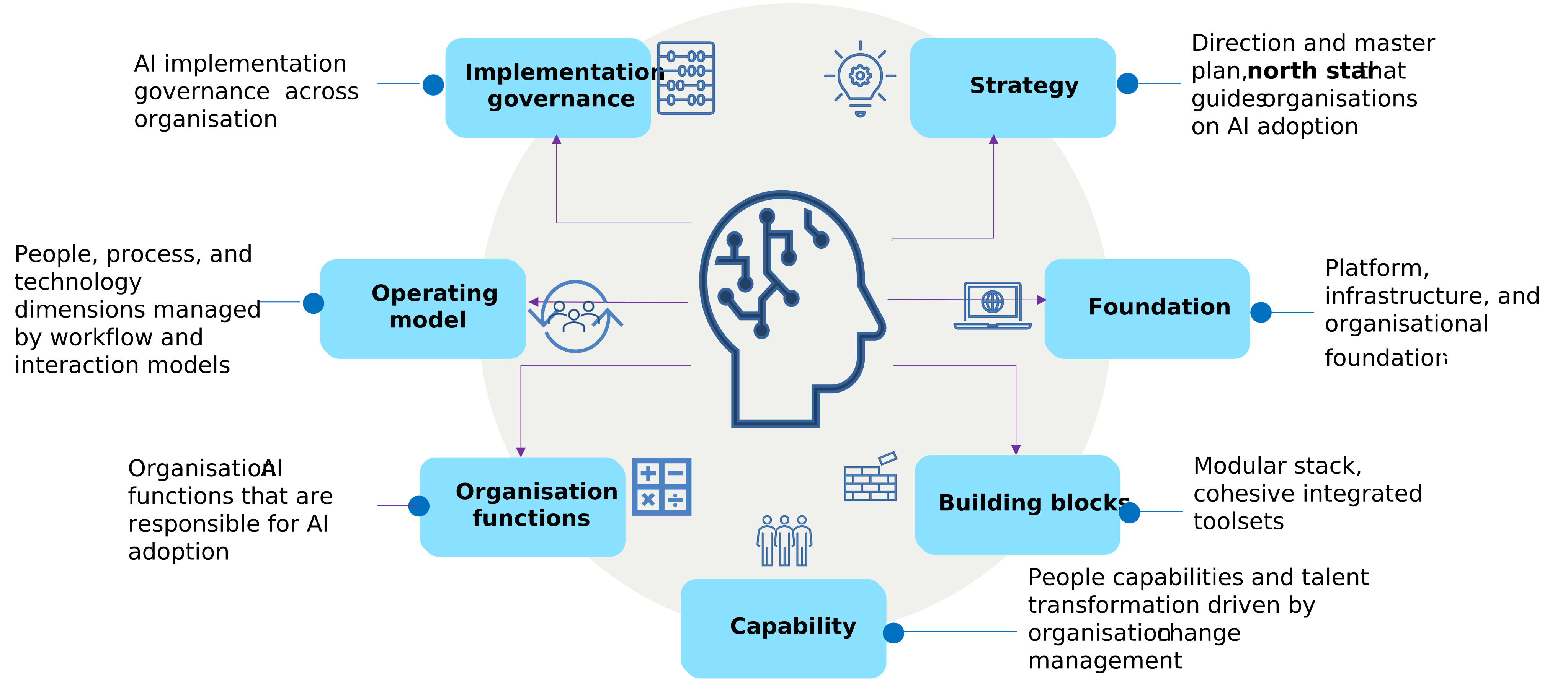
Figure 1: AI adoption framework
Figure 1: AI adoption framework
The framework consists of seven integrated dimensions:
- AI strategy
- AI foundation
- AI building blocks
- AI capability
- AI operating model
- AI organisation functions
- AI implementation governance
Together, these dimensions enable reliable, governed, and value‑driven enterprise AI adoption.
AI archetypes scope
The AI adoption framework applies to organisations mandated to self‑host AI using open‑source, open‑weight, and proprietary models within secured, air‑gapped environments. It is designed for enterprises building AI ground up, rather than consuming managed AI services.
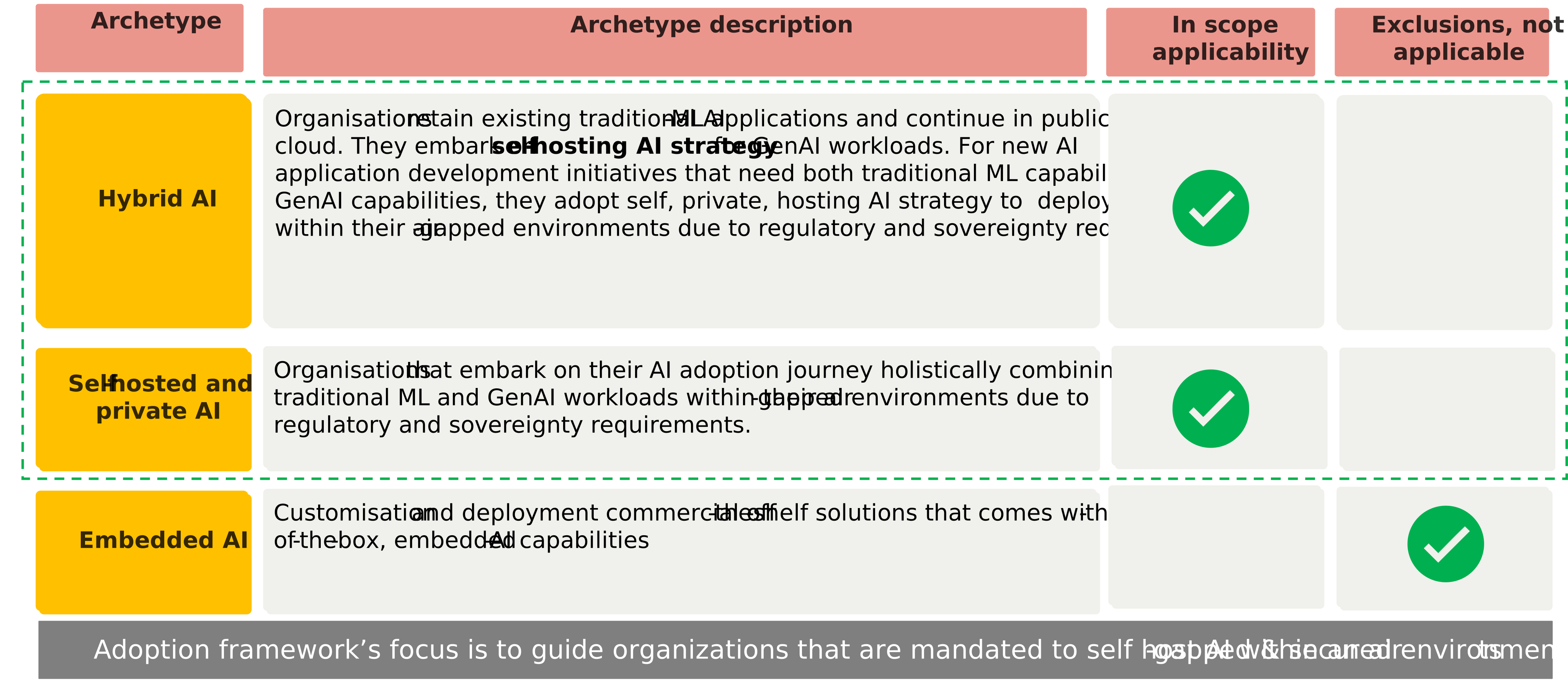
Figure 2: AI archetypes and adoption
Figure 2: AI archetypes and adoption
The framework supports hybrid AI, self‑hosted and private AI, and embedded AI.
- Hybrid AI
The framework recommends that organisations with hybrid AI retain traditional AI-machine learning (ML) workloads on public cloud while adopting self‑hosted AI for generative AI (GenAI) workloads due to regulatory and sovereignty requirements. - Self‑hosted and private AI
Organisations with self‑hosted and private AI can adopt both traditional ML and GenAI fully within air‑gapped environments. - Embedded AI
For embedded AI, the approach involves customisation and deployment of commercial off-the-shelf solutions with built-in AI capabilities.
The framework clearly defines in‑scope applicability and exclusions, ensuring organisations align AI adoption with hosting mandates while progressively improving AI maturity across enterprise functions.
Adoption guidelines
The framework provides high‑level guidelines to ensure AI initiatives are architecturally compliant, secure, and enterprise‑ready. It emphasises alignment with existing governance structures while accelerating production adoption.
Organisations are expected to:
- Comply with architecture review board (ARB) and technology review board (TRB) standards
- Collaborate with enterprise architecture, security, platform engineering, data engineering and operations, infrastructure, DevOps, and procurement
- Extend existing technology ecosystems with AI through end‑to‑end workflows
The guidelines for the AI adoption framework encourage organisations to:
- Accelerate from proof of concept (PoC) / minimum viable product (MVP) to production‑grade AI solutions
- Scale AI initiatives across functions, departments, and enterprise clusters
- Continuously track, measure, and report tangible business value
These guidelines help institutionalise AI as a repeatable, governed enterprise capability, rather than isolated experimentation.
The strategy
AI strategy defines why and how an organisation adopts self‑hosted AI. It begins with establishing executive leadership and AI leaders to define AI vision, mission, and alignment with business objectives.
Key strategy activities include:
- Understanding legal, regulatory, sovereignty, and security requirements
- Identifying key drivers for self‑hosted AI adoption
- Defining AI‑driven service and business process transformation as a core imperative
- Securing executive sponsorship across organisational units
Organisations evaluate AI hosting archetypes through:
- Cost, return on investment (ROI), and build‑vs‑buy analysis
- Business case development and approval
- Use‑case prioritisation based on impact and complexity
Procurement engages infrastructure, platform, model vendors, and system integrators to finalise contracts, service level agreements (SLAs), capacity sizing, energy requirements, and lead times, ensuring enterprise‑grade readiness.
The foundation
AI foundation establishes the technical, platform, and organisational backbone for self‑hosted AI. Central to this is a robust AI taxonomy enabling standardisation, governance, and lifecycle management of AI assets.
The foundation includes:
- Definition of AI infrastructure and stack integrated with AI security
- Enterprise AI platforms with observability and responsible AI frameworks
- Ides and collaborative workspaces for AI development
- Scalable compute environments for development and production
- Centralised model and embedding catalogues
Standardised application programming interfaces (APIs), software development kits (SDKs), and command-line interfaces (CLIs) provide consistent access to enterprise AI assets.
The foundation also establishes:
- Enterprise‑wide AI risk management approaches
- Effort and manpower estimation guidelines for AI initiatives
This dimension ensures AI solutions are secure, scalable, governed, and enterprise‑ready.
The building blocks
AI building blocks operationalise AI through industrialised pipelines, standards, and controls across the AI lifecycle.
The core building blocks include:
- Open‑telemetry‑based layers integrated with AI and enterprise observability
- End‑to‑end model and agent lifecycle management
- Platform‑agnostic blueprints, runbooks, and recipes for fine‑tuning and inference
- Distributed training and production inferencing pipelines
Organisations should implement:
- MLOps, LLMOps, GenAIOps, ModelOps, and AgentOps
- Model evaluation and validation pipelines
- Data governance, quality checks, encryption, and privacy controls
- Data wrangling pipelines for unstructured, multi‑modality data
These building blocks enable repeatable, reliable, and scalable AI deployment across enterprise environments.
AI capability
Enterprises should build organisation readiness and talent depth to sustain self‑hosted AI. Socialise and brand AI initiatives for leadership and workforce endorsement, and add rewards and incentives tied to training and certification.
Assess change‑management needs, then define roles with clear responsibilities and key performance indicators (KPIs) for data scientists, ML engineer, MLOps engineer, and AI site reliability engineer (SRE).
Also, launch focused training and certifications, enable AI playgrounds and developer environments for hands‑on practice, and run solution contests to accelerate adoption. Form cross‑functional squads that pair domain subject matter experts (SMEs) with AI practitioners, and continuously close skill gaps so that capability uplift keeps pace with platform and model evolution.
Key actions
- Assess readiness; define roles, responsibilities and KPIs
- Launch training, certifications, playgrounds, and contests
- Set up cross‑functional squads; close skill gaps iteratively
The operating model
The AI operating model defines how AI is organised, governed, and scaled across the enterprise. Organisations may adopt centralised, decentralised, or shared models. The key components of AI operating model include:
- AI office, AI centre of excellence, AI architecture council, and AI governance council
- Defined charters, roles, KPIs, and responsible, accountable, consulted, and informed (RACI) models
- Extension of enterprise DevOps with ML, LLM, GenAI, agent, ModelOps
- Integration of AI observability with enterprise monitoring
- Linking business KPIs with AI performance metrics
AI implementation governance institutionalises:
- Product‑centric delivery and factory models
- Architecture review board (ARB) and technology review board (TRB) approvals
- Reusable assets and automation
- FinOps for AI cost visibility and optimisation
Together, these ensure accountable, governed, and scalable AI adoption.
Follow a structured journey
As enterprises increasingly adopt self‑hosted AI to meet sovereignty, security and regulatory requirements, success depends on more than isolated technology initiatives. Organisations must establish a coordinated enterprise approach that brings together strategy, foundations, operating model, capability and governance to move beyond experimentation and scale AI reliably.
By following a structured adoption journey, enterprises can reduce lead time, improve consistency, and embed accountability across the AI lifecycle. This enables self‑hosted AI to evolve from a compliance‑driven necessity into a dependable, enterprise‑wide capability that delivers sustained and measurable business value.