Service
Consulting

TCS Consulting Services to Achieve Success in the Digital Era
Highlights
- Smart demand planning is transforming from being forecast-driven planning to artificial intelligence (AI)-powered, real-time demand orchestration, leveraging machine learning, agentic AI, predictive analytics, and vast internal and external data sources.
- Successful adoption of smart demand planning requires organisations to overcome key challenges related to data quality, workforce readiness, technology governance, and cybersecurity, ensuring that high-quality integrated data, digitally skilled planners, human oversight of AI-driven recommendations, and robust security and privacy controls work together.
- For industries such as life sciences, smart demand planning delivers tangible business outcomes by connecting demand signals across the end-to-end supply chain, enabling better medicine availability, optimised inventory and production planning, improved patient outcomes, reduced costs, and enhanced service levels.
On this page
On this pageinpage
Demand planning
Demand planning traditionally involved forecasting customer demand to decide the appropriate inventory levels to ensure sales and avoid stockouts. Historically, companies have relied on the past sales data, consumer trends, and human adjustments to forecast the future demand plan. However, modern supply chains are increasingly complex, whilst the volatile nature of consumer behaviours make traditional demand planning methods outdated.
The use of machine learning (ML) and, more recently, agentic artificial intelligence (AI), alongside an abundance of data and analytics, are reshaping how businesses approach demand planning. These technological innovations, using demand sensing and real-time changes, are resulting in enhanced demand planning across both product ranges and geographies.
Smart demand planning for future supply chains
Smart demand planning for future supply chains
Multiple challenges
As businesses transition to smart demand planning processes, they must navigate multiple challenges.
These challenges can be distilled around four key themes:
Data quality and integration
Effective AI and predictive analytics require high-quality data from multiple sources. However, many businesses suffer from insufficient data quality, duplicate and inadequate data. It is crucial to invest in data cleansing, governance, and integration to leverage modern demand planning software. Unlocking value from plentiful data becomes increasingly difficult without robust data definition, quality, as well as ownership.
Workforce skill gaps
Advanced demand planning technologies and harnessing the vast potential of AI and data requires more than just competent planning skills.
Organisations are recognising the requirement for individuals with a deep understanding of data analytics, market trends, and the capability to navigate the complexities of rapidly changing supply chains and marketplaces. Smart demand planning functionality like agentic AI doesn’t replace planners, but it reshapes their role. The workforce needs a blend of human judgement, digital fluency, and cross-functional agility to get the most out of agentic systems. Companies that want to leverage their advancement in tools and technology need to either appropriately improve and train their teams or hire new talent.
Technology over-reliance
Over-reliance on technology, despite the advancement of AI and automation in demand planning, without human oversight may result in machine errors. Organisations must find the right balance between human wisdom, and AI efficiency, to judge forecasts and strategic action decisions. Sometimes human experience, or even a gut feeling, proves equally useful in preparing a demand plan and making decisions that impact the wider supply chain. It would not be advisable to completely extinguish these useful tools in the human armory.
Cybersecurity and data privacy
The risk of cyber-attacks and data breaches also increases as demand planning systems become over reliant on cloud platforms and external data sources. Agentic AI, for example, pulls from multiple data streams (ERP, POS, IoT, e-commerce, social sentiment, and so on), which creates new integration points, with further exposure to cyber-attacks (application programming interface (API) abuse, data poisoning, ransomware, and so on) heightening the stakes if compromised. Companies must invest in robust cybersecurity procedures to protect sensitive demand data and comply with data privacy regulations.
Winning methodology
With a case example, we showcase how smart demand planning can bring forth the desired results. Take, for instance, the context of life sciences, where a global pharmaceutical company aims to improve medicine availability, patient service levels, and regulatory-compliant distribution across global markets. Demand is highly volatile, influenced by seasonality, epidemiological trends, regulatory decisions, and public health events. Traditional forecasting methods often fail to anticipate regional demand shifts.
The company applies smart demand planning to optimise production and distribution by combining historical demand, real-time sales and inventory data, epidemiological signals, and market access information. Agentic AI continuously connects real-time data sources–such as prescription data, hospital consumption, and public health alerts–which are then continuously connected into a self-learning demand planning system.
Artificial intelligence and machine learning: Analyses prescription trends, disease prevalence, seasonality, and external health signals to anticipate demand for vaccines and critical therapies.
Big data and predictive analytics: Predicts regional demand by incorporating population health data, reimbursement changes, and outbreak or vaccination events.
Autonomous planning and automation: Detects emerging demand signals and automatically recommends production, inventory, and distribution adjustments.
Cloud-based solutions: Enables secure, real-time data sharing across commercial, manufacturing, and supply chain teams.
End-to-end supply chain integration: Aligns suppliers, manufacturing sites, distributors, hospitals, and pharmacies on a single demand signal, reducing lead times and stock-outs.
Demand planners approve AI recommendations, resulting in improved medicine availability, lower costs, and better patient outcomes, while maintaining regulatory compliance.
Key trends
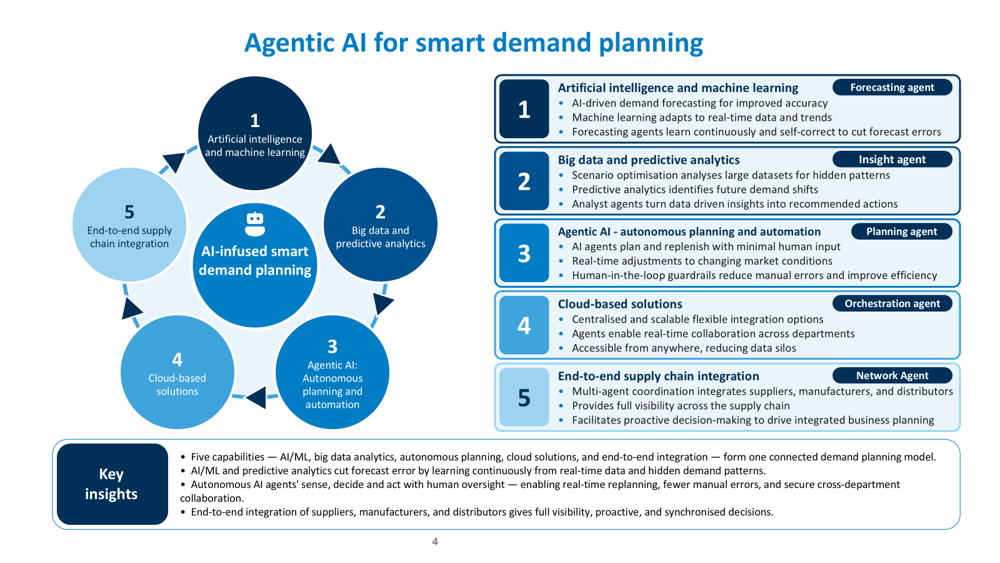
Five key trends are shaping the future of smart demand planning. The benefits accrued from them drive added value to businesses willing to adopt, adapt, and transform their capabilities:
Artificial intelligence and machine learning
Demand planning is being revolutionised through the development of AI and ML to automate traditional demand planning processes and enhance predictive capabilities. Vast amounts of data can scan in milliseconds. This unlocks intelligence across historical sales, economic factors, market trends, and even consumer attitude. Algorithms from ML can decipher patterns and outliers, way beyond the scope and speed of human endeavour.
Forecast accuracy can be unlocked through AI models that are increasingly sophisticated in handling complex data sets whilst constantly learning and responding. This ensures that companies react incredibly fast to any changes in the market. AI can prescribe or even automate decisions such as amending stock levels, production schedules, or promotional campaigns based on this enhanced foresight.
Big data and predictive analytics
Demand sensing is rapidly developing through the capability of the internet of things (IoT), the whirlwind of social media, and real-time devices, tapping into unimaginable amounts of recent data. Predictive analytical models can leverage this data to make more accurate predictions, detect demand fluctuations, and identify trends and disruptions, before the supply chain has even been impacted.
By mining data from both internal and external sources, companies can glean clarity of demand triggers, and shape demand, ensuring intelligent response making. Furthermore, predictive analytics enhances companies’ abilities to run multiple scenarios on their demand plans, using price, promotions, and market trends to decipher and execute operationally.
Agentic AI: Autonomous planning and automation
Demand planning has struggled with volatility, fragmented data, and the slow response of traditional forecast models. Agentic AI represents a step change. Unlike predictive analytics that only surface insights, agentic systems can act autonomously, learn continuously, and collaborate with demand planners to improve forecast accuracy and resilience.
In practice, agentic AI can ingest diverse demand signals (enterprise resource planning (ERP), point of sale (POS), weather, social sentiment, and so on) and dynamically adjust forecasts as conditions change. It can run thousands of ‘what-if’ scenarios in parallel–testing impacts of promotions, competitor moves, or supply shocks–and then recommend proactive actions such as stock reallocations, or supplier diversification. Crucially, it operates in a human-in-the-loop model, learning from demand planner input while automating low-value decisions.
The impact is measurable, with higher forecast accuracy, reduced inventory costs, faster scenario modelling, and greater agility in integrated business planning. The shift is from reactive planning to proactive orchestration across demand, supply, and logistics within an organisation.
Cloud-based solutions
Cloud platforms can now enable cross-functional teams from finance, sales, and operations to collaborate in real time, driving both forecast accuracy and responsiveness. These solutions can enable businesses to scale their demand planning processes, without expensive infrastructure changes, to adapt to growth, new markets, or changing consumer trends. Most cloud-based solutions negate the need for expensive on-premises hardware or maintenance costs, and, more often than not, work on a subscription model. Respective deployments are much quicker compared with traditional planning software, which also reduces the setup lead time and time to market considerably.
End-to-end supply chain integration
As supply chains become more global and interconnected, the future of demand planning is not just limited to improvements in forecasting. It expands to cover the entire supply chain, from sourcing to the end-consumer, and collaboration across multiple stakeholders. Demand planning, thus, becomes the engine that drives the whole supply chain, to ensure that all areas of the business work together to meet demand. Organisations can identify potential bottlenecks or risks through visualisation, enabling them to proactively respond and adjust their demand planning accordingly. Through alignment of demand plans with sourcing, production, and logistics, companies can guarantee accurate and real-time demand informing the optimum supply chain decisions.
Doman expertise
TCS differentiates itself by combining deep supply chain and life sciences domain expertise with AI-led innovation, helping organisations move beyond traditional forecasting toward intelligent, autonomous demand orchestration. Leveraging agentic AI, machine learning, predictive analytics, cloud platforms, and proprietary accelerators, TCS enables real-time demand sensing, faster decision-making, and end-to-end supply chain visibility. Unlike standalone planning solutions, TCS integrates demand planning across sourcing, manufacturing, inventory, logistics, and commercial operations, creating a connected and resilient enterprise. TCS accelerates business outcomes through improved forecast accuracy, reduced inventory costs, enhanced service levels, and greater agility in responding to market volatility. Backed by proven frameworks, AI-powered transformation assets, and a human-in-the-loop governance approach, TCS helps organisations unlock the full value of data and automation while ensuring trust, scalability, and sustainable competitive advantage.
What the future holds
The future of smart demand planning is swiftly evolving, driven by growth in agentic AI, machine learning, big data, and automation. Such technologies allow businesses to forecast demand with precision, adapt promptly to fluctuations, collaborate, and integrate their planning processes across the supply chain.
Smart demand planning will soon become a rapidly advancing strategic area, where data-driven intuition and automation lead to enhanced responsiveness, and effective supply chains. Organisations that adapt to these trends will ace competition, positioning themselves at the front of this demand planning revolution.