Services
Data and Analytics

Smart Data for AI: Building Agile, AI-ready Ecosystems
Highlights
- Artificial intelligence (AI) readiness is not a one-size-fits-all proposition. It exists at the intersection of enterprise readiness and use-case readiness, with requirements varying based on expected business outcomes, context, and risk.
- Organisations must evaluate readiness through three critical pillars: Context readiness, usage and governance, and fit-for-purpose engineering, ensuring AI can be deployed responsibly and effectively.
- The journey to enterprise-scale AI is progressive, requiring organisations to continuously strengthen their foundations as AI evolves from informing and assisting users to automating, deciding, and orchestrating business operations.
In this article
AI readiness
Generative artificial intelligence (GenAI) and agentic AI have moved beyond technology teams into business processes and decision-making. AI adoption is now a given; the real challenge is where and how to effectively apply it.As with every major technology wave, winners will will be those who align adoption to business context, risk, and intended outcomes. The ability to operationalise AI capabilities responsibly and repeatedly will be the distinguishing factor.
AI’s growing ability to work directly on applications, documents, and unstructured information has raised a critical debate:
- How much foundational readiness is necessary before AI can be applied safely?
- Where does it create value, and where does it introduce risk?
- How can organisations balance speed with trust and governance?
Industry narratives often frame these questions as a choice between data-first modernisation and AI-first acceleration. Neither is universally correct. Data maturity differs by domain, and varying use case risks require tailored data, governance, and engineering capabilities.
As a result, AI readiness is not a binary state with a simple yes-or-no answer. It is a spectrum that shifts by use case, risk, and business context. A successful GenAI pilot may demonstrate adoption but not readiness to scale more autonomous or decision-critical applications. Ultimately, AI readiness is an organisation's ability to deploy AI responsibly, repeatably, and at the level required to achieve specific business outcomes.
Two dimensions
If AI readiness is contextual, it must be assessed along two interdependent dimensions:
- Enterprise readiness covers the capabilities for technology, data, governance, operating models, processes, and skills required to support AI as a scalable enterprise capability.
- Use-case readiness covers specifics such as suitability of data, knowledge readiness, and controls for a specific AI outcome.
An organisation may possess strong enterprise capabilities yet lack the data required for a set of specific use cases. At the same time, a use case might be technically feasible while broader enterprise maturity is still catching up. The two do not always progress in lockstep. Knowledge retrieval, summarisation, and conversational assistants, can deliver value using existing information assets. On the other hand, operational, financial, or regulatory decisions demand far stronger foundations before AI can be trusted at scale.
AI readiness sits at the intersection of enterprise readiness and use-case readiness. In short, AI readiness is not about being ready for every form of AI. It is about being ready for the AI that matters, in the context where it matters, and at the level of readiness the outcome demands.
Additionally, it should be noted that enterprise readiness and use-case readiness are underpinned by enablers that cut across teams and functions: responsible AI principles, human oversight, knowledge lineage, access policies, evaluation mechanisms, and cost governance. These enablers decide whether AI initiatives stay isolated wins or become a sustainable enterprise capability.
Three pillars
Across both the dimensions, readiness comes down to three crucial traits (see Figure 1).
1. Context readiness
Context readiness reflects an organisation’s ability to move AI use cases from concept to production reliably and at scale. It depends on fit-for-purpose data, metadata, and knowledge assets, and on the ability to operationalise them consistently. AI readiness does not require perfect data. It requires confidence that the information behind a use case is trustworthy and a reliable method exists to access and leverage this information. Key considerations include:
- Source trustworthiness
- Metadata completeness
- Ownership and accountability
- Accessibility of relevant data and knowledge assets
2. Usage and governance
AI readiness depends on the ability to establish trust in AI-driven outcomes. As AI shapes business decisions, its use must be governed, explainable, auditable, and accountable. Governance must be built into AI systems rather than bolted on after deployment.
This requires clarity around:
- Permitted AI usage
- Human oversight requirements
- Explainability expectations
- Risk management responsibilities
The goal is the ability to deploy AI confidently and responsibly.
3. Fit-for-purpose engineering
Fit-for-purpose engineering ensures that AI solutions are aligned to business context, risk, and long-term sustainability. Not every use case requires the most sophisticated model, agent architecture, or automation pattern. In many cases, simpler and more maintainable solutions deliver better outcomes.
AI-ready organisations prioritise:
- Problem-solution fit over novelty
- Sustainability over experimentation
- Architectural consistency over isolated innovation
The aim is to ensure that the solution is in sync with the business outcome and risk profile it is intended to support.
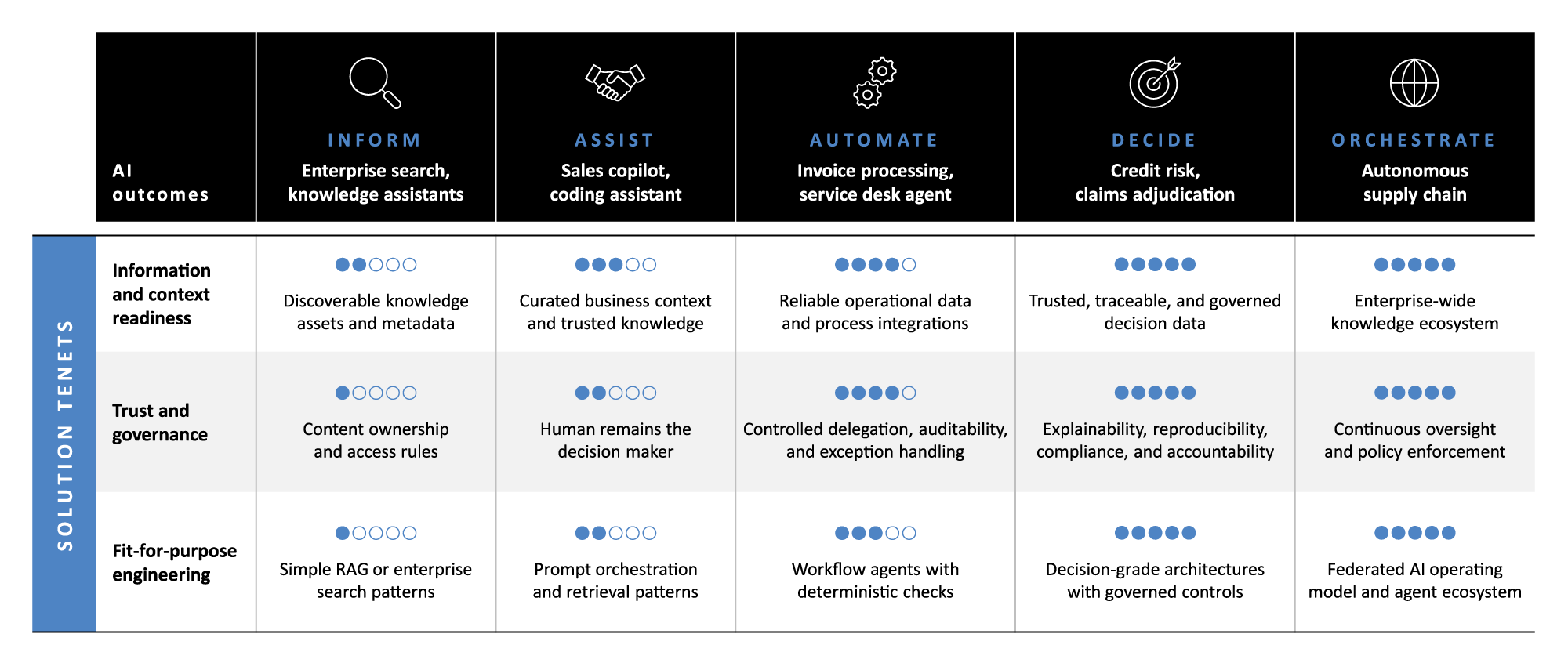
Figure 1
AI readiness is a spectrum, requiring progressively stronger foundations in context, governance, and engineering as AI takes on greater autonomy and business responsibility.
Figure 1
Building an enterprise capability
Once AI readiness is understood this way, the path forward is progressive. Leading organisations do not try to close every gap upfront. They build readiness where value and capability intersect, following the below principles:
Start where readiness and value meet: Focus on use cases with clear business value, manageable risks, and data and governance sufficient to support deployment.
Let adoption drive maturity: Early AI implementations often expose gaps in data quality, metadata, governance, ownership, and operating models. Use these insights to guide targeted investments to ensure foundational improvements are driven by real business demand.
Scale progressively: As AI evolves from experimentation to workflow integration, automation, and decision influence, organisations must incrementally strengthen governance, data quality, engineering discipline, and operational practices. This enables movement into higher‑value and higher‑risk scenarios without creating disproportionate exposure.
Over time, these principles strengthen the three pillars of AI readiness: Information and context readiness, usage and governance, and fit-for-purpose engineering. Together, they enable organisations to evolve from isolated AI successes to a repeatable enterprise capability. AI readiness is not about being ready for every form of AI. It is about being ready for the AI that matters, in the context where it matters, and at the level of readiness the outcome demands.