Services
Industrial Autonomy & Engineering

Industrial Autonomy & Engineering: Building autonomous enterprises where intelligence is embedded directly into the value chain and operating models
Highlights
- Industrial autonomy represents the next operating model for industrial enterprises, enabling systems to continuously sense, decide, and execute within defined business guardrails.
- Enterprises must move beyond isolated AI use cases by integrating ET, OT, and IT systems into a unified execution layer.
- The Infrastructure-to-Intelligence approach enables organisations to translate data, context, and AI capabilities into real-time operational execution.
- A human + AI operating model shifts human roles toward outcome definition, governance, and exception management while systems handle continuous execution.
- Organisations that combine autonomous execution, integrated intelligence, and adaptive operations can improve resilience, efficiency, innovation, and growth.
On this page
On this pageinpage
How can enterprises reimagine value chains for industrial autonomy?
Engineering designs, value chain operations decisions, and enterprise industrial intelligence no longer fit neatly apart. They overlay, influence each other, and evolve in ways aligned with demand patterns and competitive responses. Across industries, what once looked like linear value chains have become dense ecosystems of products, platforms, partners, and processes, each offering opportunities for value creation at the points of intersection, making it imperative to enable autonomous decision-making, and eliminate the lag caused by inter-dependencies. This evolution mirrors the shift from traditional value chains toward more connected, collaborative, and cognitive operating models as explored in the 21st-century neural value chain paper, where value increasingly emerges from the ability to orchestrate intelligence across a broader network of stakeholders and systems rather than focusing on local optima.
Yet many organisations still approach transformation from left to right, applying modern technologies to existing operating models and expecting better outcomes. But as products, operations, and ecosystems become increasingly intertwined, incremental optimisation is no longer enough. Decisions, operating models, and value chain interactions must then be reimagined around the target state of a ‘human + AI.’ The objective is not simply to automate existing processes, but to architect systems that can continuously learn, adapt, and act in pursuit of desired outcomes.
This shift demands a fundamentally different way of thinking. Rather than building from left to right, starting with technology and pushing toward outcomes, enterprises must begin from the right: the outcome they want to achieve in a fully autonomous state and work backwards to redesign their value chains.
The significance of this shift extends beyond operational efficiency. As enterprises move toward increasingly autonomous operations, competitive advantage will be determined not by the volume of technology deployed but by how effectively human knowledge, engineering expertise, AI reasoning, and autonomous execution are orchestrated into a continuously learning system. Industrial autonomy is the outcome of this right-to-left transformation, in which intelligence is designed into the fabric of the enterprise from the outset rather than added afterwards.
What does an autonomous enterprise look like in action?
This shift becomes most visible in systems where complexity is lived, minute by minute.
Imagine a regional transit network begins to experience disruption, a surge in demand, a stalled vehicle, and an unexpected weather shift. There is no visible escalation. Instead, routes are recalibrated, signals are reprioritised, fleet movements are adjusted, and passengers are rerouted seamlessly.
A similar pattern plays out in utility networks. As a load imbalance develops, driven by fluctuating weather, rising distributed demand, and a localised fault, the system responds autonomously, redistributing load, isolating the fault, and drawing on distributed energy sources within defined safety, reliability, cost, and carbon boundaries.
In a retail scenario, a sudden surge in demand begins to outpace inventory across channels. Without manual intervention, inventory is reallocated, replenishment plans are adjusted, fulfilment routes are optimised, and customer delivery commitments are recalibrated in real time. The system continuously balances availability, profitability, logistics capacity, and customer experience as conditions evolve.
What connects these scenarios is not the industry, but the operating model. Intelligence at the edge continuously interprets physical conditions; operational systems translate this into real-time action; and enterprise platforms ensure that decisions align with broader constraints. Together, they form a continuous loop where sensing, decision-making, and execution operate as one.
In such environments, autonomy is not an added capability; it emerges naturally from the convergence of intelligence gleaned from engineering technology (ET), operational technology (OT), and enterprise technology (IT), enabling systems to absorb complexity and operate with speed, precision, and resilience. It is the shift from infrastructure to intelligence that makes autonomy real.
What happens to human roles in autonomous operations?
As industrial systems become more adaptive, the most visible shift is not in isolated decisions, but in how work itself is executed across value chains.
Historically, execution has been human-led. The tasks were performed manually across the value chain, supported by automation systems. These systems could monitor, assist, and enforce rules, but accountability and decision-making remained dependent on human intervention. That model is now evolving. This progression typically begins with environments where execution is predominantly human-led. In engineering, this is reflected in the use of established toolchains for design and simulation. In manufacturing, operations are performed by humans supported by legacy automation systems. In asset-centric industries, field operations rely heavily on technician expertise, assisted by enterprise tools. In service environments, execution is becoming more seamless, with systems managing interactions while human involvement is reserved for exceptions or complexity.
As autonomy advances, human involvement shifts away from routine execution toward:
- Defining the outcomes to be achieved
- Setting the conditions under which systems operate
- Overseeing performance and managing exceptions
Systems, in turn, assume a greater role in continuous execution and adjustment within those boundaries. For leaders, this transition provides a practical lens to assess current operations before advancing further on the AI journey. A focused self-check across value chains can help ground this assessment:
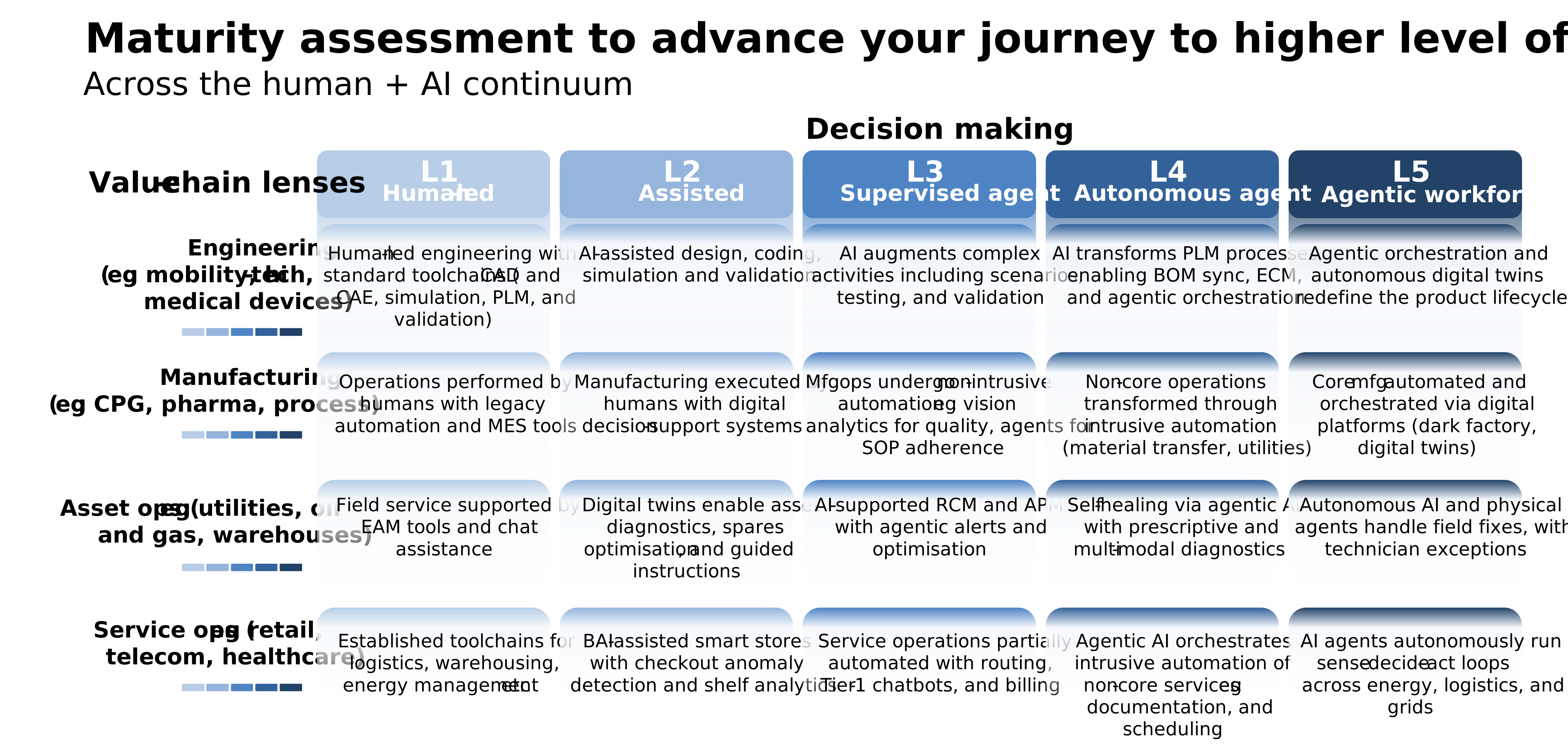
Figure 1: Maturity assessment across the human +A
Figure 1: Maturity assessment across the human +A
Autonomy does not change the work to be done; it changes how execution is orchestrated between humans and systems. The result is a more adaptive operating model, aligned to delivering outcomes with greater consistency, speed, and resilience.
How can enterprises turn industrial infrastructure into autonomous intelligence?
As systems begin to operate as unified, real-time decision systems, the next shift becomes clear, from infrastructure to intelligence.
Industrial AI scales only when systems can execute, not merely analyse. The constraint is rarely an algorithmic capability. It is the lack of coherence in the underlying systems and data. The core operations are shaped by multiple layers of information from ET, IT, and OT where each reflects a different view of reality. In most environments, these layers remain disconnected. Although data exists, without a shared structure or context, the ability to act is limited. The systems can detect and recommend without alignment across the three data sources, but they struggle to execute reliably. Progress depends on bridging the gap from fragmented infrastructure to usable intelligence.
This requires more than connectivity. It involves structuring data, models, and systems into a unified execution layer, where physical context and digital intelligence converge to enable coordinated, real-time action across the value chain. The confluence of industrial AI, generative AI, and agentic AI enables enterprises to progress from visibility and insight to reasoning, orchestration, and autonomous execution. When these layers come together, infrastructure is no longer passive and becomes intelligent by design.
For instance, a semiconductor foundry sought to improve wafer yield by addressing surface defects within high-speed production lines. The journey began with an inspection infrastructure that captured large volumes of wafer imagery which, on its own, provided visibility but limited actionability. This data was transformed into high-precision defect signals using advanced pixel-level AI models. The critical shift came when these models were optimised for edge AI hardware and embedded directly into inspection machines, enabling real-time, in-line defect detection without latency. As a result, inspection moved from a post-process analytical step to continuous execution within the manufacturing flow. This end-to-end transition from infrastructure and data capture to models and embedded execution enabled the system to sense and act in context, driving significant yield improvement, millions in annual revenue gains, and sustained market leadership, demonstrating how infrastructure, when translated into intelligence, delivers measurable business impact.
How can enterprises accelerate their journey to industrial autonomy?
This transition towards industrial autonomy does not unfold uniformly. Each organisation progresses differently, shaped by its industry context and strategic priorities. For some, the focus may be operational efficiency. For others, it may be product innovation or service experience. What differs is the starting point. What remains consistent is the path.
To help organisations navigate that path, the industrial autonomy blueprint (see figure 2) provides a reference framework that can be applied across industries. It helps organisations to assess where they are today and where readiness must be built to progress toward autonomy.
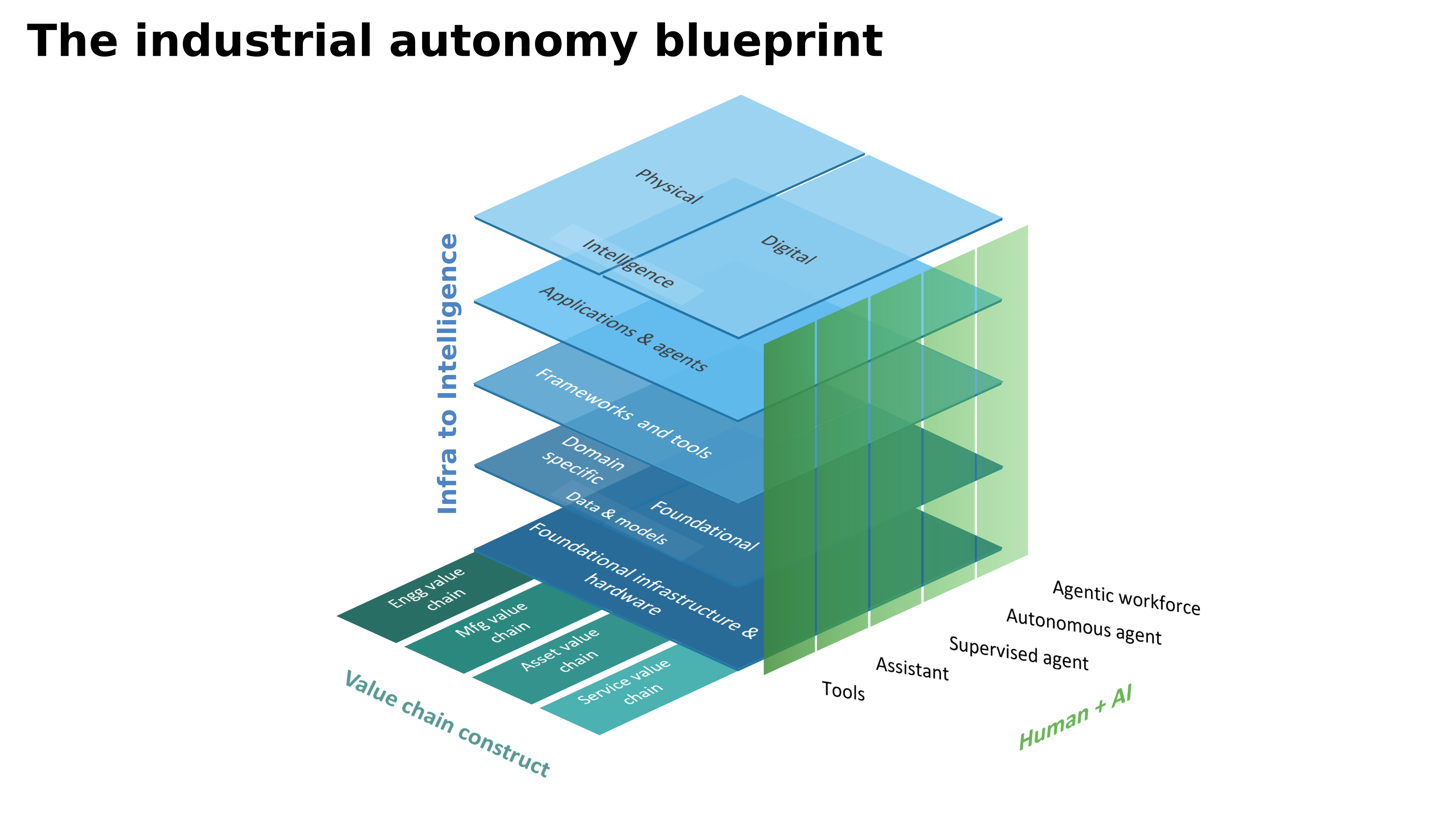
Figure 2: The industrial autonomy blueprint
Figure 2: The industrial autonomy blueprint
Autonomy is applied across engineering, manufacturing, asset, and service value chains. Regardless of the value chain they operate in, enterprises must increasingly adopt a right-to-left mindset, beginning with the autonomous outcomes they seek, whether it is accelerating product innovation, improving production efficiency, maximising asset performance, or delivering seamless service experiences. Clarity on “where to play” and “what outcomes to prioritise” defines the direction of transformation.
The journey is not about introducing autonomy, but about understanding how work is currently executed and how it needs to evolve. The key is not uniform adoption, but a clear view of where systems can execute, and how that balance evolves with human oversight. (as explained in Figure 1)
Progress depends on transforming fragmented environments into a unified execution layer where context, data, and systems converge to enable real-time, outcome-driven action.
Beyond the readiness dimensions represented in the blueprint, the journey to industrial autonomy is shaped by three foundational AI capability domains:
- AI engineering enables software-defined everything (SDX), creating AI-native products, systems, and processes that can continuously evolve.
- AI-IoT connects products, assets, operations, and infrastructure into an intelligent digital fabric, providing the contextual awareness required for autonomous decision-making.
- Autonomous operations translate intelligence into action through agentic execution, closed-loop orchestration, and adaptive workflows.
Together, these three capability domains enable enterprises to move from isolated automation initiatives to autonomous, outcome-driven operating models that translate intent into real-world autonomous action.
How can enterprises scale industrial autonomy responsibly?
Industrial autonomy does not scale without clearly defined execution boundaries. As systems take on a greater role in execution, the operating model must explicitly define what systems can do and under what conditions they must stop, escalate, or return control. This can be framed as a set of execution guardrails that sit across the human + AI continuum:
In practice, this requires six clear design choices. Enterprises must define:
The outcome boundary
|
Defines what the system is optimising for, whether yield, uptime, safety, cost, energy, or experience |
The non-negotiables |
Safety and compliance conditions that must never be violated
|
Execution rights |
Which actions can be automated, approved and escalated |
System integrity |
How autonomous systems are protected from manipulation or unauthorised intervention |
Accountability loops |
How decisions are logged, explained, and continuously improved |
Human intervention points |
Who can override system behaviour, under what conditions, and how quickly |
The challenge, therefore, is not the capability of AI models, but the ability to translate intelligence into consistent, real-world execution. This demands clear leadership action. CIOs must unify fragmented data and systems to create an execution-ready foundation. CTOs must embed intelligence into products and systems so they can operate in real-world conditions. COOs must redesign operations to enable system-led execution that creates measurable value. Industrial engineering leaders must redefine how work is distributed between humans and systems across the value chain.
Industrial systems have traditionally been built for stability and predictability. Once deployed, they remained largely unchanged, and any modification typically required physical intervention. That assumption is now being challenged.
The real test of autonomy is not what systems can predict, but what they can execute consistently, under the real-time system constraints and demands, within clearly defined boundaries. Without that discipline, autonomy remains an idea. With it, autonomy becomes real, embedded into everyday operations, where systems execute with precision, respond with intent, and operate reliably in real world.
No enterprise can make this journey alone. The pace of innovation across industrial AI, generative AI, agentic AI, software-defined systems, and platforms makes a robust ecosystem of partners, hyperscalers, and domain specialists critical to accelerating industrial autonomy.
At the same time, autonomy must be designed for scale. As enterprises navigate the race for compute efficiency, token optimisation, sovereign data management, privacy, and security, these considerations must be embedded by design rather than addressed retrospectively. The future belongs to AI-by-design value chains, where intelligence, trust, resilience, and economic efficiency are built into the fabric of products, processes, and operations from the outset.