Industry
High Tech

High Tech Solutions to Drive Business Transformation through Technology
Highlights
- An AI-ready data enterprise unifies trusted data, business context, and AI-driven capabilities to scale intelligence securely and reliably.
- Certified data products, semantic ontology, and enterprise memory give AI consistent meaning, reusable context, and a trusted foundation for decisions.
- AI for Data automates engineering, quality, governance, and self-healing DataOps, reducing manual effort while improving speed, resilience, and control.
- The Prepare–Remember–Reason–Act loop turns data into continuous enterprise intelligence, enabling trusted conversational analytics and faster business action.
Overview
What is an AI-ready data enterprise?
An AI-ready data enterprise unifies trusted data, enterprise context, and AI-driven capabilities. It combines data for AI and AI for data to build governed, contextualised foundations; automate data operations; improve decisions; and scale enterprise intelligence. The operating model connects certified data products, semantic and business ontology, enterprise memory, AI-driven DataOps, conversational analytics, and responsible governance.
Challenges
Why enterprise AI stalls without data readiness.
Many organisations have started AI and GenAI initiatives, but a significant number remain stuck in prototype or pilot stages. The primary reason is a lack of data readiness. AI pilots are typically built on limited, manually prepared datasets. When the same solution is asked to run against full enterprise data volume, it encounters quality, access, performance, governance, and business context problems for which it was not prepared.
Enterprise data is scattered across systems, applications, databases, warehouses, files, documents, and external sources.
Across industries, the pattern is the same even though the labels change. In semiconductors it is wafers, lots, tools, and yield; in manufacturing and architecture, engineering, and construction (AEC) it is supply chains, assets, and lifecycle history; in telecom it is networks, service quality, and churn; in media it is content, subscribers, and engagement; in services it is engagements and expertise; in financial markets it is entities, positions, and risk and more. In every case, this critical domain data is scattered, inconsistent, and poorly connected, so AI stays stuck in pilots instead of scaling across the real business.
Different business units often use different definitions for the same metric or entity. And much of this data is also uncertified and ungoverned. In that environment, AI applications cannot determine which data to trust, which rule to apply, or which output to rely on. Organisations end up stuck in experimentation, unable to scale.
- Insight gap for business personas
- Data exists across finance, HR, operations, sales, and customer service. It captures how the organisation works. Yet business personas do not get the insight they need from it.
- Most leaders and managers rely on fixed dashboards and reports. These answer predefined questions and must be rebuilt when new questions arise. Access to deeper analysis depends on technical teams and cannot keep up with daily decisions.
- So data is present, but not delivered in the way the business wants it: aligned to value chains, tailored to each role, and available at the moment of decision.
- The result is an insight gap: data is present, but not delivered in the right form, at the right time, or in the right context for each persona and value chain.
- Missing business context and enterprise memory
- Data represents transactions, but often not shared business meaning. Different teams define data assets in different ways. Projects add their own hierarchies and rules. Over time, there is no single, consistent definition for key concepts.
- AI and analytics are then applied on top of these inconsistencies. Without a common semantic structure, they operate on fragmented interpretations of the business. At the same time, most systems lack persistent enterprise memory. Each query or dashboard view is treated as an isolated event rather than part of a continuous history of decisions, actions, and outcomes.
- This combination of missing shared context and weak memory keeps the organisation from building cumulative intelligence over time.
- Project-based data management instead of certified data products
- In many organisations, data is still managed through isolated projects. Each new request generates new pipelines, data marts, and reports. Logic and metrics are recreated repeatedly across initiatives.
- This project-centric pattern produces multiple versions of the same KPIs and entities. Quality checks and governance rules are unevenly applied. There is no clear, stable single source of truth spanning domains and use cases.
- Under these conditions, AI pilots may perform well on carefully prepared samples, but they fail when exposed to full, inconsistent enterprise data. The lack of standardised, certified data assets makes it difficult to move from experimentation to reliable, scalable use.
These challenges make it essential for organisations to establish a unified, AI‑ready data foundation that turns fragmented, inconsistent data into trusted, well‑governed insight that can reliably support decisions at scale.
Solutions
How to enable an AI-ready data enterprise?
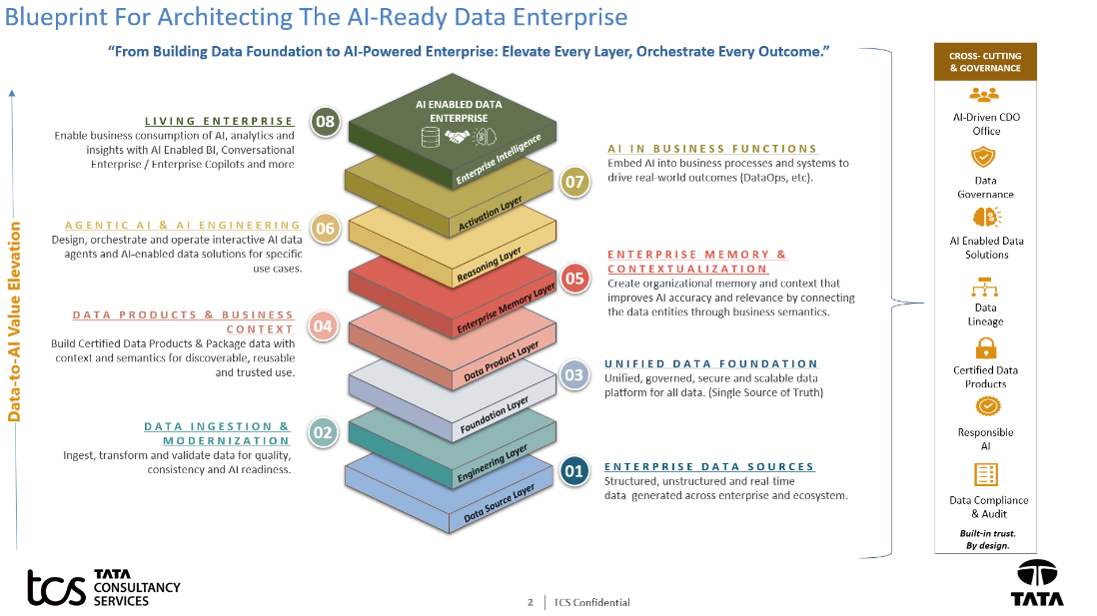
Figure 1:
Blueprint for architecting the AI-ready data enterprise
Figure 1:
Enterprise AI scales only when data and intelligence are designed to work as one system. Our blueprint defines that system, combining data for AI, AI for data, and a continuous Prepare - Remember - Reason - Act loop into a single operating model for the business (see Figure 1).
- Data for AI
Data for AI turns fragmented information into a unified, trusted, business‑aware foundation that AI can scale on safely.
The blueprint starts by making sure the right data is even in scope.
Unified data foundation: Land and organise ingested data in a unified data foundation (lakehouse, fabric, mesh) backed by a metadata catalogue. This is the central stage where enterprise data is stored, structured and made accessible, breaking down silos and enabling consistent use across analytics and AI.
Quality, observability and governance: On this foundation, use AI-enabled data solutions to cleanse, standardise and embed data quality, observability, security, lineage and more. Governance is built into each stage.
From projects to certified data products: Transform raw, governed data into certified, reusable data products. Each data product has clear purpose, ownership, definitions, quality expectations, lineage and consumption interfaces. This replaces one‑off, project‑specific datasets with shared building blocks and gives the business a single source of truth for core entities and metrics.
Semantic and business ontology: Define a semantic ontology that describes entities and their relationships, and a business ontology that encodes KPIs, rules and value chains. Together, they ensure every term and metric has one consistent meaning across systems, dashboards and AI agents, so every query and recommendation is business‑aware rather than purely technical.
Enterprise memory: Build enterprise memory on top of the ontology and data products to capture entities, events, decisions and workflows over time. Use:- Working memory for active, session‑bound context
- Episodic memory for past interactions and outcomes
- Semantic memory for shared facts and definitions
- Procedural memory for learned workflows and behaviours
Together, these steps form Data for AI: connected sources, a unified foundation, embedded trust, reusable data products, shared meaning and enterprise memory that turn data into enduring organisational intelligence. - AI for data
AI for Data makes the data foundation itself intelligent, cutting manual effort and keeping humans focused on business value.
Once the foundation is in place and trusted, we turn AI back toward the data ecosystem itself.- Accelerate the data development lifecycle: Use AI agents to analyse schemas, metadata, code and lineage, then recommend source mappings, generate transformation logic, propose quality rules and test cases, and auto‑produce documentation. This compresses the time and effort needed to build and modernise data pipelines, warehouses and reporting environments.
- Intelligent data operations and self‑healing: Combine AI with observability to monitor pipelines and data products in real time. When failures, schema changes, data quality issues or anomalies occur, the data agents perform root‑cause analysis, identify impacted assets, propose or apply fixes, validate recovery and update the knowledge base. Over time, repeated patterns become automated remediations, moving the organisation toward a self‑healing, near‑zero‑ops model.
- AI‑driven BI and talk‑to‑data: Expose governed data products and enterprise memory through AI‑driven business intelligence and talk‑to‑data interfaces. Business users ask questions in natural language and receive trusted answers, visualisations, explanations and forecasts. Because every response is grounded in semantic and business ontology, conversational analytics becomes a safe way to democratise insight, not a source of inconsistent or misleading results. AI for Data turns the foundation from static infrastructure into an active, intelligent system that builds, operates and explains itself, while keeping humans in control of high‑impact decisions and governance.
- Prepare, remember, reason, act
The AI‑ready enterprise learns from every decision it makes, because data and intelligence move in one continuous loop.
With Data for AI and AI for Data in place, the organisation can move into a continuous learning cycle.- Prepare: Ingest and engineer raw data into governed, contextualised data products on the unified foundation. Quality, observability and governance are embedded, and semantic and business ontology give each asset shared meaning.
- Remember: Capture data entities, metrics, events, decisions and workflows in enterprise memory. Working, episodic, semantic and procedural memory ensure that knowledge accumulates and can be reused across agents, analytics, applications and business functions.
- Reason: Let AI for Data and domain‑specific data solutions draw on the foundation and memory to interpret situations, answer questions, detect anomalies, simulate scenarios and recommend actions. Reasoning is grounded in the organisation’s ontology and enterprise memory, so AI understands not just data patterns, but business context and impact.
- Act: Execute decisions in business processes, operations and data workflows. Actions produce new data and outcomes, which flow back into the unified foundation and enterprise memory, feeding the next round of preparation and reasoning with richer context.
This Prepare-Remember-Reason -Act loop keeps the enterprise in motion. Data for AI prepares and gives meaning, AI for Data operates and improves, and the loop ensures the organisation becomes more intelligent, more trusted and more effective with every decision it makes.
Benefits
How does TCS turn data into business capability, and what is the advantage?
The “Enterprise AI-Ready Data” blueprint becomes real only when it is delivered as concrete data capabilities. The solutions below describe how TCS enables the building of a data enterprise that turns fragmented, low-trust data into unified, governed, contextualised assets that AI can safely and effectively build on.
Unified data platform and ingestion modernisation
- One governed data foundation instead of many disconnected platforms.
- We consolidate warehouses, lakes, and shadow databases into a unified platform and modernise ingestion from various internal and external feeds. This reduces duplication, simplifies access, and applies consistent security and governance.
- For the business, it means faster time to data, lower platform cost, and a single place where analytics and AI can find complete, up‑to‑date information.
Data product factory (certified domain data products)
- Reusable, certified data products give every team one version of the truth.
- We set up a factory model that turns raw source data into curated domain data products, each with clear ownership, business definitions, quality SLAs, lineage, and ready‑to‑use interfaces.
- On top of this, an AI solution can automatically analyse the sources and metadata to propose and define candidate data products, so the organisation can scale the model without manually designing every product from scratch.
Shift from project- to product-driven approach
- Shift from rebuilding the same datasets for every project and start investing in shared products.
- We help organisations move from a project mentality to a product mentality. Instead of building a new pipeline and report for every request, teams create and reuse certified data products that serve multiple use cases.
- This reduces redundancy, aligns metrics across the business, and cuts long‑term maintenance cost, so new analytics and AI demands can be met by reusing what already exists.
Semantic and business ontology design
- Give every key term one shared meaning so business and AI interpret data the same way.
- We design a semantic ontology that defines entities and relationships, and a business ontology that encodes business contexts. Together, they form the map that connects data to how the business operates. This becomes the starting point for enterprise memory, a shared knowledge layer that every dashboard, model, and AI agent can use to understand what data entities really mean, reducing hallucinations and making insight more explainable.
AI-driven data quality and governance
- Business users describe data quality rules in plain language, AI turns them into executable controls.
- We provide NLP‑driven tooling where a business user can state a rule in natural language and AI translates it into a data quality rule that is applied and monitored.
- AI-enabled data agents monitors these rules across data products, detects violations and anomalies, and enable creation of new rules based on patterns it sees.
- This reduces the technical overhead needed to define and maintain data quality and governance, while keeping business users in control of what “good data” means.
Self-healing DataOps and application support
- Fewer tickets and faster recovery through automated detection and repair.
- We implement AI-enabled data agents that continuously watch pipeline runs, logs, and data health. When issues are identified, they identify the failure, assess impact on data products and reports, suggest or apply known fixes, and validate the outcome. For routine patterns, the system self‑heals directly. For higher‑risk issues, it escalates with full context to the right owner. This reduces manual support effort, shortens downtime, and builds confidence that the data platform will stay reliable as usage grows.
AI-assisted data engineering and platform migration
- Migrate faster with AI that generates and tests the migration scripts.
- Use AI to analyse legacy schemas, ETL scripts, and reports; automatically generate target-platform scripts and mappings; propose conversion logic; build initial pipeline code; and produce reconciliation checks and validation queries. Engineers review and refine these outputs, and the system learns from that feedback.
- This significantly reduces the time and risk of moving from legacy platforms to the unified data foundation.
AI-driven data SDLC
- Utilise AI to automate code generation to deliver data products faster.
- We apply AI across the data management lifecycle. Given source and target models and business rules, AI generates transformation logic, pipeline code, and test cases. Engineers then refine and approve what is generated rather than starting from a blank screen. This speeds up build cycles, improves consistency between pipelines, and makes it easier to evolve data products as business requirements change.
Conversational analytics and talk-to-data
- Every persona can be enabled with direct, conversational access to trusted data, thus shifting from a static dashboard approach.
- We provide a conversational layer where business users ask questions in natural language and receive answers, charts, and explanations backed by governed data products and ontology.
- Because it is grounded in certified data and shared definitions, the answers are trusted and consistent. This turns data into a daily tool for decision making, not an occasional report.
Evolution from traditional BI to AI-driven business intelligence
- Dashboards become an intelligent assistant that explains and recommends, not just displays.
- We extend existing BI tools with AI features that interpret dashboards for users. The system can highlight anomalies, explain drivers behind trends, generate narratives in business language, and suggest follow‑up analyses or actions.
- BI becomes more accessible and action‑oriented, so decisions move faster and rely on deeper insight.
Move towards zero-ops data platform operations
- Run the governed data foundation with high automation so day‑to‑day operational effort drops.
- Automate routine monitoring and remediation for data pipelines, quality checks, and platform jobs using built‑in observability, rules, and runbooks, so common issues are handled directly by the platform and only exceptions reach engineers.
- Standardise incident patterns and recovery steps so the system can apply fixes consistently and log them for audit and learning.
- Reduce time spent on manual checks, ticket handling, and status reporting, freeing data teams to focus on improving data products, governance, and new analytics and AI use cases.
AI-augmented CDO office and enterprise stewardship
- Give the CDO office AI support for cataloguing, ownership, quality, and policy at enterprise scale.
- We equip the data office with AI agents that scan metadata, enrich catalogues, recommend data owners, generate glossary entries, track quality metrics, and check policy compliance across data products and ontology.
- This lets the CDO team focus on strategy, value, and risk while automation handles a large part of the repetitive governance work. Stewardship then covers not only data but also shared meaning and AI decisions, keeping trust and accountability consistent end to end.
Data observability, guardrails, and responsible AI controls
- Make data and AI safe and reliable with full visibility and built‑in controls.
- We implement data observability so teams can see pipeline health, freshness, completeness, accuracy, and anomalies in one place.
- Guardrails add access control, data masking, privacy rules, sensitive data detection, lineage, and audit logging. On top of this, responsible AI controls govern which data AI agents can use, how queries are handled, and how outputs are monitored for compliance. This enables broad data and AI adoption without losing control or increasing risk.
Cost optimisation for data platforms (FinOps for AI and data)
- Grow data and AI capability while keeping spend under control.
- We apply FinOps principles to data and AI platforms. Crucially, we link these optimisations to business outcomes. Investments are directed towards the data products, ontology work, and AI capabilities that clearly drive revenue, efficiency, risk reduction, or innovation, so the data foundation for AI remains both powerful and economically sustainable.
- Provides a comprehensive solution for cost visibility and optimisation across teams. Offers real-time insights to identify and address cost drivers and anomalies.
- Supports data-driven decision-making to reduce unnecessary spending. Facilitates accountability and governance for improved financial outcomes.
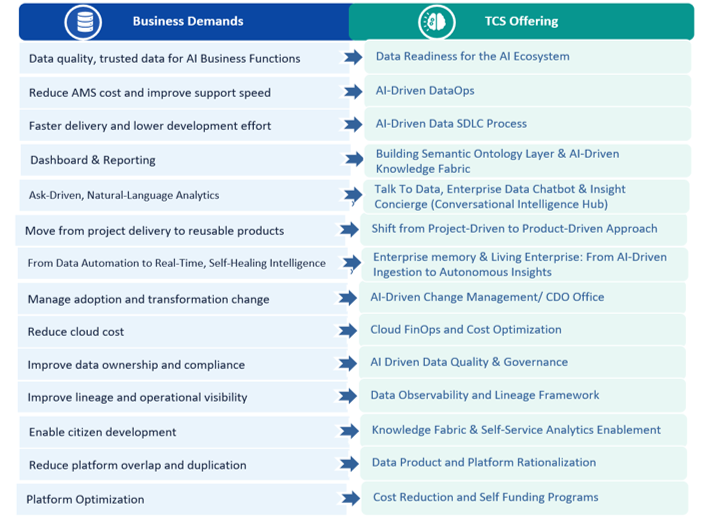
Figure 2:
TCS offerings from data challenges to AI-driven advantage.
Figure 2:
Taken together, these capabilities turn the “Enterprise AI‑Ready Data” blueprint into a working operating model, not just an architecture diagram. TCS enables business to move from scattered, low‑trust data and project‑driven delivery to a unified platform of certified data products, shared ontology, automated DataOps, and conversational intelligence that business can rely on every day.
Conclusion
How can enterprises scale the blueprint?
The same blueprint, adapted to each business domain
The four movements, Prepare, Remember, Reason, Act, don't change from one industry to the next. What changes is only the vocabulary layered on top of them: the entities, relationships, and domain language that populate the semantic layer, the ontology, and enterprise memory. For example, a semiconductor fab and a telecom network can run on the same underlying architecture; they simply populate it with wafers and lots in one case, and network assets and service-level agreements in the other.
This matters because it means an organisation doesn't need a different architecture for every sector it operates in. It needs one architecture, populated with the right domain vocabulary, connected through the right ontology, and fed by the right data products for its own business. Mapping this approach to a specific industry is a translation exercise, not a redesign.
This same architecture holds across industries, adapting only through the vocabulary layered on top of it. Telecom and network operators can use it to bring together network, service, and customer data for better informed decisions. In semiconductor manufacturing, it can work with production and equipment data using the sector's own terms and relationships. Manufacturing, OEM, and architecture, engineering, and construction apply it to multi-tier supply chains and asset lifecycles, connected through a single ontology. Communication, media, and information services apply the same foundation to content, audience, and usage data to understand how their business performs. In advisory and professional services, it becomes the mechanism for capturing and reusing institutional knowledge across projects.
In every case, the approach for building the AI-ready data enterprise remains constant; only the domain vocabulary populating it changes. Across all these cases, the underlying question an organisation needs to answer is the same: what are our entities, what are our relationships, and what decisions do we need our data and AI systems to make faster and more reliably? Once that's answered, the same architecture applies.
This is where the architecture stops being abstract and starts being a decision an organisation makes: adopt one coherent foundation now, or keep paying the cost of fragmented data and stalled AI indefinitely. Enterprise AI success depends entirely on enterprise data readiness.
TCS enables organisations to make their enterprise data AI-ready: preparing data for intelligence and letting intelligence give back to data in return, so they grow more capable with every decision they make.
Aligning data strategy, AI strategy, business strategy, and the operating model is how organisations unlock trusted AI at scale, reduce cost, improve agility, empower business users, strengthen governance, and build a genuinely living enterprise—one that remains continuously ready for what intelligence makes possible next.