Industry
Manufacturing

Future-Ready Manufacturing: Partnering in your journey to a sustainable manufacturing enterprise
Highlights
- AI-driven workloads are transforming data centers into highly volatile, peak-intensive infrastructure, exposing critical gaps in conventional energy systems that were designed for stable and predictable demand.
- Battery energy storage systems (BESS) provide a scalable solution to this challenge by buffering peak demand, stabilising power fluctuations, and enabling efficient integration of renewable energy sources.
- This paper explores how an intelligent BESS evolves from a supporting system into the central orchestrator of a smart energy ecosystem, enabling resilient, efficient and sustainable operations in data centers.
On this page
Energy challenge
Rising digital adoption is rapidly transforming data centers into large-scale, capital-intensive infrastructure, with global investments projected to exceed USD 1.7 trillion by 2030. Unlike traditional enterprise and cloud workloads, AI systems driven by large-model training and real-time inference introduce highly variable, peak-intensive power demand.
These workloads create sharp fluctuations in electricity consumption, often exceeding 50% within minutes[1], alongside sudden thermal surges that strain cooling systems. These demand changes can also account for a significant portion of a data center’s energy bill.
At the same time, rack densities have surged to 30–50 kilowatts (kW) and, in many cases, over 100 kW per rack, far beyond the 5–10 kW typical of conventional setups[2], making peak demand the dominant design constraint. Global data center electricity consumption is set to more than double, rising from over 415 terawatt-hours (TWh) in 2024 to nearly 945 TWh by 2030[3].
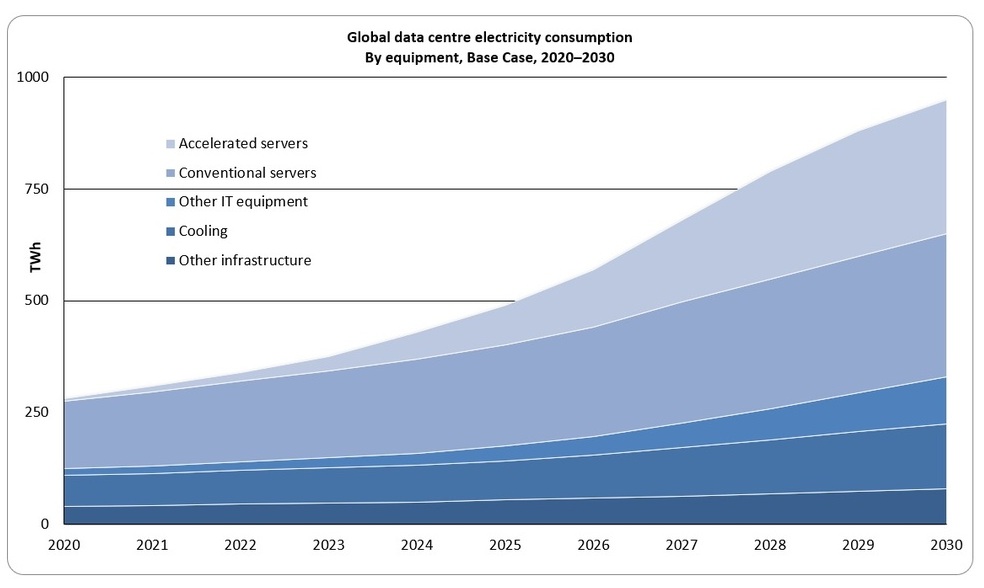
Global Data Centre Energy Consumption
Global Data Centre Energy Consumption
The challenge lies in the mismatch between these dynamic, high-density load profiles and existing energy infrastructure, which is designed for stable and predictable demand. This gap raises critical concerns around power quality and grid reliability, backup power availability, energy costs, thermal management, and long-term energy planning making efficient and resilient power systems essential to sustaining AI-driven growth.
Green data centers
Growing global commitments to climate action, net-zero targets, and carbon reduction are accelerating the move towards green data center models. Government, regulators, and policymakers are increasingly introducing mandates for efficient renewable energy integration and transparent environmental performance metrics for new and expanded facilities.
Rising energy costs, stricter sustainability regulations and growing enterprise commitments to reducing carbon emissions are driving rapid growth in the green data center market, which is expected to expand from USD 48.26 billion in 2025 to USD 155.75 billion by 2030, registering a CAGR of 26.4%[4].
However, renewable energy integration introduces additional complexity. Sources such as solar and wind are inherently intermittent and are often misaligned with the highly dynamic and peak-intensive power profiles of AI workloads. At the same time, compliance with key efficiency and sustainability metrics, such as power usage effectiveness (PUE), carbon usage effectiveness (CUE) and water usage effectiveness (WUE), standardised under ISO/IEC 30134, adds another layer of constraint in already volatile operating environments.
Together, these factors create a dual challenge:
- Managing extreme and rapidly fluctuating performance demands from AI-driven workloads.
- Meeting increasingly stringent sustainability and regulatory requirements.
This convergence of performance and sustainability requirements highlights a critical gap in current data center energy architectures, one that requires not only efficient consumption but also intelligent energy balancing and buffering capabilities.
Energy storage
Energy storage is becoming an essential layer for decoupling highly dynamic demand from constrained and often inflexible power supply in data centers. This growing importance is reflected in market momentum, with the global data center energy storage market estimated at USD 1.58 billion in 2024 and projected to reach USD 2.67 billion by 2030, growing at a CAGR of 9.5%[5].
Within this evolving landscape, Battery Energy Storage Systems (BESS) are emerging as a primary enabler of this capability, forming a critical component of modern power architectures that help buffer peaks, improve resilience, and stabilise power supply.
By providing fast-response energy, BESS absorbs sudden demand spikes, smooths grid draw, reduces peak-demand charges, and maintains stable voltage and frequency for sensitive IT systems. It also enables short-duration ride through during disturbances, supports coordination with backup generation, and allows higher rack densities without requiring immediate grid upgrades, thereby enhancing scalability and operational flexibility.
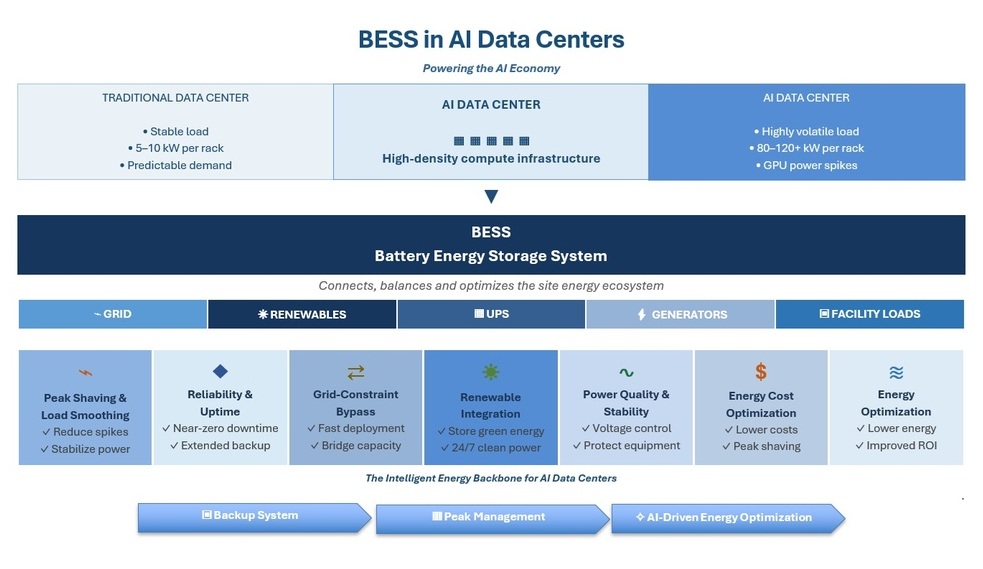
The intelligent Energy Backbone of AI Data Centers
The intelligent Energy Backbone of AI Data Centers
From a sustainability perspective, BESS supports greater renewable energy integration by storing excess generation and aligning it with dynamic demand, bridging the gap between intermittent supply and continuous IT demand. This time-shifting capability reduces curtailment, increases renewable energy utilisation, and lowers reliance on plants during demand spikes, translating sustainability goals into measurable operational impact.
Intelligent BESS
As data centers grow more complex, managing energy through static rules and predefined thresholds becomes increasingly limited. AI driven BESS introduces the intelligence required to manage this complexity effectively.
Instead of fixed rules, it continuously learns from workload behavior, power flows, cooling demand, and grid conditions to anticipate future events. This enables storage to prepare for demand ramps and smooth synchronised load events.
More importantly, intelligence allows decisions to be coordinated across systems that have traditionally operated in isolation. Energy, computing, and cooling are no longer managed as separate domains. Storage dispatch can be aligned with expected compute activity, cooling response, and grid conditions rather than following static schedules or fixed reserve margins.
This shift makes it possible to operate closer to optimal conditions while maintaining resilience. It supports higher utilisation of existing assets, smoother integration of renewable energy sources, and more predictable operation under volatile demand. Intelligence does not replace the core capabilities of storage; it amplifies those capabilites by transforming BESS from a passive buffering system into an active decision-making layer.
Smart energy ecosystem
Meeting data center demand growth sustainably requires a fundamental shift in how energy is sourced, managed, and consumed. By combining resilient power infrastructure within a smart energy ecosystem, supported by intelligent energy management and intelligent BESS, data centers can maintain operational reliability while improving efficiency and reducing environmental impact.
While intelligent energy management controls the overall operation between energy producers, prosumers and consumers, intelligent BESS serve as the heart of the smart energy ecosystem, ensuring stable and resilient power flow to different energy elements in the most efficient and sustainable manner.