Industry
Manufacturing

Future-Ready Manufacturing: Partnering in your journey to a sustainable manufacturing enterprise
Highlights
- AI reveals that the greatest value of organisational change management lies not in producing deliverables, but in identifying, interpreting and mitigating organisational risks before they become barriers to successful transformation.
- Many risks that influence transformation outcomes first emerge as ambiguity, weak signals, missing information or stakeholder concerns rather than formal metrics, reports or data points.
- Trust and judgement remain critical differentiators in an AI-enabled environment: trust uncovers signals, while judgement separates risk from noise and enables effective intervention.
- AI is most effective at accelerating activities once information exists, while experienced practitioners create value by interpreting context and influencing outcomes when information remains incomplete and uncertainty is high.
- As AI reshapes knowledge work, organisations can align change expertise with transformation complexity, risk and business objectives through more flexible OCM delivery models.
On this page
On this pageinpage
Introduction
This paper examines how artificial intelligence is reshaping organisational change management and argues that OCM’s greatest value lies not in deliverables, but in identifying, interpreting and mitigating organisational risks. It explores the roles of trust, judgement, stakeholder influence and early signal detection in improving transformation outcomes, and discusses how organisations can align change expertise with transformation complexity, risk and business objectives.
AI is reshaping knowledge work – OCM is no exception
AI is changing OCM and revealing that its greatest value lies in human judgement, trust, influence and risk identification rather than artefact production.
AI can accelerate many traditional OCM activities, but successful transformation still depends on people. The highest-value OCM work involves identifying emerging risks, building alignment and influencing adoption in uncertain environments.
The real value of OCM goes beyond outputs
AI is changing how transformation work is delivered. As routine OCM activities become faster and more automated, organisations must focus scarce expertise where it creates the greatest value: reducing transformation risk, improving adoption, strengthening alignment and increasing the likelihood of achieving intended business outcomes.
Traditional OCM is often measured by deliverables rather than outcomes. The greatest threats to transformation success rarely begin as formal project issues. They appear first as hesitation, guarded language, weak sponsorship, competing priorities, informal resistance or uncertainty about how work will change. By the time these signals become visible in dashboards, status reports or adoption metrics, the organisation may already have lost valuable room to intervene. AI can analyse signals that have become observable. Trust-based human engagement helps make consequential signals observable in the first place.
Critical organisational risks, such as leadership misalignment, weak sponsorship, resistance, competing priorities and cultural barriers, often emerge before they are visible in project data and are difficult to address when identified late. Organisations across industries are investing heavily in AI, digital transformation and automation while facing increasing volumes of change, resource constraints and adoption challenges.
AI is accelerating operational efficiency and organisational change. Leaders must determine which activities can be automated and where experienced human judgement remains essential to manage risk, drive adoption and protect transformation investments.
Beyond the data: How judgement and trust reveal emerging risks
TCS helps organisations rethink how OCM is delivered in an AI-enabled environment by aligning change expertise, AI capabilities and transformation risk to maximise outcomes and resource efficiency.
We help clients use AI to accelerate routine OCM activities while enabling experienced practitioners to focus on risk identification, stakeholder alignment, adoption, and business outcomes.
- Assess transformation complexity and risk.
- Determine where AI can accelerate delivery.
- Align OCM expertise to risk and impact.
- Identify and address emerging organisational risks and cultural aspects.
- Drive stakeholder adoption and outcome realisation.
The cost of treating OCM as a late-stage activity or non-essential
Accelerating OCM with AI can improve transformation success by combining AI efficiency with human judgment to identify risks earlier, strengthen stakeholder alignment, accelerate adoption, and focus expertise where it creates the greatest value. The value is clear:
- Reduced transformation risk.
- Faster adoption and realisation of benefits.
- Better leadership alignment and decision-making.
- Improved resource utilisation and scalability.
- Greater returns on transformation investments.
Organisations can gain a competitive advantage by scaling change (OCM) capabilities more efficiently while preserving the human judgement, trust, and contextual understanding required to navigate complex transformations and achieve intended outcomes.
AI finds patterns – experienced practitioners interpret context within a company’s culture
Unlike approaches focused primarily on automating deliverables, TCS human practitioner OCM emphasises aligning AI capabilities with transformation risk, so that technology enhances rather than replaces human judgement. TCS uses AI to streamline routine OCM activities while directing experienced practitioners toward risk mitigation, stakeholder alignment, adoption, and value realisation.
This distinction becomes evident in several practical scenarios:
- Identifying risks beyond the data: A dashboard can show that frontline operators have completed training, but it will not show a distrust of scheduling driving a workaround to not use the new system or, perhaps a group of senior employees in a certain area of the plant that have “exempted themselves” from what they feel is a disruptive new practice as it gives too much transparency to previous legacy obscuration.
- Understanding the current state firsthand: An experienced OCM practitioner, who can achieve a great deal remotely insists on two to three site visits to observe the current state of work and better understand the pain points firsthand of the legacy system prior to creating a training or communications strategy.
- Designing for local realities: Consider a manufacturer introducing a standardised digital workflow across multiple plants. The technology may function exactly as designed, yet local sites may perform ostensibly identical work differently because of equipment, staffing, customer requirements or established operating practices. If change practitioners engage only after the workflow has been designed, those differences become adoption problems to manage and, one that you will have a very hard time “training your way out of”. Engaged earlier, this information becomes design inputs that shape the solution before choices are locked in.
We use an adaptive delivery model that combines AI, scalable talent, and experienced change leadership according to transformation complexity and impact. This helps organisations balance efficiency and effectiveness, protecting transformation investments and accelerating value realisation risk while improving adoption, scalability, and business outcomes.
The strategic choice – the evolving OCM delivery model
Figure 1 below details an AI-enabled OCM delivery model that incorporates stakeholder engagement, organisational risk identification, executive alignment, adoption strategy, change communications, training, readiness, and transformation governance. These options are not simply productivity choices; they are risk-allocation choices. The appropriate configuration depends on how structured the work is, how much contextual judgment it requires, the consequences of error, and whether the relevant information already exists.
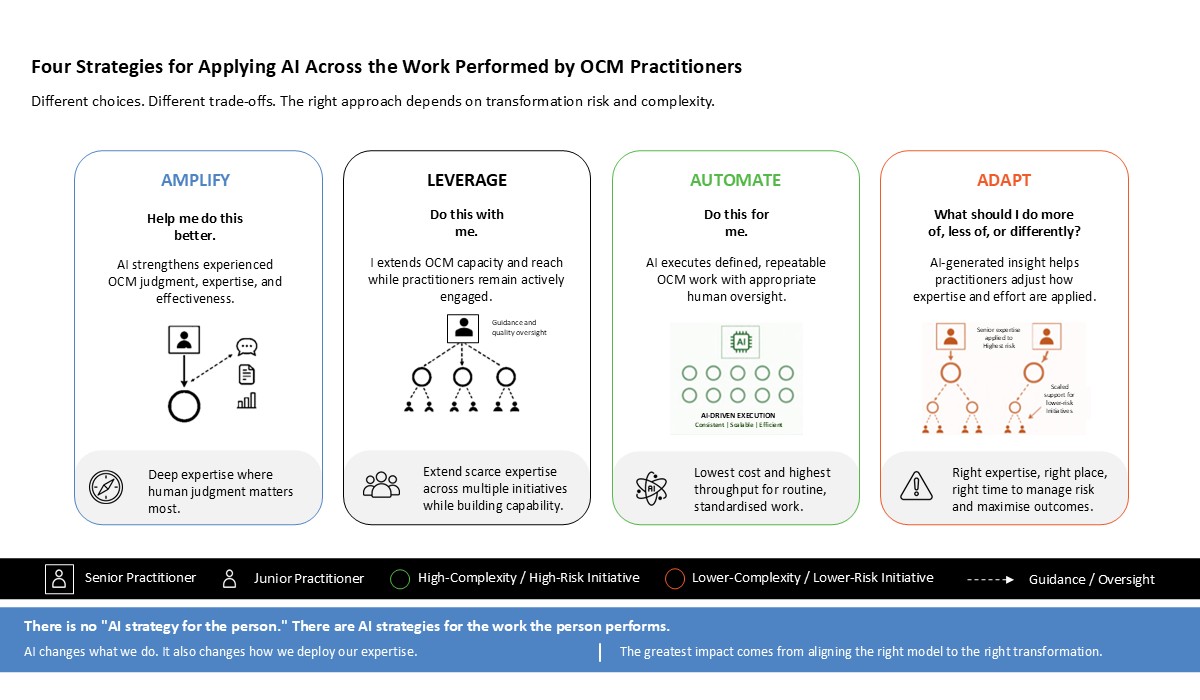
How the Delivery of OCM Incorporates AI
How the Delivery of OCM Incorporates AI
Conclusion
The critical question is where human expertise adds the most value. That value often lies in recognising, interpreting, and mitigating early organisational signals that are unstated, dispersed or uncodified. Human interactions reveal insights into culture and attitudes. AI is a strong partner once information exists; however, experienced change leaders remain essential when signals are ambiguous, organisational dynamics are complex, and influence is still possible.
AI will continue to make change work faster, more scalable, and more evidence-rich. However, transformation success will still depend on recognising what has not yet become data, interpreting what the organisation is not saying directly, and acting while consequential choices remain open. The future of OCM is not the preservation of traditional deliverables. It is the more deliberate configuration of AI, human judgment, and change expertise around the risks that matter most.