Industry
Manufacturing

Future-Ready Manufacturing: Partnering in your journey to a sustainable manufacturing enterprise
Highlights
- Forward deployed engineering (FDE) embeds hands-on technical expertise in manufacturing operations to adapt and integrate AI-enabled software for live production environments.
- Manufacturing AI deployment depends on operational fit, integration and user validation as well as model performance.
- An FDE-led multidisciplinary team combines field integration with specialist expertise in AI, operational technology, cybersecurity, safety and responsible AI.
- Manufacturers should apply to FDE selectively, with clear decision rights, human oversight and knowledge transfer to plant or product teams.
On this page
Introduction
What is forward deployed engineering (FDE)?
Forward Deployed Engineering (FDE) is an embedded, technically hands-on delivery role focused on adapting and integrating AI-enabled software within a customer’s live operating environment. In manufacturing, FDE bridges product and platform engineering with plant operations by translating site-specific constraints into technical requirements, resolving deployment issues rapidly, and feeding field learnings back into reusable product capabilities.
AI technology is advancing through machine vision, generative AI, and agentic automation. However, manufacturing value depends on whether these capabilities can work safely and reliably in live workflows. FDE contributes through sustained proximity to plant operations, hands-on software configuration and integration, rapid field iteration, and continuous feedback to product teams. Domain experts validate process decisions, while architecture, AI, operational technology (OT), cybersecurity, responsible AI, and change specialists provide the depth and approvals required for production deployment.
Unlike a handoff-led delivery model, FDE remains close to a bounded deployment outcome from discovery through stabilisation. The FDE observes the process at the point of work, translates plant constraints into implementation requirements, configures and integrates the solution, troubleshoots site-specific gaps, and coordinates specialist inputs.
Role and responsibilities – why does manufacturing need FDE?
An FDE operates at the customer boundary as the technical integration lead for a defined manufacturing use case. The role combines broad software and AI implementation capabilities with customer-facing problem solving, while relying on specialist teams for architecture, advanced model development, OT engineering, cybersecurity, responsible AI, safety, and change management.
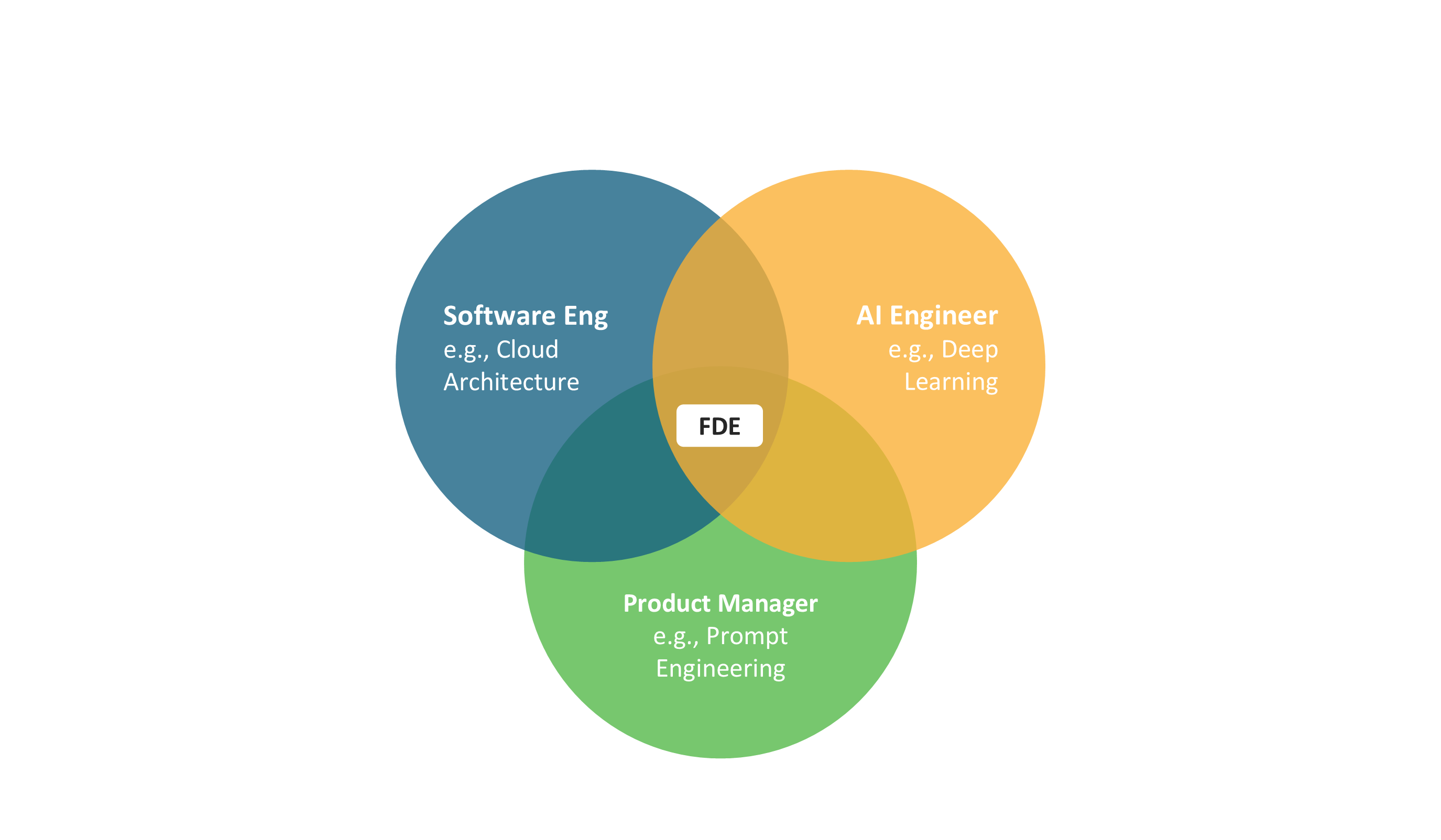
Role Amalgamation with FDE
Role Amalgamation with FDE
The FDE’s core responsibilities are to understand the local workflows and constraints, translate them into technical requirements, configure and adapt AI-enabled software, integrate it with plant and enterprise systems, test it with users, resolve field issues, and return deployment learnings to the product team. The FDE implements approved controls but does not define enterprise governance, security, safety, or change-management policies.
Manufacturing AI programmes often stall between proof-of-concept and production because plant data is fragmented, legacy systems are complex, operational workflows vary by site, and compliance requirements are strict. FDE teams help overcome this gap by working inside the customer environment to contextualise data, configure AI systems, validate outputs with domain experts, and scale successful patterns across plants and product lines.
Challenges
Why do AI pilots fail on the plant floor—and what can limit the FDE model?
Manufacturing AI pilots often fail when they move from controlled environments to the plant floor. Machine and material variation, changing lighting and line configurations, fragmented manufacturing execution system (MES), supervisory control and data acquisition (SCADA), historian, quality, maintenance, and enterprise data, site-specific workflows, real-time latency, safety, cybersecurity, and change-control requirements can undermine a model that performed well in a lab. Operators must also be able to validate outputs, manage exceptions, and continue production when AI is uncertain or unavailable. FDE addresses these conditions by working within the live environment, integrating technical and operational knowledge, and adapting the solution without losing governance or production continuity.
FDE delivery challenges: The model also has practical limits. Professionals who combine strong software and AI engineering with manufacturing context and customer-facing skills are scarce and can command higher costs. Expecting one person to cover architecture, domain, OT, security, governance, and change management can reduce specialist depth and create a single-person dependency. A hero-based model is difficult to scale across plants and creates continuity and knowledge-retention risks when an FDE rotates or leaves.
Manufacturers should therefore use an FDE-led multidisciplinary team rather than rely on a “super individual.” The FDE provides field continuity and integration leadership, while Solution Architects, AI/machine learning (ML) engineers, data and OT engineers, domain leads, cybersecurity, responsible AI, safety, and organisational change management (OCM) specialists provide depth at defined stages. Shared documentation, paired coverage, reusable code, decision records, and an explicit transition to plant or product teams reduce concentration risk.
Within this wider deployment challenge, token usage is one operational cost and latency consideration for generative and agentic AI—not a defining FDE responsibility. The FDE identifies actual usage patterns, runaway agent loops, context inefficiencies, and access issues observed in deployed workflow, then implements approved optimisation and security mechanisms. AI architects, platform teams, FinOps, and cybersecurity specialists define enterprise standards, budgets, access controls, and assurance requirements.
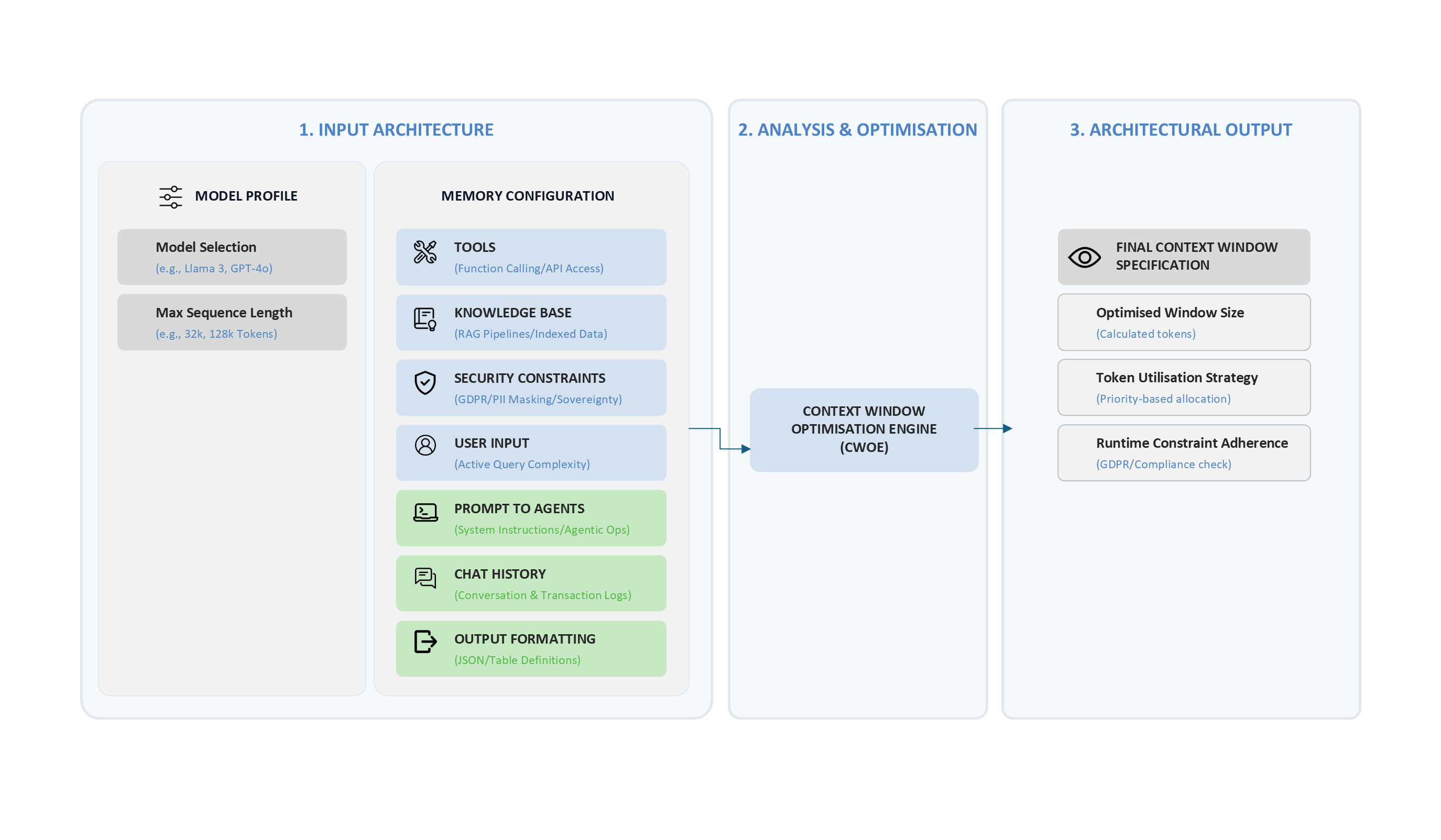
Context Window Architectural Planning
Context Window Architectural Planning
Context-window planning, caching, retrieval filters, token budgets, and iteration limits can reduce unnecessary processing and improve responsiveness. These mechanisms should be treated as shared platform and architecture capabilities. The FDE’s contribution is to validate them against real plant-floor workloads and incorporate approved controls into the local deployment.
Token costs must be considered in the total business case, particularly for high-volume or continuously running agentic workflows. However, they should be evaluated alongside integration effort, reliability, quality, safety, adoption, and the operational value created—not presented as the central purpose of FDE.
Solution
Technology stack layers & categorisation in FDE
To work autonomously within an enterprise architecture and bridge the gap between core R&D and field implementation, FDE utilises a multi-disciplinary tech stack categorised into four core operational layers.
- AI orchestration and agentic software development kits (SDKs) (the intelligence layer): This layer contains the tools used to programmatically query models, handle parameters, build custom application business logic, and structure inputs/outputs. E.g. LangChain, Open AI SDK & Anthropic SDK, FastAPI, Python+TensorFlow.
- Vector architecture and context injection (the retrieval layer): This layer allows the FDE to ground base models with domain-specific client knowledge in real-time, eliminating the need to retrain core models from scratch. E.g. Pinecone/Milvus/FAISS as vector embedding/database store.
- Enterprise data and cloud infrastructure (the data ingress layer): This layer enables the FDE to tap into existing enterprise transactional databases, handle large analytical workloads, and configure secure regional infrastructure. E.g. Databricks & Snowflake, cloud environment (AWS/Azure/GCP).
- Governance, guardrails, and telemetry (the safety layer): This layer is where the FDE ensures compliance, data security, operational integration, and dataset curation inside the client's security network. E.g. Scale AI, Palantir, Salesforce.
For Manufacturing, this stack must connect plant-floor systems, enterprise platforms, engineering data and AI orchestration while preserving latency, safety and compliance requirements.
FDE operating model for manufacturing AI
Forward Deployed Engineering transforms this technology stack into operational value through six connected steps:
- Select a production problem linked to a measurable KPI.
- Observe the process at the point of work.
- Map machines, data, decisions, users, and operational constraints.
- Build and test with operators and domain specialists.
- Integrate the solution with OT and enterprise workflows.
- Deploy through a controlled pilot with human oversight.
The four technology layers support this lifecycle, while the FDE remains accountable for connecting architecture decisions to safe, usable, and measurable plant-floor outcomes.
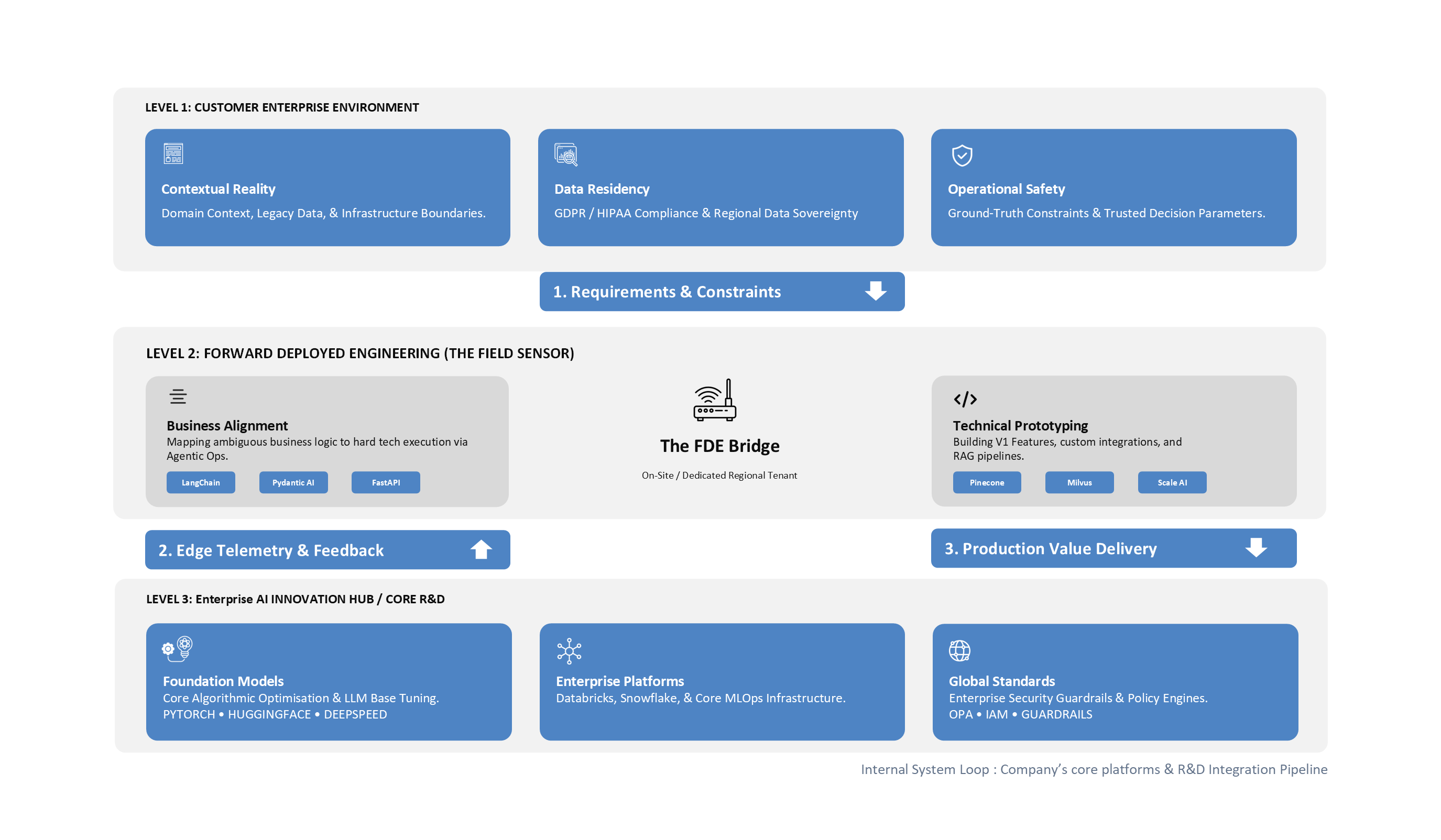
FDE Structural Hierarchy & Technical Flow
FDE Structural Hierarchy & Technical Flow
Responsible AI coupled with FDE is emerging as a critical enabler for safety centric, real-time decision-making systems. FDE explores how AI enabled engineering team embedded directly with operational environment (like manufacturing plants, aerospace systems, automotive supply chain systems, healthcare decision, retail offerings) enables enterprises to make rapid prototyping, contextual intelligence and continuous validation of AI-driven solutions.
By integrating FDE responsibly, organisations are transforming from experimental AI adoption to trusted, scalable and safety-first deployment in enterprise applications suites.
Benefits
Expected outcomes through FDE
- Faster movement from AI proof of concept to controlled production deployment, shortening time to measurable value.
- Reduced false rejects, escaped defects, detection-to-action time, and rework through contextual quality workflows.
- Reduced unplanned downtime and faster maintenance response through connected plant data and decision workflows.
- Improved first-pass yield, throughput, production continuity, and operator productivity.
- Reduced integration risk across plant, enterprise, and cloud systems, with lower total cost of ownership through less rework and fewer deployment failures.
- Improved adoption through embedded collaboration with operators, users, and domain experts.
- Stronger governance through responsible AI, security, safety, compliance-by-design, and human oversight.
- Continuous product feedback from real operating environments and faster replication of proven patterns across plants.
How FDE differs from conventional engineering roles (see table below):
Dimension | Software Development Engineer | AI Engineer | Solution Architect | FDE in Manufacturing |
Primary focus | Software functionality and release quality | Model, pipeline, and AI application performance | Architecture coherence, integration principles, and non-functional requirements | End-to-end operational outcome in a live plant |
Work environment | Product or application environment | Data, model, or platform environment | Defines target architecture, standards, interfaces, and design guardrails | Plant-floor, OT, enterprise, and user workflows |
Stakeholders | Product and IT teams | Data science and ML teams | Enterprise or system-wide solution | Operators, quality, maintenance, engineering, OT, IT, safety, and business |
Success measure | Functionality, reliability, and delivery | Accuracy, latency, robustness, and model performance | Architecture assurance and design governance | Adoption, uptime, quality, throughput, safety, and business value |
Delivery approach | Requirements-led | Experiment- and model-led | Architectural integrity, scalability, security, and maintainability | Embedded, iterative, site-aware, and outcome-led |
FDE is not a repackaged solution architect and does not replace that role. The solution architect defines the target architecture, integration principles, and non-functional guardrails. The FDE works within those guardrails to make a bounded solution function in the customer’s specific operating environment and supplies field evidence that may require architectural refinement.
How do FDEs operationalise AI for quality control in automotive manufacturing?
Forward Deployed Engineering bridges the gap between raw cloud intelligence and the physical factory floor by embedding expert agents directly into operational environments. By fusing GenAI, enterprise data pipelines, hybrid cloud infrastructure, and operational SaaS platforms, FDE model delivers immediate, production-grade business value.
The most relevant manufacturing use cases are those where AI must operate close to live production systems, regulated engineering data, and human decision workflows. The following use cases represent current implementation work in the quality control of automotive domain. Each case connects physical assets with AI-led sensing, decision support, workflow integration, and human oversight, making the theme of ‘intelligent physical systems’ practical and execution-oriented. This section will elaborate on some of the use cases.
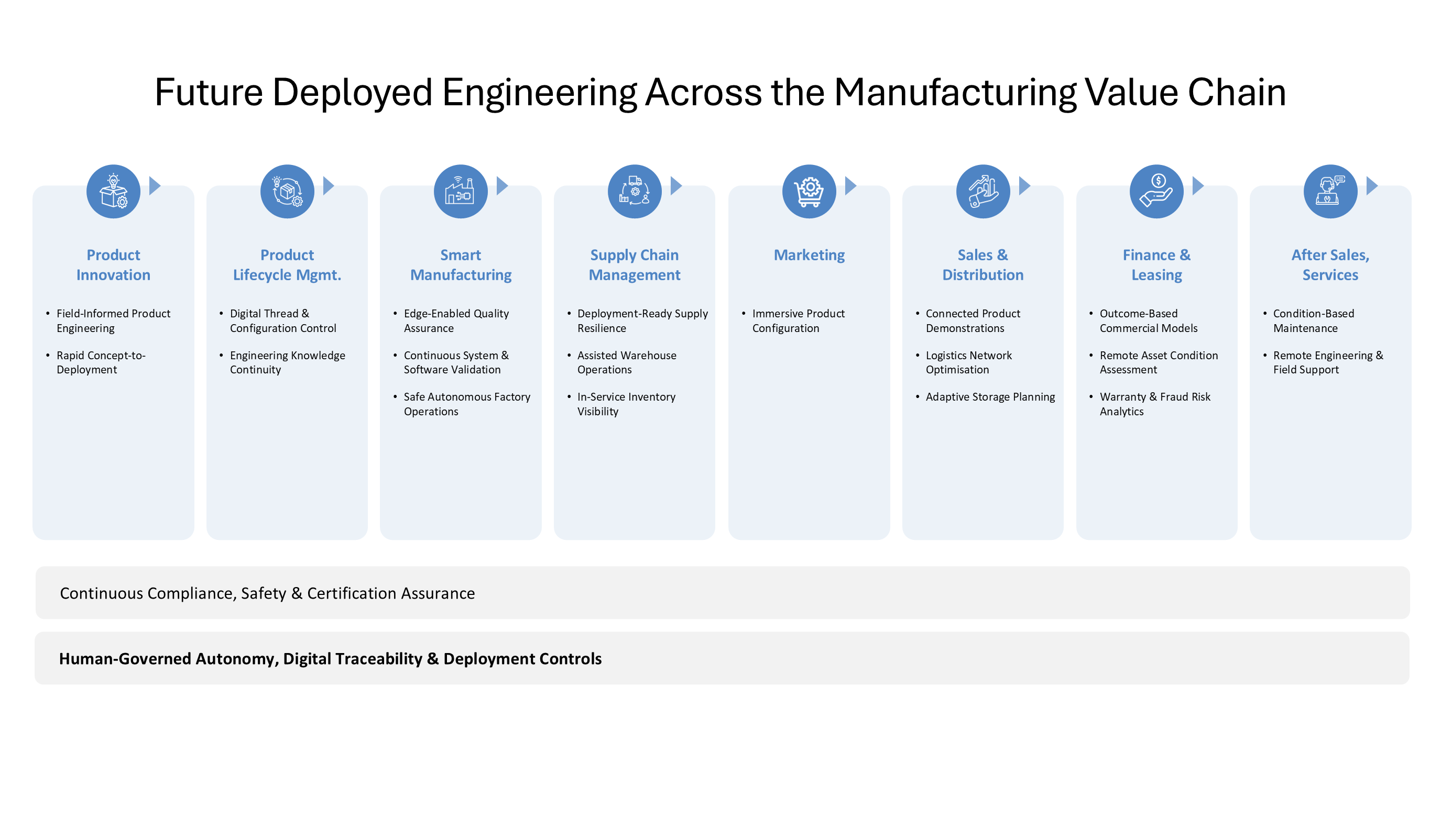
Future Deployed Engineering Across Manufacturing
Future Deployed Engineering Across Manufacturing
Intelligent seat and dashboard quality inspection - Automotive car seat wrinkles and instrument panel/dashboard image capture: This implementation improves image capture quality for seat wrinkle detection and dashboard inspection by adjusting camera placement, lighting, angle, and focus, so that the downstream vision model receives clearer and more consistent images.
FDE teams work close to the inspection station to calibrate physical capture conditions, define acceptable image quality thresholds, and connect the output with defect classification and operator review workflows. In the seat manufacturing plants, quality supervision and wrinkle detection are primarily dependent on the manual effort and the following are the key challenges:
- The vast majority of car seat quality control failures are due to surface imperfections such as wrinkles.
- Returns from OEMS causing millions/annum, as addressing wrinkles post-delivery is costly.
- Impact on revenue and brand reputation.
- No method available to quantify defects for future analysis and improvement.
- Difficulty for QA team in identifying wrinkles.
How would that be different from what’s done today?
- Digitise defect detection and capture data with autonomous decision making using FDE.
- Capture image of seats at the very end with camera being adjusted as per the requirement being monitored by AI.
- Quantification of defects for future quality improvement.
- Detect and categorise wrinkles.
Intelligent shop-floor quality inspection - Conveyor belt quality check with robotic handling: This case applies FDE to robotic machinery used for material handling and quality checks on conveyor lines. The implementation connects camera feeds, conveyor triggers, robotic actions, defect detection logic, and line-level decision rules so that products can be inspected, accepted, rejected, or escalated with minimal production disruption.
How would that be different from what’s done today?
With traditional AI delivery, IT services-based organisations have most of the teams offshore and nearshore. FDE is about being closer to the action, with experts who can do most of the AI work. In this case, the cost per resource may increase for intelligent shop-floor quality inspection. However, we should note that the high-cost delivery resources will produce a lower overall cost of AI ownership and a faster value realisation.
AI governance with human-in-the-loop controls for responsible AI - This implementation operationalises an AI governance programme through FDE by translating policy intent into practical controls, review checkpoints, audit trails, escalation rules, and human validation points. Its objective is to ensure that AI-enabled manufacturing decisions remain explainable, monitored, and aligned with responsible AI expectations before broader scale-up.
NHI for AI – Managing and securing non-human identities (NHIs) is a key part of AI governance. These include API keys, service accounts, OAuth tokens and autonomous agents that systems use to access data and carry out tasks without human intervention.
Beyond current automotive quality-control implementations, FDE can extend to other manufacturing scenarios where AI must operate close to live production systems, regulated engineering data, and human decision workflows:
More applications of FDE:
- Predictive maintenance anticipates equipment failures from operational data and initiates maintenance workflows before breakdowns occur.
- Generative engineering accelerates design exploration by generating alternatives for engineers to evaluate against product requirements.
- AI-powered validation generates and tests edge cases to assess how products and systems perform under varied conditions.
- Supply-chain intelligence detects potential disruptions and recommends response actions to support production continuity.
- Safety-aware operations identify unusual equipment or process behavior and flag anomalies for human review.
- Workforce assistants turn manuals and engineering knowledge into guided support for operational tasks and troubleshooting.
- Automated compliance reporting supports product and process validation by compiling evidence against applicable requirements.
- Industrial process optimisation analyses operating data to improve efficiency, resource use and production decisions.
Conclusion
What’s so different about FDEs in manufacturing?
Sustained proximity to the point of deployment and hands-on ownership of the field-level iteration loop distinguishes FDE in manufacturing. Its value is highest where site-specific conditions, physical-process integration, user validation, and rapid feedback determine whether an AI solution can move safely from pilot to production.
Manufacturers should use an FDE-led model selectively: when requirements emerge through observation, AI must interact with live equipment and operators, site-specific integration is a major risk, and rapid feedback to product engineering is essential. Specialist-led teams remain preferable for enterprise platform design, advanced model research, formal safety engineering, cybersecurity certification, regulatory assurance, and large-scale organisational change.
The practical model is an FDE-led multidisciplinary pod, not a single expert expected to master every discipline. Organisations should pair field leadership with specialist depth, define decision rights, maintain reusable code and deployment records, provide overlapping coverage, measure knowledge transfer, and transition ownership to plant or product teams after stabilisation. Applied within these boundaries, FDE can shorten the last mile from AI pilot to trusted plant-floor capability without creating an expensive hero-based dependency.