Industry
Retail

Omnichannel CX and Intelligent Innovation – The Future of Retail
HIGHLIGHTS
- Agentic AI converts AdOps from a dashboard-reading discipline into a governed decision layer that senses, decides and executes across the campaign lifecycle.
- A coordinated cohort of specialised agents creates a smarter decision architecture, with each agent playing a defined role and its authority determined by the quality of the signal.
- Connected orchestration turns fragmented touchpoints into one journey, coordinating messaging, onsite, offsite, in-store and AI-assisted shopping interactions.
- Intelligent pricing and guardrails maximise media value, improving yield while protecting the balance between trade and retail media.
On this page
How can agentic AI move Advertising Operations (AdOps) beyond dashboards?
Retail media is at a tipping point. As networks scale, channels multiply, and shopper interactions become more interconnected, the challenge is no longer managing campaigns. It is orchestrating decisions across the retail media ecosystem.
Yet, most retail media operating models still rely on dashboards. They show what has happened: impressions delivered, budgets paced, and SLAs met. But they do little to answer the more important question: what should happen next?
Competitive advantage is not about having more data but being able to turn the right signals into timely, coordinated action. This is where agentic AI can make a difference. It provides a decision layer (Figure 1), with specialised agents continuously interpreting signals, identifying root causes, prioritising next-best actions and executing approved changes. Together, they connect experiences across digital, social, in-store and emerging AI surfaces while navigating the different data, consent and measurement requirements of each.
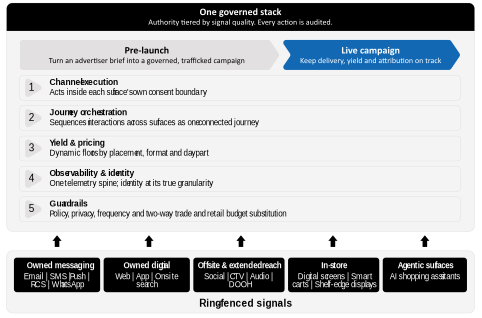
The agentic decision layer for commerce media
Overview
The agentic decision layer for commerce media
How does ring-fencing add to the complexity in commerce media decisions?
The complexity of commerce media becomes clear when you look at where shoppers now make decisions. Commerce media journeys now span five broad groups of surfaces, each ring-fenced by a different consent model and identity key:
Commerce media surface | Examples | Identity, consent and data boundary |
Owned messaging | Email, SMS, Rich Communication Services (RCS), WhatsApp and messaging apps, push notifications, in-app messaging | Explicit opt-in, channel frequency limits and hashed contact identifiers |
Owned digital | Retailer websites and apps, onsite search, sponsored products, category and product-page display, onsite video | Logged-in shopper ID, session context and basket signals |
Offsite and extended reach | Programmatic open web, social, connected TV (CTV) and streaming, digital audio and podcasts, in-game, creators and affiliates, near-store digital out-of-home (DOOH) | Clean-room-matched cohorts rather than raw identifiers; CTV typically resolves at household level |
In-store | Digital screens and endcaps, shelf-edge displays, electronic shelf labels, smart carts, retail audio, self-checkout and kiosks, QR-bridged journeys, digital receipts | Primarily place and time, such as store, aisle and hour, rather than individual shopper identity |
Agentic surfaces | AI shopping assistants and conversational commerce through emerging agent protocols | Retailer control over product recommendations and how products are represented |
Not all signals are equal. Onsite activity may identify a logged-in shopper, CTV may provide household-level signals, while in-store activity may reveal where and when shopper activity occurs. The decision layer must not just recognise these differences but understand the precision of each signal to act with confidence.
The harder problem sits above the diverse surfaces. Trade, shopper marketing and retail media often compete for the same shelf, screen and search placements, making attribution harder, potentially distorting return on ad spend (ROAS), organic sales and margins. Substitution runs both ways: trade dollars inflate retail media performance, while retail media absorbs funds that once bought promotional depth and distribution. Neither direction can be ring-fenced by any single feed. As more agents optimise their own surfaces in parallel, coordinated decision-making becomes critical.
How does an agentic AI decision layer work in AdOps?
Understanding the differences between signals is only half the challenge. The decision layer must also know what it can safely do with each signal. This can be addressed with a decision architecture with five distinct layers, each with its own specialised agents and clearly defined authority:
Dedicated to individual surfaces, these agents interpret channel-native signals, apply consent, frequency, and creative rules, and execute approved sends, bids, or plays within clearly defined boundaries.
Sequence interactions across channels as one connected journey. Using shared shopper and campaign context, they connect experiences across push notifications, onsite placements, CTV and in-store screens. Offsite channels build reach, onsite interactions capture shopper intent and in-store surfaces reinforce that intent.
Optimise how media inventory is valued and monetised. They adjust bid floors based on placement, format, daypart and audience density, balancing demand, fill and yield while identifying under-monetised inventory. This allows high-value in-store and CTV slots to be priced differently from always-on onsite search.
Create a connected view of performance across channels, showing what is happening, where issues are emerging and why, from detecting anomalies and diagnosing issues to monitoring pacing, delivery and Service Level Agreements (SLAs). At the same time, they recognise whether a signal represents a person, a household, a cohort, or simply a place and time, ensuring that decisions reflect what is known.
Make sure decisions remain commercially sound and within policy boundaries. They watch for overexposure across channels, assess whether paid activity adds incremental value, keep pricing aligned with demand, and track shifts between trade and retail media budgets.
Ultimately, autonomy is determined by the signal quality, and not by ambition. When signals are reliable and execution-ready, agents act with confidence within defined boundaries and shift to observation or recommendation where identity is inferred or aggregated.
What business outcomes can agentic AI deliver in AdOps?
Together, this cohort of agents helps retailers maximise the value of every decision across the commerce media network:
Messaging, on-site, off-site, in-store, and agentic interactions work as part of one connected journey, rather than as separate campaign plans.
Dynamic pricing reflects the value of each placement, format and daypart (ad scheduling), helping monetise scarce opportunities while surfacing unsold inventory.
Cross-channel visibility helps teams spot issues sooner and move from manual investigation to agent-recommended, human-approved next-best actions.
Incrementality, halo and new-to-brand metrics replace flattering last-click ROAS, strengthening advertiser confidence and encouraging renewals.
Guardrails identify catch budget substitution in either direction before it distorts performance or erodes value.
How can retailers scale agentic AdOps with confidence?
The commerce media networks that win with agentic AI will not be those with the most agents or the most channels. They will be the ones who know where agents can act independently, where decisions need to be connected, and where guardrails must step in.
As AI assistants play a bigger role in the shopper journey, that discipline becomes critical to scaling with confidence. The next advantage in AdOps will not come from seeing more data, but from knowing which signals to trust and turning them into timely, measurable and governed action.