Industry
Retail

Omnichannel CX and Intelligent Innovation – The Future of Retail
HIGHLIGHTS
- Data-driven insights aiding business decision-making involve interpreting scenarios, patterns, trends, and opportunities. These, however, are fundamentally reliant on the executives driving the business, making them a critical factor in translating complex analytics into effective business strategies and actions.
- Agentic AI solutions can help capture and codify business context to ensure the actions are based on available data and insights.
- Using agentic AI solutions can help minimise the gap between information and action, enabling quicker and more targeted decision-making and better positioning businesses to accelerate growth and respond more effectively to dynamic market conditions.
On this page
On this pageinpage
Overview
Retail businesses operate in a highly competitive, customer-centric environment.
Additionally, businesses derive key performance indicators (KPIs) from business process data using analytical methods. This, in turn, helps organisations gain insights into their performance and align the progress to their strategic objectives and goals. Further, retail business leaders and decision-makers must continuously consume numerous dashboards and reports with KPIs, historical and real-time, to run their business efficiently. Not to mention the wide range of visualisation tools to make the interpretation more seamless and lucid. That makes leveraging data, analytics, and insights not a discretionary but a strategic imperative for growth, efficiency, and innovation.
While data-driven insights help businesses make the right decisions, the ability to interpret underlying causes, scenario patterns, trends, and opportunities remains fundamentally reliant on human experience and knowledge. In other words, human expertise is critical for translating complex analytics into effective business strategies and actions. However, because the KPIs are measured based on historical data, there are times when insights can be misinterpreted or overlooked by decision-makers. Further, the overwhelming load of information can at times hinder the ability to identify the most appropriate strategic or specific actions. This presents an opportunity for organisations to adapt agentic AI capabilities to better their operational performance and drive profitable growth.
The decision loop
Traditionally, leaders have relied heavily on their tacit knowledge—acquired through personal experience within the organisation—to make these critical decisions.
However, systematically analysing different reports and advanced insights, correlating them with business objectives and then deriving concrete necessary actions for business is not always a cakewalk.
The challenge lies in translating insights and KPIs into actionable decisions, which can be complex and overwhelming for decision makers. They struggle to determine effective actions due to complex data perspectives and knowledge gaps, the estimated impact of action (which requires a simulation in mind). In addition, the modern business environment is characterised by high attrition rates, which frequently introduces new decision makers into the organisation. The new hands also require time to imbibe the organisational knowledge that underpins sharp and effective decision-making. Any delays in developing this foundational understanding can impede swift, precise business actions.
Deriving business actions from data requires a systematic approach for interpretation and analysis. It involves several steps, including:
- Defining key objectives or goals the business wants to achieve, set clear targets (e.g., improve margin, reduce stockouts).
- Determining the relevant metrics that align with business objectives.
- Integrate information (e.g. data from point of sale (POS), inventory, and digital channels etc.), Analysing metrics and using visualisation to quickly spot anomalies, drill into trends (e.g. by stock keeping unit (SKU), location, time periods etc.) or areas that require further investigation.
- Assessing and comparing the metrics against standards, historical performance and current goals.
- Prioritising the findings, interpret and execute an action plan based on the cognitive knowledge of the decision makers (immediate operational changes, strategic adjustments), assess impacts and refine actions in loops.
Decisions, decision
Decision-making in retail commonly spans different time horizons.
For example, a daily sales dashboard supports immediate operational actions by providing real-time insights, enabling quick interventions to address sales performance, stock levels, and promotional effectiveness. However, its speed can lead to overreactions or inconsistent decisions if not balanced with a broader context. The monthly sales dashboard, on the other hand, offers a strategic view through consolidated, reconciled data, aiding long-term planning, financial governance, and cross-functional alignment, but may slow response to emerging issues. Together, these dashboards create a dual-horizon framework that can help leaders balance the need for rapid action with strategic oversight, ensuring decisions are both timely and aligned with business objectives. Additionally, sometimes optimisation locally might improve individual site performance but harm wider margins and inventory across the business.
In the retail setting, there are several information-based decision points or actions, such as:
- Resetting sales targets and forecasts.
- Changing category or brand strategies.
- Adjusting pricing and markdown policies.
- Revising store formats or layouts.
- Investing/exiting channels, regions, or categories, etc.
However, the key challenge for a decision maker is to strike a judicious balance between quick action and waiting for more validated insights informed by external factors. And, while dashboards highlight KPIs, there is often an actionability gap—users must rely on their own judgement to turn insights into actions.
The insight overload
Customer insight dashboards, in retail, are designed to analyse buyer behaviour, demographics, purchasing patterns (Recency, Frequency, Monetary value analysis etc.), customer lifetime value (CLTV), satisfaction scores Net Promoter Score, and retention rates etc.
They also cater to multiple departments, including marketing, sales, customer/customer experience support, product development, and CoXs, each leveraging the dashboard for specific insights such as campaign planning, customer segmentation, tracking KPIs. Decision makers turn these insights into strategic actions such as marketing personalisation, optimising loyalty programmes, reducing churn, refining product development and pricing, mapping customer journeys, and forecasting inventory demand. However, decision-making capabilities face challenges from issues such as a lack of explanatory insights, information overload and clutter, and a shortage of contextual knowledge. In addition, reliance on ineffective metrics can make it hard to spot the most important trends, leading to decision paralysis. These challenges can hinder the realisation of actionable business strategies from customer insight.
In fact, all the core retail reports/dashboards (retail sales, inventory management, customer insight, store performance, etc.) or functional and strategic report/dashboards (supply chain and logistics, marketing performance, financial dashboard, operational efficiency, etc.) can create the same dilemmas for the decision makers in correctly interpreting information and subsequently planning the right business actions.
The introduction of an agentic AI solution offers a promising approach to overcoming these challenges. By capturing and codifying business contextual knowledge, such solutions empower any business user to evaluate various possible courses of action based on available data and insights This approach minimises the gap between information and action, enabling quicker and more targeted decision-making. As a result, businesses are better positioned to accelerate growth and respond more effectively to dynamic market conditions.
Multi-agent AI solution
In retail, transforming raw data into actionable insights is a multi-step process: from data to information, then to knowledge, and finally to practical wisdom.
Applying both knowledge and wisdom aids effective business decisions. Knowledge, which comes from information, may be useful in certain situations but isn't always reliable across different scenarios or contexts. Carefully evaluating information with a knowledge repository organised contextually can yield practical business wisdom. This is obviously time-intensive, sometimes suboptimal, and dependent on individual expertise.
A multi-agent AI solution can help address these challenges by ensuring retail leaders can access contextual knowledge and reinforced learning. The solution aims to advise retail business leadership and recommends contextual actions based on the insights derived from the data, dashboards, and reports. This approach can help integrate business goals and strategy with key information such as sales, inventory, customer preferences, and supply chain metrics. It analyses retail KPIs and simulates scenarios across functions like merchandising, marketing, customer service, and store operations, etc. With real-time, transparent recommendations, it can enable businesses to make informed decisions that boost sales, improve customer satisfaction, optimise inventory, and support organisational objectives.
Architecture for the muti-agent AI, including its core components and functionality:
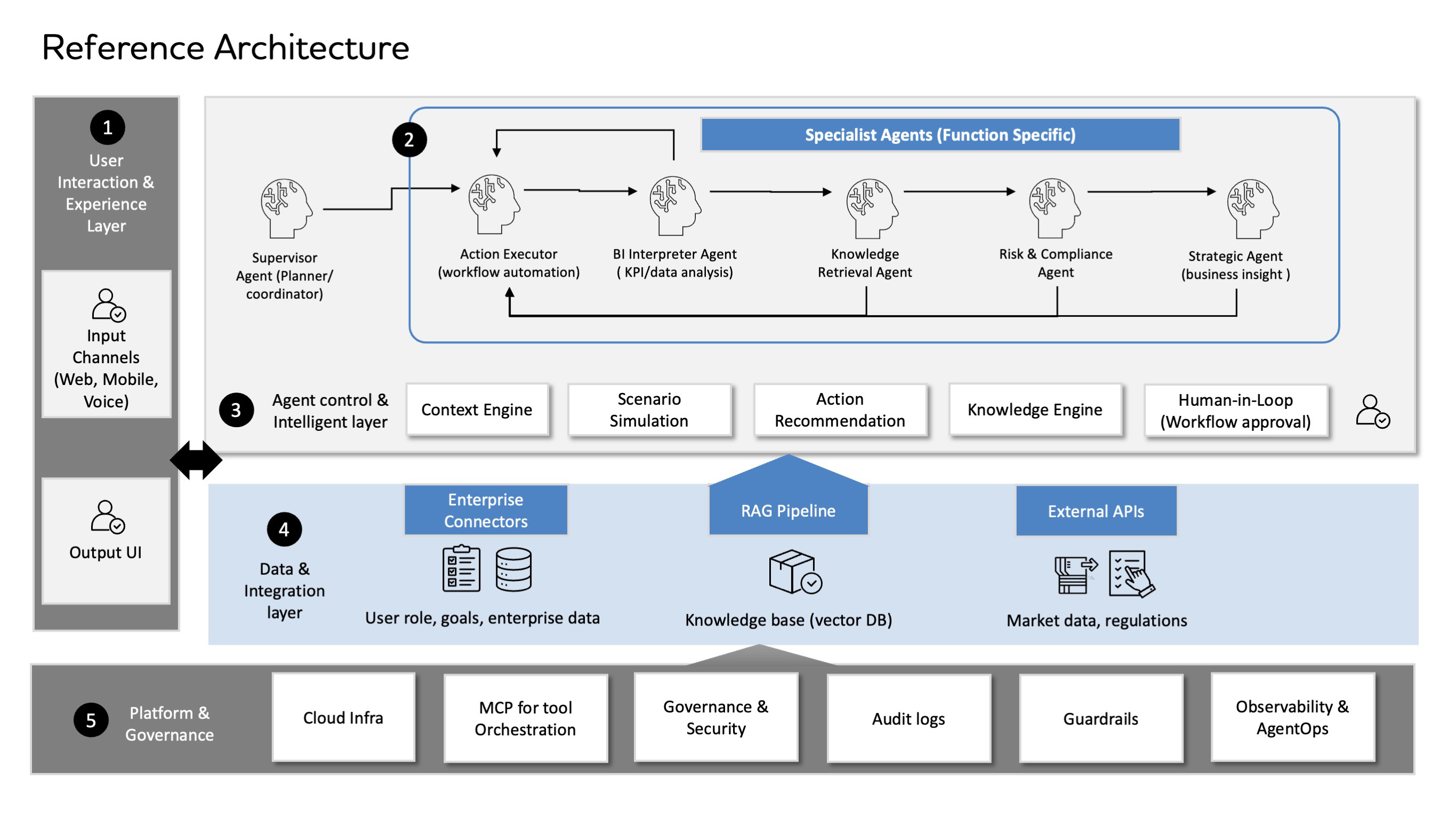
Figure 1
Reference architecture for retail multi-agent AI solution to drive action
Figure 1
AI for decision support
We begin with leveraging Large Language Models (LLMs) of generative AI, with Natural Language Processing (NLP) and generative Business Intelligence (BI), which utilise semantic context to interpret results and deliver reports to business users.
Based on multi-agent AI, this will not only help provide comprehensive reports but also identify potential recommended actions based on organisational knowledge, with transparency into the decision path. In addition, it will help protect sensitive information using guardrails, analyse industry-specific contexts to establish action priorities, and incorporate reinforcement learning to enhance our collective knowledge capital.
Here’s a quick look at the trappings of the key components and the results:
Component |
Description / Functionality |
1. User Interaction / Conversational Interface |
|
2 .Agent Control & Orchestration |
|
3. Intelligent Engines |
|
4. Data & Integration |
|
5. Platform & Governance |
|
Table 1: Components and functionalities of the reference architecture
In summary, a multi-agent AI solution can empower retailers to turn complex reports, dashboards and data visualisations into clear, actionable recommendations based on past decisions, current business strategy, and organisational goals. This, in turn, will ensure businesses have more time for implementation, with greater focus and lower risk.
Per the findings of the TCS Retail Outlook, the path to profitable growth runs through intelligent operations, and while chatbots dominate current AI initiatives, the real value lies in operational transformation for sustainable competitive advantage.
By leveraging this solution, integrated with regular and real-time insights, retailers can stay ahead of market trends and enable faster, smarter decisions. Now is the time to embrace AI-driven decision support and unlock new levels of growth and efficiency to lead the business into the future of retail.