Solution
Cloud

Enabling Enterprise Agility & Resilience with a Robust Cloud Strategy
Highlights
- Token-based pricing, vendor-specific pricing models, and unpredictable usage are pushing AI costs beyond enterprise control.
- AI FinOps must begin with use case conceptualisation, weighing total cost of ownership against business outcomes.
- A closed-loop observe, analyse, optimise, and govern approach ties every unit of AI spend to business value.
In this article
AI cost discipline
AI at scale needs cost discipline at scale
Enterprises are scaling AI faster than they can see, explain, or control what it costs. Generating measurable business outcomes while keeping AI and cloud spend in check is now one of the most pressing challenges on the path to becoming AI-first. This paper presents a holistic approach to implementing AI FinOps for enterprise-scale AI adoption. It covers FinOps considerations for buildingAI use cases from conceptualisation and design, along with a closed-loop approach to observe, analyse, optimise, and govern AI workloads during build and operate. The proposed approach helps enterprises map AI spending to business outcomes, strengthen financial accountability, and significantly optimise AI costs.
Role of governance in scaled AI adoption
Enterprises are accelerating their transformation into AI-first enterprises, which requires modernisation across the technology stack, from Infrastructure to Intelligence. Figure 1 outlines TCS’ view of what an AI-first enterprise stack should be.
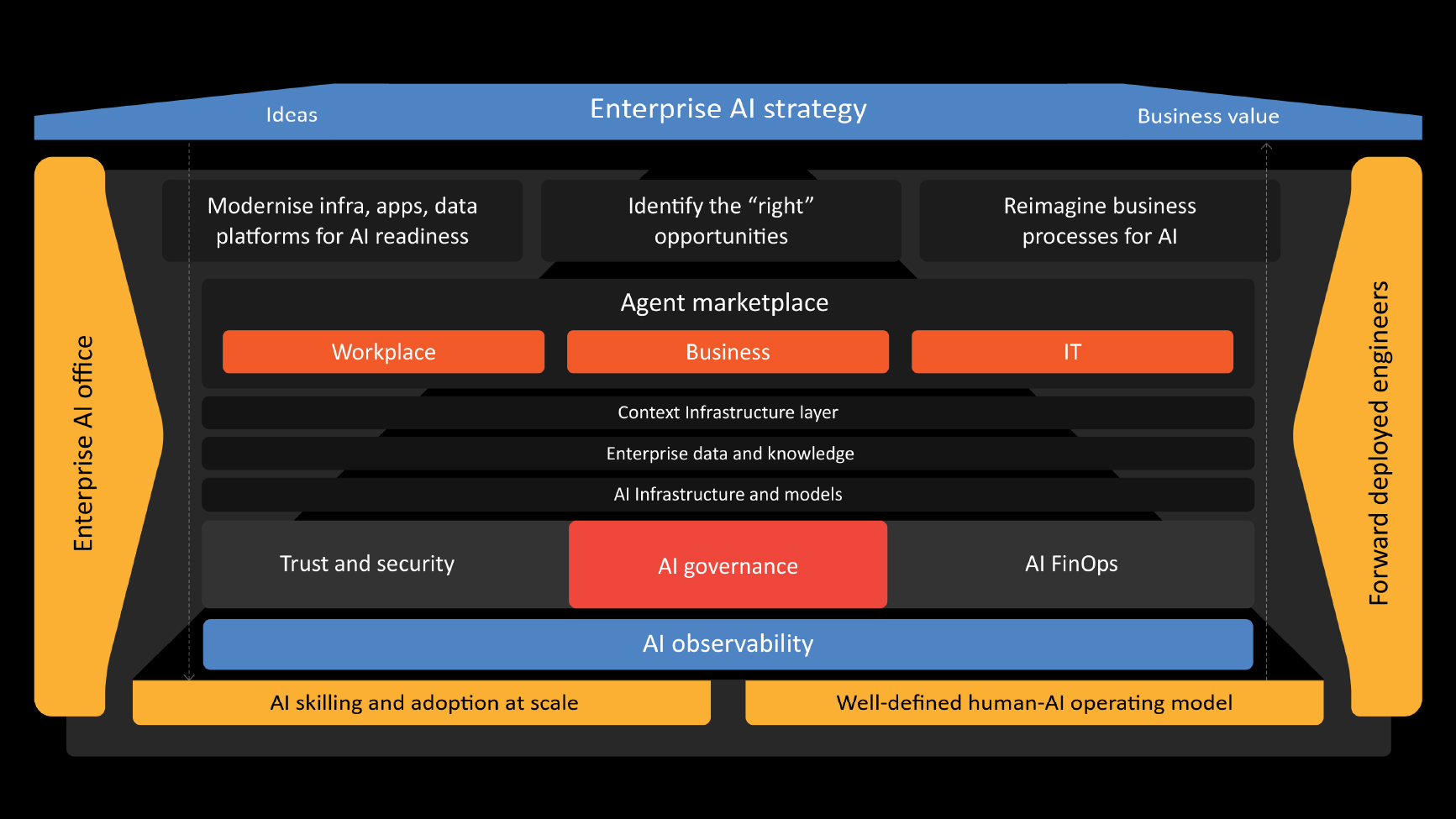
Figure 1
An AI-first enterprise stack, with governance at the core
Figure 1
The core infrastructure (cloud and hybrid), data platforms, and application layers are upgraded to support AI adoption at scale. Alongside, a new context intelligence layer and an agent marketplace are established to operationalise AI efficiently. AI governance plays a key role in ensuring secure, responsible, and trustworthy AI adoption while maintaining alignment with business goals.
This governance spans three focus areas that work together. AI observability provides end-to-end visibility into how AI workloads are used and how they perform, including their quality, health, and behaviour. Trust and security set the guardrails, covering AI model and agent usage policies, data privacy, identity and access controls, and compliance. AI FinOps brings financial discipline to AI through budgeting and forecasting, token usage and cost visibility, optimisation, and accountability. While all three are essential, this paper focuses on AI FinOps, the discipline that connects AI spend to business value.
Why AI FinOps now
AI FinOps is the practice of applying FinOps frameworks, principles, and processes to AI workloads, including AI agents, copilots, and hosted generative AI models. AI workloads introduce new challenges, including the stochastic nature of AI models and agents, rapidly evolving capabilities, multi-vendor pricing complexities, unpredictable consumption patterns, and high inference costs. In addition, the shift from subscription-based pricing to consumption-based token pricing has made cost predictability a growing challenge for enterprises adopting AI at scale.
A robust AI FinOps framework, combined with a return on investment (ROI) measurement model and proven best practices, helps enterprises turn AI spend into measurable business outcomes. To maximise value and optimise costs, AI FinOps must be embedded across the entire AI lifecycle, not added after deployment.
AI lifecycle FinOps
AI FinOps imperatives throughout the AI lifecycle
A common reason for AI project failures is the lack of visibility into the total cost of ownership during the use case discovery and qualification stages. Too often, build and runtime costs come to light only as solutions move from pilot to production, when changing course is far more expensive. Figure 2 shows different AI FinOps considerations across the AI lifecycle.
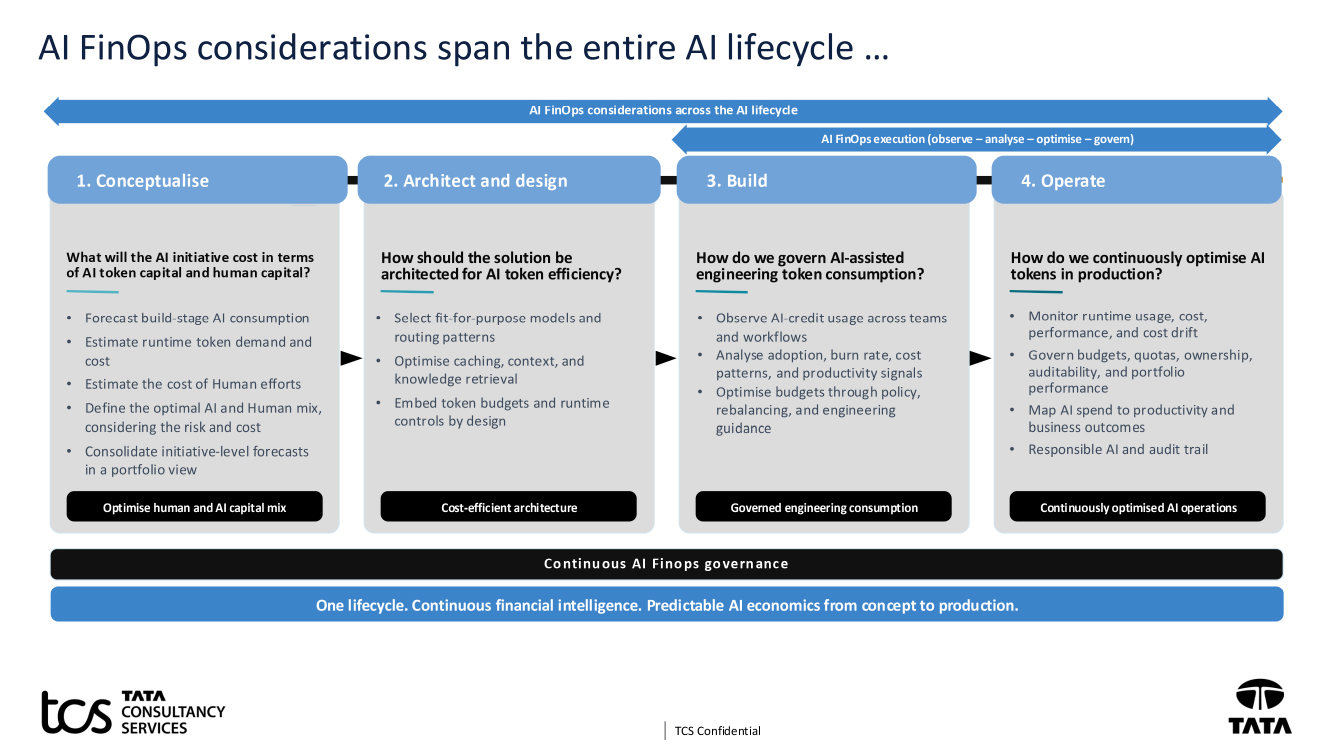
Figure 2
AI FinOps considerations across the AI lifecycle
Figure 2
Across conceptualisation, design, build and operate, the following guidelines help estimate development and runtime costs and embed cost optimisation by design.
Conceptualisation: AI FinOps considerations begin during use case conceptualisation. Estimate the optimal mix of token capital and human capital required to build and run AI workloads based on factors such as token cost, human effort, business benefit, and the risk associated with AI use. The token cost should be estimated across the development stages and at runtime based on:
- Use case type (conversational, content generation, reasoning, workflow automation, multi-agent, autonomous agents)
- User interactions, workflows, and transaction volumes
- Model type, context length, and number of input and output tokens
- Retrieval volumes
- Agent and tool interactions
- Use of AI coding tools
Together, token capital and human capital make up the total cost of ownership. Weighed against the expected business benefits and associated risks, this becomes the basis for deciding whether a use case should move forward.
The business outcomes and productivity improvements expected from the AI use case should be identified and agreed upon with key stakeholders during the conceptualisation stage. For example, for an AI solution designed to assist with legal contract reviews, expected business outcomes may include reduced contract turnaround time and improved compliance adherence. Relevant productivity metrics may include the number of contracts reviewed per week and reduction in legal review effort. Defining these metrics upfront enables organisations to correlate AI spending with measurable business outcomes and ROI.
Design: The principle of “cost by design” is increasingly important for AI workloads. The complexity and nature of work, usage patterns, data sources, compliance requirements, and non-functional requirements are key inputs to the design of AI workloads. Based on these inputs, development teams should evaluate the following design considerations to optimise cost and performance:
- Fit-for-purpose model selection (frontier, specialised, fine-tuned, and smaller models)
- Model routing (switching) versus model cascading
- Prompt and context optimisation
- Retrieval architecture and optimisation strategies
- Semantic cache to avoid duplicate requests
- Agent interactions and tool call optimisation
- Private, public, or hybrid cloud deployment models
Selecting the right AI models, architectures, and design patterns can not only significantly reduce AI costs but also improve the overall performance of the solution.
Build and operate: TCS proposes a structured, closed-loop AI FinOps execution approach for the build and operate stages. As shown in Figure 3, we believe a robust AI FinOps approach rests on four continuous activities: observe (visibility into AI usage and costs), analyse (consumption patterns, inefficiencies, waste, and business value), optimise (models, architectures, and resource allocation), and govern (budgets, policies, guardrails, and controls that ensure accountability).
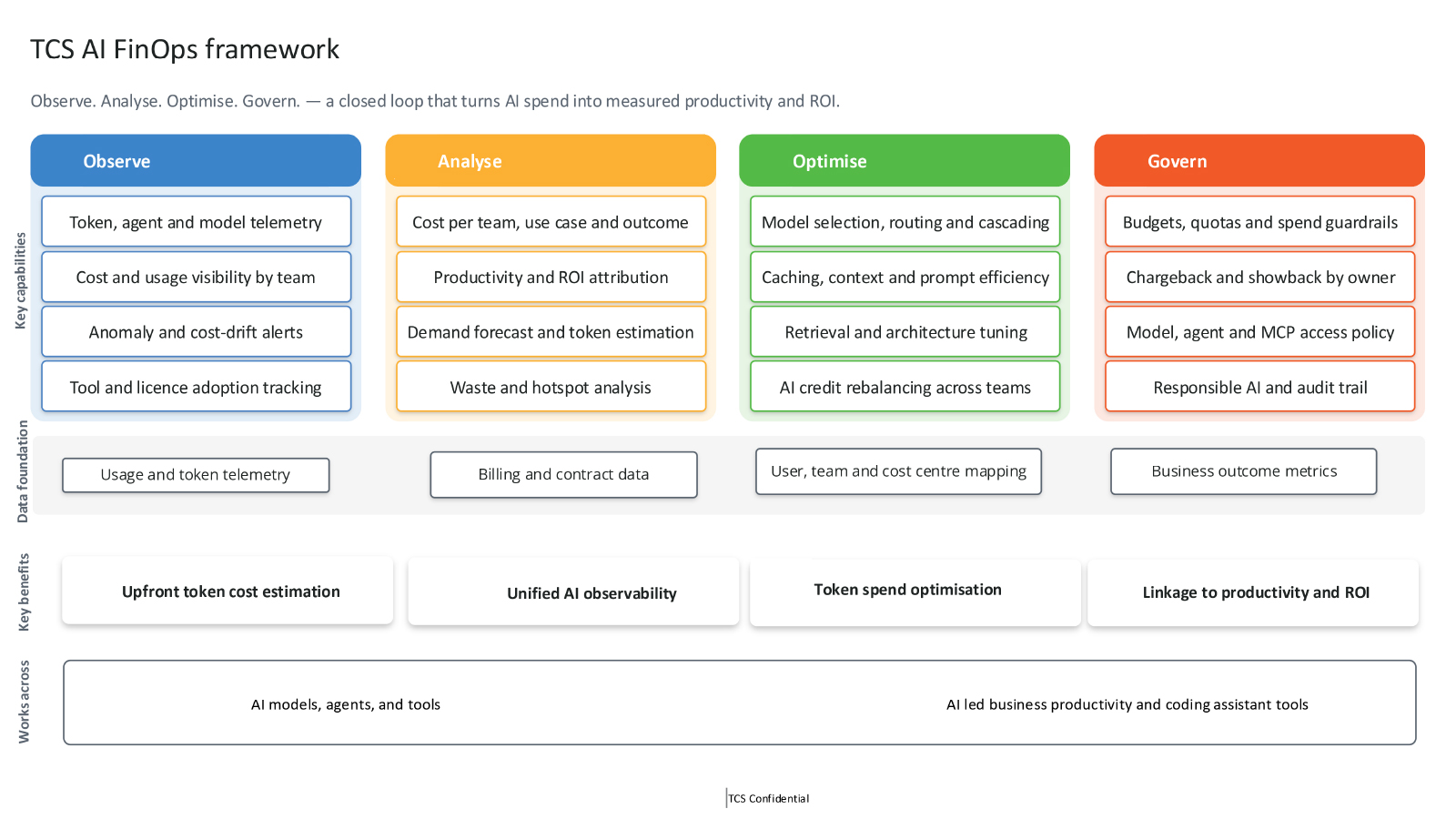
Figure 3
A closed-loop approach to AI FinOps implementation
Figure 3
The loop runs on a shared data foundation. Organisational hierarchy (teams, users, and roles), billing and contract details, AI usage and token telemetry, and business outcome metrics together make it possible to trace AI spend to who used it, what it cost, and what value it created. Without this foundation, none of the four phases can work reliably.
Four phases, one continuous loop
The observe phase is about understanding what is happening. It involves comprehensive tracking of AI usage and costs, including:
- Tokens consumed by individuals, teams, and portfolios
- Cost attribution and identification of top spenders
- Licence tracking and identification of underutilised or unused licences
- Monitoring model, agent, and tool usage patterns
- Detecting anomalies, cost drift, and unusual consumption trends
- Cost of each AI use case, mapped to productivity and business outcome data
These insights form the foundation for the analyse and optimise phases.
The analyse phase focuses on understanding why it is happening and identifying opportunities to improve efficiency and business value.
- Root-cause analysis of cost anomalies and spend drift
- Demand forecasting and token consumption estimation for effective budget planning
- Hotspot and waste analysis to identify major cost drivers and inefficient usage patterns
- Unit economics and ROI analysis to measure the business value generated from AI investments
Together, these insights drive actions to control AI spend, optimise resource allocation, and realign budgets based on changing usage patterns, adoption trends, and business priorities.
The optimise phase focuses on identifying and implementing cost optimisation recommendations based on insights from the analyse phase as well as proven AI FinOps best practices. Key AI cost optimisation techniques include:
- Model selection, routing, and cascading – Identify the most appropriate model strategy for each use case. In some cases, a smaller model delivers sufficient quality at a lower cost; in others, requests should be routed to different models based on task complexity.
- Caching, context, and prompt efficiency – Ensure prompts are clear, concise, and give models sufficient context. Well-structured prompts avoid unnecessary round trips and keep the data sent to the model lean. Caching can be applied to repetitive tasks.
- Retrieval and architecture tuning – Data storage, retrieval patterns, and retrieval efficiency can have a significant impact on AI costs. Multiple retrieval patterns exist today, including retrieval-augmented generation (RAG), graph RAG, and agentic RAG. Selecting the appropriate strategy can improve response quality while reducing token consumption.
- AI credit rebalancing – Redistribute licences and available AI credits from underutilised teams to high-value use cases based on productivity and ROI analysis.
Continuous optimisation, combined with strong governance, is essential for achieving sustainable and cost-efficient AI adoption at scale.
The governance phase focuses on ensuring that AI adoption remains aligned with business objectives while operating within established guardrails.
- Define model, agent, and tool usage policies aligned with enterprise security, risk, and compliance requirements.
- Establish budgets, allocation mechanisms, and spend guardrails to ensure efficient cost control.
- Monitor and audit AI usage to ensure accountability at both team and individual levels.
Together, continuous observability, analysis, optimisation, and governance give enterprises ongoing visibility into token consumption, keep AI spend optimised, and establish a clear link between AI investment, productivity improvement, and business outcomes.
From cost to value
AI governance and AI FinOps are critical enablers of scaled AI adoption. As AI moves from pilots to enterprise-wide execution, cost can no longer be an afterthought.
Enterprises that get this right do three things differently. They estimate the total cost of ownership, across token capital and human capital, before a use case is approved, and agree upfront on the business outcomes it must deliver. They treat “cost by design” as a design principle, choosing models, retrieval patterns, and deployment options with both cost and performance in mind. And they run AI FinOps as a continuous loop of observe, analyse, optimise, and govern, so every token can be traced to a team, a use case, and a business result.
Those that treat AI FinOps as a core operating discipline, rather than a cost-control exercise, will be best placed to scale AI with confidence.