Solution
Cloud

Enabling Enterprise Agility & Resilience with a Robust Cloud Strategy
Highlights
- Healthcare payers are shifting toward care-first, consumer-centric models to address rising costs, regulatory pressures, and demand for personalised digital experiences.
- They are placing greater emphasis on service innovation driven by artificial intelligence (AI)-enabled care orchestration, autonomous agents, and composable platforms, all aimed at improving outcomes and maximising cost efficiency.
- AI-driven hybrid multi-cloud architectures can unify experience, services, data, AI lifecycle management, and zero-trust security to support resilient, high-performance business operations.
- An AI-native hybrid multi-cloud strategy can deliver measurable value through cost savings, greater automation, faster innovation, stronger resilience, and improved healthcare outcomes—helping payers move toward proactive, intelligent healthcare ecosystems.
In this article
In this articleinpage
Care-first, outcome-driven healthcare
Healthcare payers face a structural inflection point that demands more than technology modernisation.
For decades, payer organisations have been architected around a transactional operating model—built to adjudicate claims, manage risk pools, and control costs. It optimised financial processing, not coordinated, outcome-based care.
Today, that model is under pressure. Medical and administrative costs continue to rise. Regulatory expectations now expand beyond data privacy and security to transparency, explainability, and accountability, especially in artificial intelligence (AI). Meanwhile, digital-first experiences in adjacent industries are resetting consumer expectations. Consumers now expect personalised engagement, real-time response, and seamless care experiences.
These pressures are converging with a deeper shift in healthcare itself—from episodic treatment to continuous, preventive, and outcome-driven care. This requires payers to move beyond reactive processes to proactive engagement across the full member lifecycle.
However, most organisations are trying to meet these new demands with architectures built for a different era—ill-equipped for AI-driven, patient-first care.
AI, often positioned as the catalyst for transformation, is exposing this gap. In fragmented systems, siloed data environments, and rigid workflows, AI may improve individual processes, but enterprise-wide impact remains out of reach.
AI-led innovations
An AI-first approach can help payers move from transactional insurance to care orchestration.
The next phase of healthcare transformation will not be defined by incremental modernisation. It will require a deeper rethinking of how the business is designed, operated, and evolved—moving from transactional insurance to continuous care orchestration.
In a care-first model, value is no longer derived solely from operational efficiency. Instead, it is created through the ability to anticipate needs, intervene early, and deliver personalised, context-aware experiences across the patient journey. Rather than acting primarily as a financial intermediary, the payer becomes an orchestrator of health outcomes—coordinating across providers, partners, and ecosystems in real time. This redefined role demands capabilities traditional architectures were not designed to support: unified member intelligence, dynamic care pathway orchestration, and continuous decision-making that integrates clinical, operational, and financial perspectives.
Delivering on this vision is not possible through incremental upgrades to existing systems. It requires a structural shift in how the enterprise is architected—with AI at the core.
This shift is already taking shape through AI-driven platforms that reconfigure how payer businesses operate. Care orchestration platforms optimise pathways across clinical, operational, and financial parameters. Enterprise AI agents and copilots streamline workflows such as claims adjudication, provider support, underwriting, and fraud detection. Digital twins simulate health risks, cost trajectories, and intervention effectiveness. Composable insurance products support modular, application programming interface (API)-driven offerings tailored dynamically to individual needs, while continuous compliance frameworks embed regulatory validation, explainability, and auditable controls directly into operations. AI-augmented engineering practices further accelerate development through automated code generation, testing, and anomaly detection.
Taken together, these developments signal a broader transition—from traditional system modernisation to intelligent, adaptive ecosystems powered by AI and data-driven insights.
AI-native hybrid multi-cloud architecture
Hybrid multi-cloud becomes strategic when it is architected to turn data, intelligence, and action into measurable outcomes.
Hybrid multi-cloud is now a foundational element of modern enterprise architecture, particularly in regulated industries like healthcare. It provides the scalability, resilience, and flexibility required to support diverse workloads, ecosystem integration, and compliance needs.
However, cloud adoption alone is not a source of competitive advantage. The differentiator lies in how organisations architect on this foundation. AI-native payers leverage hybrid multi-cloud to enable real-time data flow, seamless ecosystem integration, and scalable deployment of AI capabilities across the enterprise. In this context, cloud becomes the operating fabric for intelligence—not just infrastructure at scale.
Leading payers are adopting AI-enabled, hybrid multi-cloud architectures that integrate experience, data, and decisioning into a cohesive whole (see Figure 1). These architectures enable real-time intelligence and seamless interoperability across ecosystems. They embed AI-driven insights directly into core workflows and create a continuous flow of data, intelligence, and actions across the enterprise.
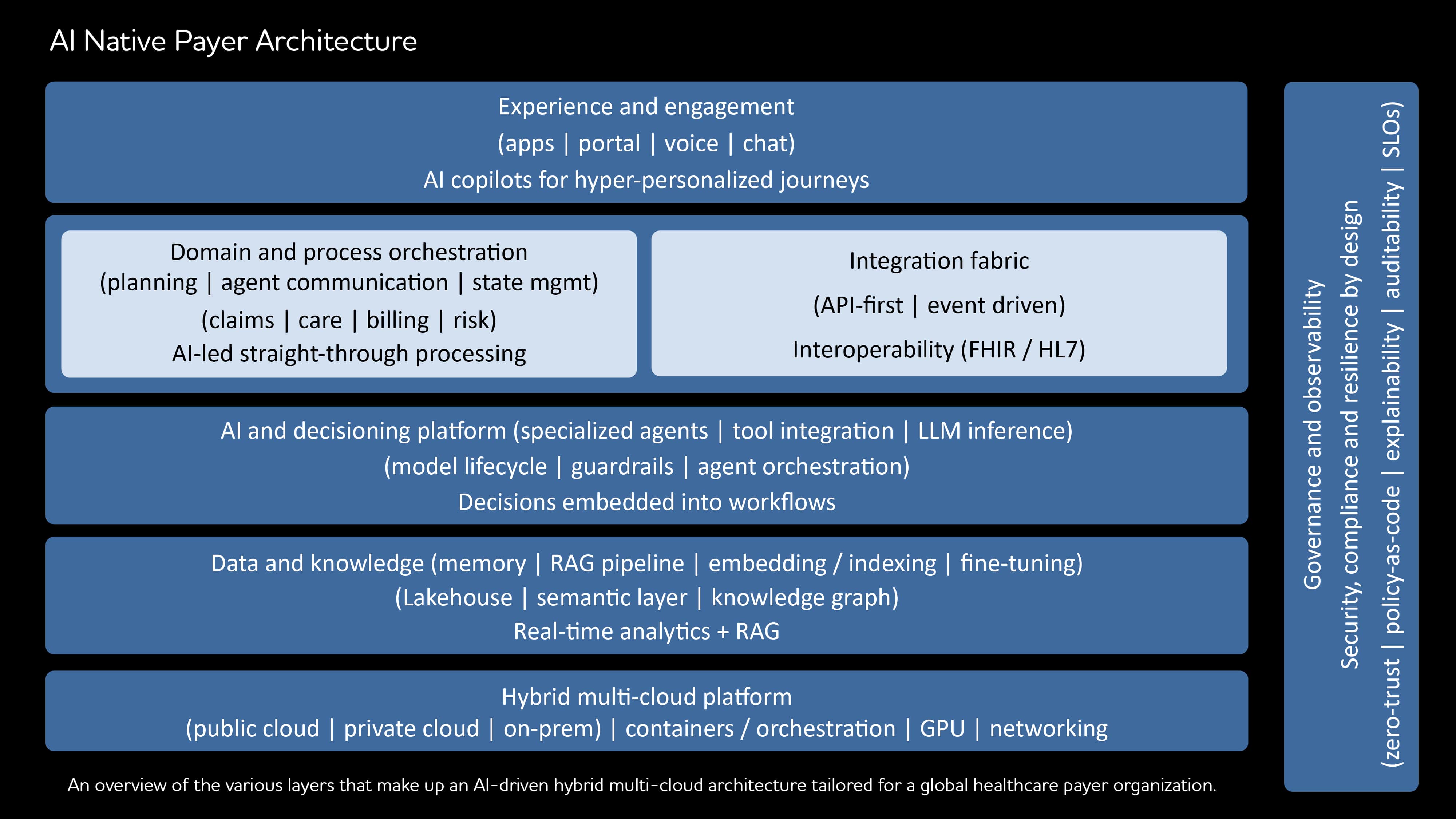
An AI-native architecture for healthcare payers
An AI-native architecture for healthcare payers
Despite significant investments in AI, cloud, and digital technologies, many payer transformation initiatives still stall. The underlying problem is the approach. Organisations tend to focus on connecting existing systems rather than re-architecting for intelligence.
The challenge is no longer whether payers can modernise technology; it is whether they can redesign the enterprise so intelligence can act where care, cost, risk, and experience intersect.
Implementation strategy
A platform-driven, phased implementation strategy can help payers transition to AI-native healthcare enterprises.
The transition is best executed through a phased road map that moves from foundational readiness to core modernisation, embedded intelligence, and scaled outcomes—each step tied to clear business priorities and measurable value.
Phase 1: Foundation
The focus is on establishing the essential groundwork for future developments. Key activities include:
- Establishing a hybrid cloud landing zone and creating a robust security baseline to support scalable and secure operations
- Setting up an API gateway and integration backbone, facilitating effective communication and interoperability between systems
- Developing a comprehensive data governance and interoperability framework to ensure data integrity and accessibility across all platforms
Phase 2: Core modernisation
The second phase is centred on modernising core systems to increase agility and enable advanced functionalities. Key actions are:
- Decomposing legacy systems into domain-specific services, allowing for targeted improvements and enhanced modularity
- Implementing a lakehouse architecture alongside an AI platform, providing sophisticated data management and analytical capabilities
- Deploying initial AI-driven use cases, such as claims automation and fraud detection, to drive operational efficiency and reduce risk
Phase 3: Experience and intelligence
In this phase, the focus shifts to enhancing user experience and integrating intelligent solutions. The main initiatives include:
- Launching an omnichannel experience layer to deliver consistent and seamless interactions across multiple platforms
- Introducing AI copilots and agent workflow solutions, streamlining processes and empowering staff with intelligent assistance
- Enabling real-time decision-making capabilities, facilitating prompt responses and improved outcomes
Phase 4: Optimisation and scale
The final phase emphasises optimising operations and scaling solutions to maximise impact. Activities in this stage are:
- Applying FinOps, site reliability engineering (SRE), and resilience engineering practices to ensure cost efficiency, reliability, and robust performance
- Expanding integrations across the ecosystem, fostering collaboration and synergy among disparate systems and partners
- Supporting ongoing AI model improvement and enhanced governance, reinforcing continuous innovation and regulatory compliance
The guiding principle is: Adopt a broad vision, start small, and scale where outcomes are measurable.
Success enablers
Transformation requires key enablers that lay the foundation for lasting progress.
To become an AI-native, consumer-centric healthcare payer, organisations must anchor their transformation in a care-first vision and measurable outcomes. Clear key performance indicators (KPIs) help track progress, while securing data sharing—built on Fast Healthcare Interoperability Resources (FHIR®) and Health Level 7 (HL7®) standards—creates the foundation for interoperability. Platform engineering practices enable rapid, resilient software delivery, and a structured legacy modernisation road map reduces technical debt while improving agility and allowing payers to adapt swiftly to evolving consumer and business needs.
AI becomes a true enabler when it is governed through enterprise-level oversight, designed to be ethical and reliable, and aligned with organisational goals. A highly skilled AI and cloud workforce, supported by effective change management, is equally critical to successful adoption.
Security must be elevated through a zero-trust approach that continuously verifies every user, device, and interaction, whether inside or outside the network. FinOps brings transparency and accountability to cloud spend, performance, and resource allocation. Policy as code automates regulatory compliance, enabling real-time, consistent adherence to requirements while reducing manual overhead.
Strong partnerships with providers, technology firms, and startups further expand the payer ecosystem, fuel innovation, and unlock new capabilities that keep the healthcare payer agile, consumer-focused, and future-ready.
The path forward
AI-native cloud architecture is becoming the differentiator in care-first transformation.
As the industry evolves, leaders will be those that architect for intelligence rather than integration, operationalise AI across core workflows rather than isolated use cases, and design trust, compliance, and resilience into the architecture from the start. These organisations are not simply modernising; they are redefining how value is created and delivered.
Organisations that make this transition move beyond reactive insurance models to proactive health orchestration. They can predict and address care gaps and ensure there is no escalation, deliver highly personalised care experiences, orchestrate seamlessly across providers and ecosystems, and optimise clinical and financial outcomes in real time. The result is not only operational efficiency, but a step-change in how healthcare value is delivered.
Incremental modernisation will not be enough to address the structural challenges and opportunities ahead. The path forward lies in an AI-native, care-first model that aligns architecture, data, operating models, and governance around continuous intelligence.
Payers that embrace this shift will do more than remain competitive—they will define what patient-first healthcare looks like in an AI-native era.