INDUSTRY
Consumer Packaged Goods and Distribution

Enabling Product Innovation and Omnichannel Experience in CPG
Highlights
- Sustainability is no longer just about compliance-driven reporting. It is rapidly shifting to artificial intelligence (AI)-enabled, real-time enterprise decision-making, enabling organisations to drive measurable environmental, social, and governance (ESG) outcomes.
- AI enables predictive, autonomous, and scalable sustainability interventions across supply chains and operations.
- A combined AI and sustainability approach is essential to build an intelligent autonomous enterprise and unlock long-term business value.
- AI-led sustainability enables enterprises to convert ESG into measurable value driving cost savings, risk reduction, and smarter decisions. It enhances efficiency, ensures compliance, and improves resilience while enabling real-time tracking of outcomes.
On this page
On this pageinpage
Sustainability shift
Sustainability has rapidly transitioned from being just a regulatory obligation to a core strategic priority for enterprises across industries. Increasing regulatory scrutiny, stakeholder expectations, and supply chain transparency requirements are compelling organisations to rethink how sustainability is embedded into their operating models.
However, most sustainability initiatives remain fragmented, reactive, and reporting-centric. Organisations often lack real-time insights, predictive capabilities, and integrated governance frameworks to effectively respond to dynamic environmental and social challenges.
To address this gap, enterprises must shift from static sustainability programmes to dynamic, intelligence-driven models. This transition requires integrating sustainability into decision-making processes at every level powered by advanced digital and artificial intelligence (AI) capabilities.
AI transforms sustainability from a reporting obligation into a continuous, enterprise-wide decision intelligence capability
Enterprise gap
Despite significant investments in sustainability initiatives, many organisations struggle to achieve measurable impact. This gap stems from siloed data systems, lack of standardisation, and limited integration between business processes and sustainability objectives at the organisational level.
Traditional environmental, social, and governance (ESG) approaches are often backward-looking, relying on periodic reporting and manual data aggregation. This limits the ability of enterprises to respond proactively to risks such as supply chain disruptions, regulatory changes, and resource constraints.
Furthermore, the absence of a unified digital backbone prevents organisations from scaling sustainability initiatives across geographies and business units. Addressing these challenges requires reimagining sustainability as a core enterprise capability rather than a standalone function.
AI as an enabler
AI provides the foundation for transforming sustainability into a dynamic and predictive capability. By leveraging advanced analytics, machine learning, and automation, enterprises can move from reactive reporting to proactive, real-time decision-making.
AI enables real-time monitoring of sustainability metrics, predictive risk assessment, and optimisation of resource utilisation. It also facilitates automated compliance tracking, supporting organisations in navigating complex and evolving regulatory landscapes.
Importantly, AI can synthesise large volumes of structured and unstructured data across enterprise ecosystems, enabling holistic insights that drive smarter and faster decisions. This positions AI as a critical enabler in building intelligent, responsive sustainability frameworks.
Adaptive model
The convergence of AI and sustainability enables the concept of Intelligent autonomous enterprise—an organisation capable of continuously sensing, learning, and responding to change (see Figure 1).
In this model, sustainability is embedded into core business processes through an intelligent digital layer that integrates data, insights, and decision-making. AI-powered platforms enable continuous optimisation of operations, ensuring alignment with sustainability goals while maintaining business performance.
This adaptive approach allows enterprises to anticipate risks, respond to disruptions, and uncover new opportunities for innovation. It transforms sustainability from a constraint into a driver of agility and resilience.
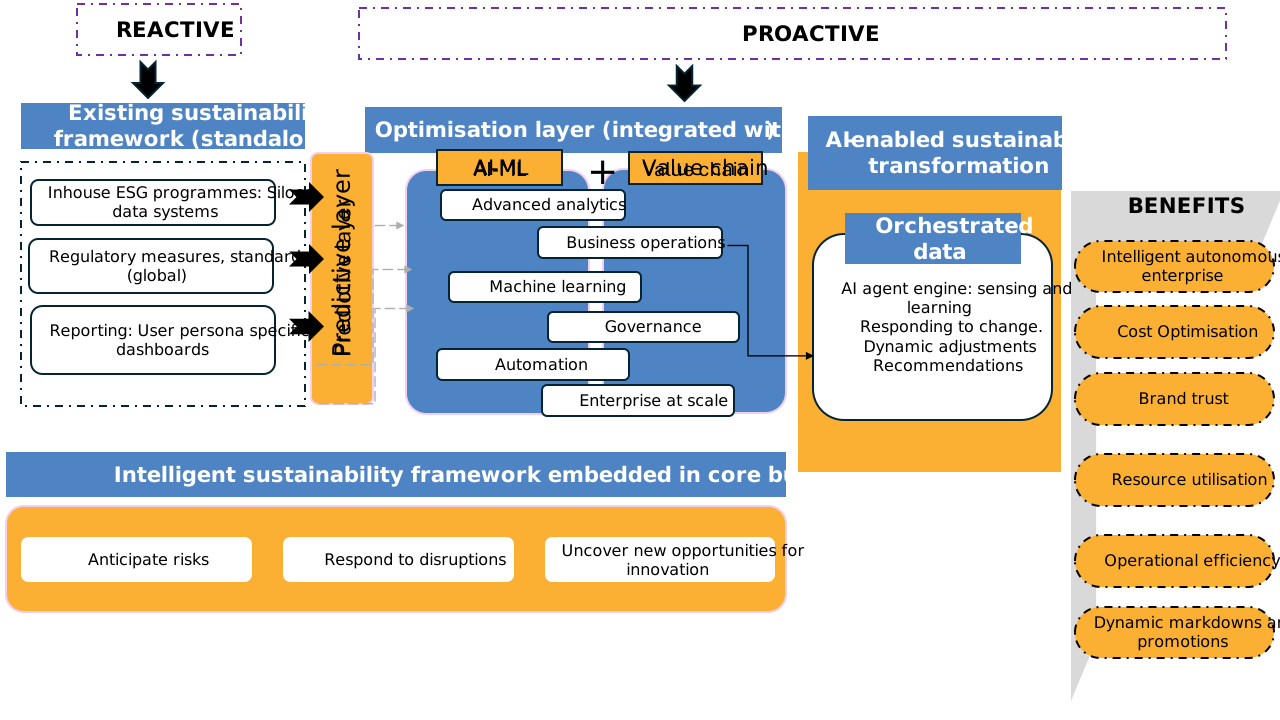
Figure 1
Intelligent sustainability model overview
Figure 1
Industry impact
The impact of AI-driven sustainability transformation extends across industries. In consumer goods, it enables traceability and responsible sourcing across complex supply chains. Furthermore, AI-driven sustainability transformation is reshaping the consumer goods industry by embedding intelligence across the value chain right from sourcing to consumer engagement. It enables real-time visibility into emissions, waste, and resource usage, allowing companies to optimise supply chains, reduce overproduction, and minimise environmental impact. AI-powered demand forecasting and inventory optimisation significantly cuts waste and improves operational efficiency, while advanced analytics drive sustainable product innovation and low-carbon formulations. At the same time, AI enhances transparency and personalisation, helping consumers make informed, sustainability-driven choices. Overall, this shift moves sustainability from a compliance obligation to a strategic value driver, unlocking cost savings, revenue growth, resilience, and stronger brand differentiation in an increasingly sustainability-conscious market.
The cross-industry applicability underscores the need for a unified approach that combines domain expertise with scalable technology capabilities, enabling enterprises to accelerate their sustainability journeys.
Value realisation
AI-enabled sustainability transformation delivers measurable business value across multiple dimensions. These include cost optimisation through efficient resource utilisation, risk mitigation through predictive insights, and revenue growth through sustainable product innovation.
Additionally, it enhances brand reputation, strengthens stakeholder trust, and supports regulatory compliance. By embedding sustainability into the core enterprise fabric, organisations can unlock long-term competitive advantage. When sustainability is integrated across governance, operations, and real-time decision-making, it enables companies to anticipate risks efficiently, optimise resource utilisation, and enhance operational efficiency, subsequently strengthening financial performance. This integration also enhances resilience and future-readiness by addressing regulatory pressures, climate risks, and evolving stakeholder expectations.
To realise this value, enterprises must adopt a structured approach combining strategy, technology, and governance to operationalise AI-driven sustainability at scale.
Ultimately, embedding sustainability into the core business builds brand trust, attracts customers and investors, and drives sustained long-term value, creating a strong competitive edge.