Industry
Manufacturing

Future-Ready Manufacturing: Partnering in your journey to a sustainable manufacturing enterprise
Highlights
- Process intelligence reveals the bottlenecks and compliance gaps that extend technical assistance resolution times and increase vehicle downtime.
- A significant share of technical assistance cases exceed expected resolution times, directly affecting customer satisfaction, workshop capacity and operating costs.
- Agentic AI supports faster first-time resolution by curating relevant knowledge articles, proven fixes and historical resolutions for technical support teams.
On this page
Driving NPS growth
Original equipment manufacturers (OEMs) need strong after-sales services to protect customer satisfaction and Net Promoter Score (NPS). Retail-point technicians must have the tools, skills and knowledge to diagnose and resolve vehicle issues quickly and accurately.
Faster, more accurate issue resolution minimises customer inconvenience and supports stronger long-term relationships. It also lowers costs associated with roadside assistance, courtesy cars and repeat workshop visits, while helping return vehicles to customers sooner.
Slow issue resolution
40% of vehicle issues take longer than expected to resolve, increasing costs and customer dissatisfaction.
For automotive manufacturers, technical assistance (TA) remains a significant business challenge. Retail technicians and support teams are expected to diagnose and resolve vehicle issues quickly; however, service organizations continue to face challenges related to repair quality, capacity constraints, and extended appointment wait times. According to the J.D. Power 2025 U.S. Customer Service Index (CSI) Study, 12% of repairs are not completed correctly on the first visit. Vehicles therefore remain off the road for longer, reducing customer satisfaction and increasing operating costs.
A key cause is retailers’ growing dependence on local and global technical support teams for complex diagnoses. Repeated escalations and the time needed to identify appropriate solutions push cases beyond expected turnaround times. The resulting delays increase vehicle downtime, constrain workshop capacity, create courtesy-car shortages and raise operational costs.
Plugging the gaps
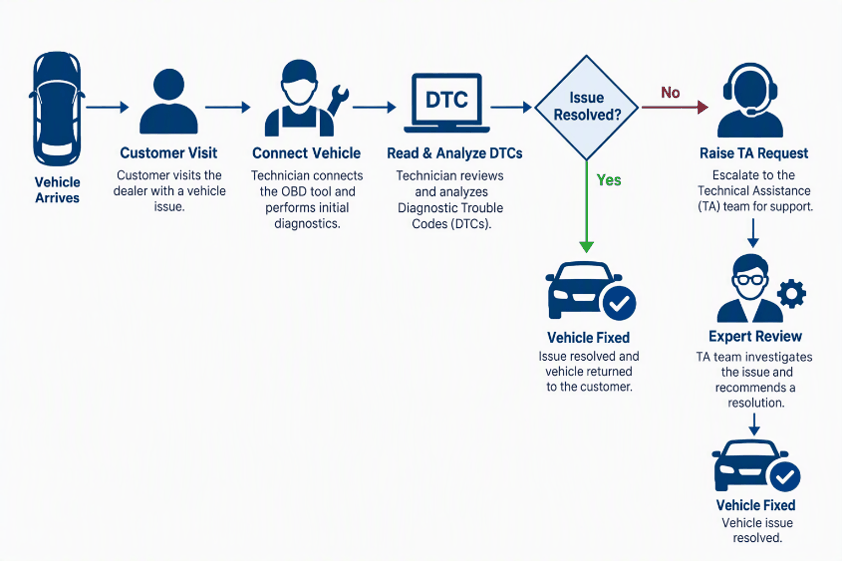
Vehicle Diagnostics & Technical Assistance Roadmap
Vehicle Diagnostics & Technical Assistance Roadmap
Technical assistance data was mined to create process intelligence insights and end-to-end visibility. The analysis distinguished the “happy path” of efficient case resolution from the “unhappy path” of delays and inefficiencies, exposing bottlenecks, throughput issues and process-compliance gaps across upstream and downstream activities.
Targeted KPIs measure results across regions, dealers, vehicle symptoms and process touchpoints. These insights show where and why retailers need support, helping the business detect anomalies, identify high-impact patterns, highlight training gaps and take corrective action. They also reveal why some retailer technicians resolve issues efficiently while others need technical assistance, contributing to delays in returning vehicles to service.
Beyond process intel
Growing technical assistance volumes place significant pressure on local and global technical support teams, limiting their capacity to focus on complex cases and extending vehicle downtime. Greater retailer self-service would reduce avoidable support demand, improve resource utilisation and return vehicles to customers faster.
Knowledge in action
An agentic AI solution works alongside the process intelligence capability to curate relevant knowledge-base articles, proven fixes and historical resolutions for incoming technical assistance requests. Faster knowledge discovery supports quicker retailer responses and higher first-time resolution rates. By automating information retrieval and supporting decisions, the solution reduces workload, accelerates vehicle return times and improves the customer experience.