Industry
Retail

Omnichannel CX and Intelligent Innovation – The Future of Retail
HIGHLIGHTS
- The yard is emerging as the next strategic frontier in autonomous supply chain execution.
- Supply chain decision intelligence is redefining how organisations manage flow, capacity, and operational risk.
- The challenge for supply chain leaders is no longer visibility; it is decision velocity.
- The future of yard management is not about moving assets more efficiently. It is about enabling smarter, faster, and increasingly autonomous decisions, powered by supply chain decision intelligence.
On this page
On this pageinpage
Yard is the new strategic lever
The next era of supply chain excellence will be determined not by how much data organisations collect, but by how quickly and effectively they convert it into action. As supply chain networks become increasingly complex and dynamic, supply chain decision intelligence is emerging as a critical capability for turning operational signals into business outcomes.
Over the last two decades, supply chains have transformed warehouse operations, transportation execution, and planning capabilities through digitisation and automation. Yet, one critical link between transportation excellence and warehouse automation remains largely under-optimised: the yard.
The yard sits at the intersection of transportation and warehouse execution-where delays compound, priorities compete, and operational decisions directly impact supply chain performance. It is the staging ground for inbound materials, outbound shipments, trailers, containers and carrier interactions. Despite its strategic importance, many organisations continue to manage yard operations through manual processes, spreadsheets, radio communications and localised decision-making.
As supply chains face growing pressure to increase responsiveness, strengthen resilience, and improve efficiency, the yard is emerging as a major opportunity for operational transformation.
This paper argues that the next stage of yard management will not be defined by greater visibility, but by the ability to continuously anticipate, decide, and act-creating an intelligent execution environment that orchestrates resources, resolves constraints, and optimises decisions across transportation and warehouse operations.
Yard transformation
The challenge with modern supply chains is no longer access to information but the speed and quality of decision-making. Organisations that excel at supply chain decision intelligence can convert operational awareness into decisive action, creating a measurable advantage in execution.
The yard is emerging as the next strategic frontier for transformation. The first generation of yard management systems (YMS) digitised the yard; the next generation will make it intelligent. As yard management evolves from visibility to decision intelligence and ultimately autonomous execution, success will increasingly depend on decision velocity─ the ability to turn operational data into timely decisions and execute them faster than competitors.
Organisations that embrace this shift can:
- Reduce dwell times and congestion
- Improve throughput and resource utilisation
- Accelerate operational decision-making
- Increase resilience against disruptions
- Create a sustainable competitive advantage
The visibility plateau and decision gap
When supply chain leaders discuss bottlenecks, attention typically focuses on transportation delays or warehouse productivity. However, a significant portion of operational inefficiencies occurs in the transition between these two environments.
Common challenges include excessive dwell times, inefficient asset movements, detention costs, gate congestion, and fragmented operational awareness. These issues create ripple effects across warehouse throughput, transportation schedules, labour utilisation, and customer service performance.
The first generation of YMS solved the problem of operational awareness. Organisations gained the ability to track trailer locations, gate transactions, dock assignments, and asset movements.
However, access to information alone does not guarantee better decisions. Knowing where every trailer is located improves awareness; knowing the best next action creates value. This is where supply chain decision intelligence becomes essential, helping organisations move beyond observation to optimised decision-making.
Many organisations have reached a visibility plateau. They can observe operations in real time but still struggle to determine the optimal course of action. Over the last decade, YMS solutions have dramatically improved visibility across yard operations. Organisations can now see where trailers are located, monitor dock utilisation, and track yard activities in real time.
While operators have access to more information than ever before, they remain responsible for interpreting signals, prioritizing actions, and coordinating execution. As operational complexity grows, decision-making often becomes a bottleneck.
This creates a decision gap─organisations know what is happening in the yard but struggle to determine which action to take next. Closing this gap requires a shift from systems that report information to systems that actively recommend, orchestrate, and ultimately execute decisions.
The rise of the autonomous yard
The next competitive advantage in yard management will not come from greater visibility, but from reducing the time between insight and action. The evolution of yard operations reflects a broader shift toward autonomous supply chain execution, where intelligent systems continuously coordinate activities, optimise resources, and execute decisions across the supply chain ecosystem.
This evolution can be viewed as:
Manual yard-Digital yard-Intelligent yard-Autonomous yard
Operations rely on spreadsheets, radios, and human coordination, resulting in fragmented awareness and reactive decision-making.
The YMS platform introduces real-time situational awareness and process automation, improving control over yard activities.
AI and analytics enable predictive insights, helping operators anticipate disruptions and optimise decisions before issues turn to escalations.
The autonomous yard is not simply an enhancement to YMS technology. It signals a broader shift toward intelligent supply chain execution.
Intelligent systems continuously orchestrate the flow of assets, resources, and decisions, enabling real-time optimisation with minimal human intervention. This marks the transition from traditional yard operations to autonomous yard management (Table 1), where execution becomes increasingly self-optimising and adaptive.
Each stage builds on the previous one: transparency enables awareness, intelligence enables anticipation, and autonomy enables execution at scale.
Dimension |
Traditional yard |
Intelligent yard |
Autonomous yard |
Primary focus |
Asset tracking |
Decision support |
Decision execution |
Operating model |
Reactive |
Predictive |
Self-optimising |
Decision making |
Human-driven |
AI-assisted |
AI-orchestrated |
Operational awareness |
Fragmented |
Real-time |
Continuous and adaptive |
Resource allocation |
Manual coordination |
Dynamic recommendations |
Autonomous optimisation |
Human role |
Operator |
Supervisor |
Strategic exception manager |
Business outcome |
Operational control |
Improved efficiency |
Execution excellence and competitive advantage |
Table 1: The shift toward intelligent supply chain execution
Pivoting from insights to execution
The autonomous yard is not a future-state concept; it is the logical progression in the evolution of supply chain execution. As organisations advance toward autonomous supply chain execution, the yard becomes an intelligent execution layer capable of synchronising transportation, warehouse operations, labour availability, and network priorities in real time.
In the autonomous yard stage, technology evolves from a system of record into a system of action-continuously translating insight into execution and execution into learning.
Forecasts arrivals, warehouse readiness, labour availability, and equipment constraints to proactively optimise dock and yard execution.
Determines the next best action based on shipment urgency, customer commitments, dwell-time risk, and network impact.
Predicts surges in gate traffic, yard bottlenecks, and capacity constraints before service levels are affected.
Continuously recommends optimal movement of trailers, yard spotters, and equipment to maximise utilisation.
Operators interact with complex operational data through natural-language conversations, accelerating insights generation and decision-making.
A single technology does not enable the autonomous yard; rather, it emerges from the convergence of connected data, intelligent automation, and advanced analytics that collectively provide the context, awareness, and decision intelligence required for autonomous decision-making.
- IoT and real-time tracking establish real-time awareness of assets, equipment, and yard activity.
- Computer vision digitises physical operations and reduces reliance on manual monitoring.
- Machine learning predicts congestion, delays, and operational bottlenecks.
- Digital twins simulate operational scenarios before actions are executed.
- Generative AI enables human operators to interact with complex systems using natural language.
Together, these technologies transform the yard from a managed environment into a self-learning execution layer capable of sensing, adapting, and responding to shifting operational conditions in real time. Collectively, these capabilities provide the technological foundation required for autonomous yard management and, ultimately, broader autonomous supply chain execution.
Operational maturity assessment
The autonomous yard is best understood as an operational maturity journey rather than a technology initiative. Each stage of maturity strengthens an organisation's ability to develop supply chain decision intelligence, increase decision velocity, and progress toward autonomous execution.
As organisations progress, the key question evolves from understanding what is happening in the yard to enabling systems that can continuously optimise outcomes (Figure 1).
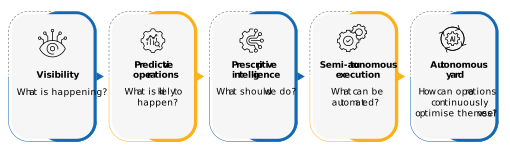
Figure 1
Operational maturity assessment
Figure 1
The objective is not to replace human judgment, but to amplify it and enable people to focus on strategic decisions while intelligent systems handle operational complexity at scale.
The next frontier in yard management
The next challenge in yard management is not visibility; it is decision velocity. Organisations that can convert operational intelligence into action faster than their competitors will define the next generation of supply chain performance.
The future of yard management is not about moving assets more efficiently. It is about enabling smarter, faster, and increasingly autonomous decisions, powered by supply chain decision intelligence.
As supply chains become more dynamic and interconnected, the yard is evolving from a coordination point into an intelligent execution layer that synchronises transportation and warehouse operations in real time.
The autonomous yard represents more than the next generation of yard management. It marks a fundamental shift toward autonomous yard management and serves as a critical stepping stone to autonomous supply chain execution. Organisations that begin this journey today will be best positioned to build the agility, resilience, and execution advantage required for the supply chains of tomorrow.