Industry
Travel and Logistics

Data and AI in Travel Industry for a Memorable Passenger Experience
Highlights
- Discovery in hospitality is collapsing into a single moment of artificial intelligence (AI)-driven recommendations, sharply reducing the number of hotels a traveller evaluates.
- Visibility alone no longer drives demand; inclusion in AI-generated shortlists is now the primary determinant of guest consideration.
- Inconsistent, unstructured, or promotional content reduces AI confidence, leading to exclusion before price or brand is even evaluated.
- Intermediaries outperform brand channels not through marketing, but through superior data standardisation and interpretability.
- Discoverability is no longer a marketing key performance indicator (KPI); it is a revenue quality lever impacting channel mix, acquisition cost, and demand quality.
On this page
On this pageinpage
Introduction
There is a fundamental change in how hotels are found, evaluated, and selected. Hotel discovery has evolved from a brand‑led journey to platform‑led comparison; it is now increasingly being shaped by artificial intelligence (AI)-driven recommendations. Search and map experiences are answering traveller questions before a guest even reaches a hotel website, while zero‑click and AI summary interfaces are reducing engagement with traditional listings. Now, hotels are no longer competing solely for visibility; they are competing for inclusion in a rapidly narrowing set of recommended options. In this environment, the challenge is not just to be seen, but to be considered. When AI summaries appear ahead of organic results, click‑through to even top‑ranked listings can decline sharply.
This structural change raises the stakes for how hotels present, structure, and govern their content across the digital ecosystem. This structural change reshapes how hotels present and govern their content across every digital channel. For hospitality brands, the real challenge is to ascertain when a content management problem becomes a commercial one.
In this environment, visibility is no longer about ranking higher; it is about being selected before the booking decision is even made.
DISCOVERY VS VISIBILITY
Modern travellers move fluidly across Google search, maps, online travel agents (OTAs), review platforms, and brand sites, validating information instantly across sources. When descriptions differ, policies are unclear, or amenities are inconsistently presented, confidence drops long before price becomes a factor.
Consider a guest searching for an extended stay during a temporary relocation. The search rarely begins with a brand name. It begins with intent, such as: “I need a place for two adults and two children near the hospital with a full kitchen, parking for two cars, and spacious rooms.” In this scenario, discoverability determines whether a hotel figures in a traveller’s decision set or is completely excluded from it, regardless of the brand strength.
Hotels that describe what they do well, consistently and unambiguously, are evaluated. Those that rely on generics such as “ideal stay” or “convenient location” are filtered out early.
Discoverability is how easily a hotel can be found and quickly understood as a good fit. For this, the information has to be clear, complete, and credible. Visibility, by contrast, is simply how often and where the hotel shows up (in search results or ads). A hotel can be visible without being discoverable.
Beyond visibility
Search behavior is changing. Travelers are expressing needs in natural language, images, or voice, expecting a direct answer rather than a long list of options. AI systems interpret these queries and synthesize recommendations based on structured attributes, historical performance signals, and confidence thresholds. Hotels are no longer competing to rank higher. They are competing to be recommended. AI systems do not evaluate all available options, they filter aggressively based on confidence, often excluding properties before comparison begins. In AI-mediated discovery, ambiguity doesn’t reduce visibility, it eliminates it.
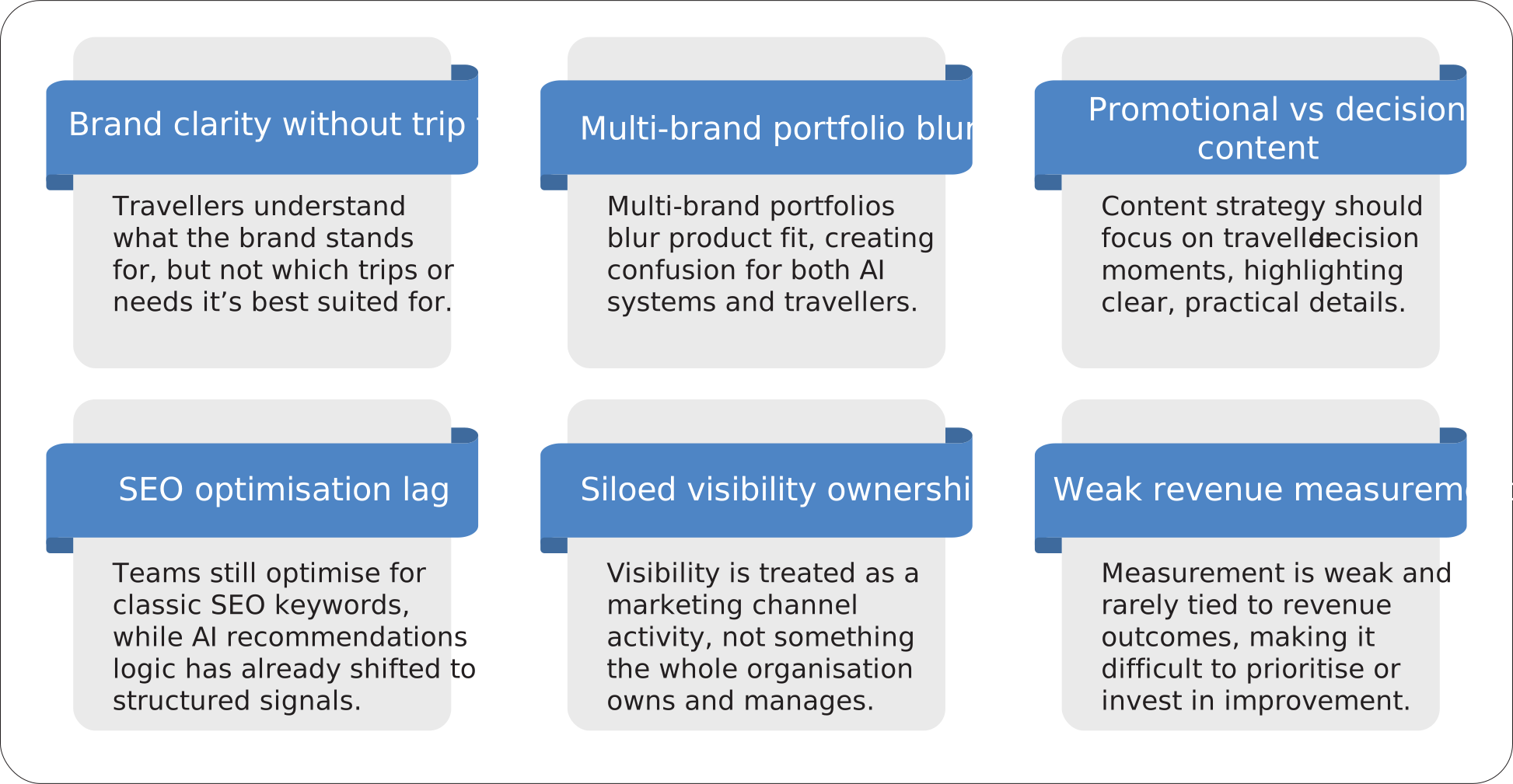
Figure 1
Barriers to effective visibility in hospitality
Figure 1
Revenue Driver
Online travel agencies frequently appear in AI-generated recommendations not because they market better, but because they publish highly standardised and comparison ready data at scale. Room types, amenities, policies, pricing formats, reviews are normalised to reduce ambiguity.
AI systems favour sources that are easier to reconcile. When brand-owned signals are inconsistent across websites, listings, and reviews, generative systems default to intermediaries by design. This is not a preference for Online Travel Agencies; it is a consequence of signal clarity.
For large hotel groups, scale amplifies this challenge. Variability across properties, regions, and brands weakens interpretation. Without portfolio-level consistency, scale dilutes relevance rather than compounding it.
This standardisation enables AI systems to process, compare, and rank options with lower ambiguity and higher confidence. In contrast, brand-owned channels often rely on narrative descriptions, inconsistent attribute definitions, and fragmented content governance across properties and regions. This increases interpretation effort, reducing the likelihood of inclusion in AI-generated recommendations. As a result, intermediaries are not just distribution partners, they are becoming default data sources for AI-mediated discovery.
Discoverability as a revenue driver
The commercial implications of discoverability are often underestimated. Discovery systems now filter demand before it even reaches the booking engine. As a result, revenue variance between similar hotels is no longer explained by location or rate alone; it is explained by discoverability and readiness.
The way a hotel is discovered determines not just the volume of bookings but also the quality of demand. This shifts acquisition expenses, average stay length, cancellation rates, and even guest perception well before the reservation is confirmed. OTA-sourced bookings reduce net revenue relative to direct bookings, compounding the commercial cost of poor discoverability. Two hotels can achieve similar occupancy yet deliver materially different commercial outcomes because the quality of demand differs.
In this context, discoverability is no longer a marketing metric; it is a revenue quality lever. Discovery systems are now upstream revenue managers who are shaping demand before pricing or availability ever comes into play.
AI discovery model
Gaps limiting AI discoverability today
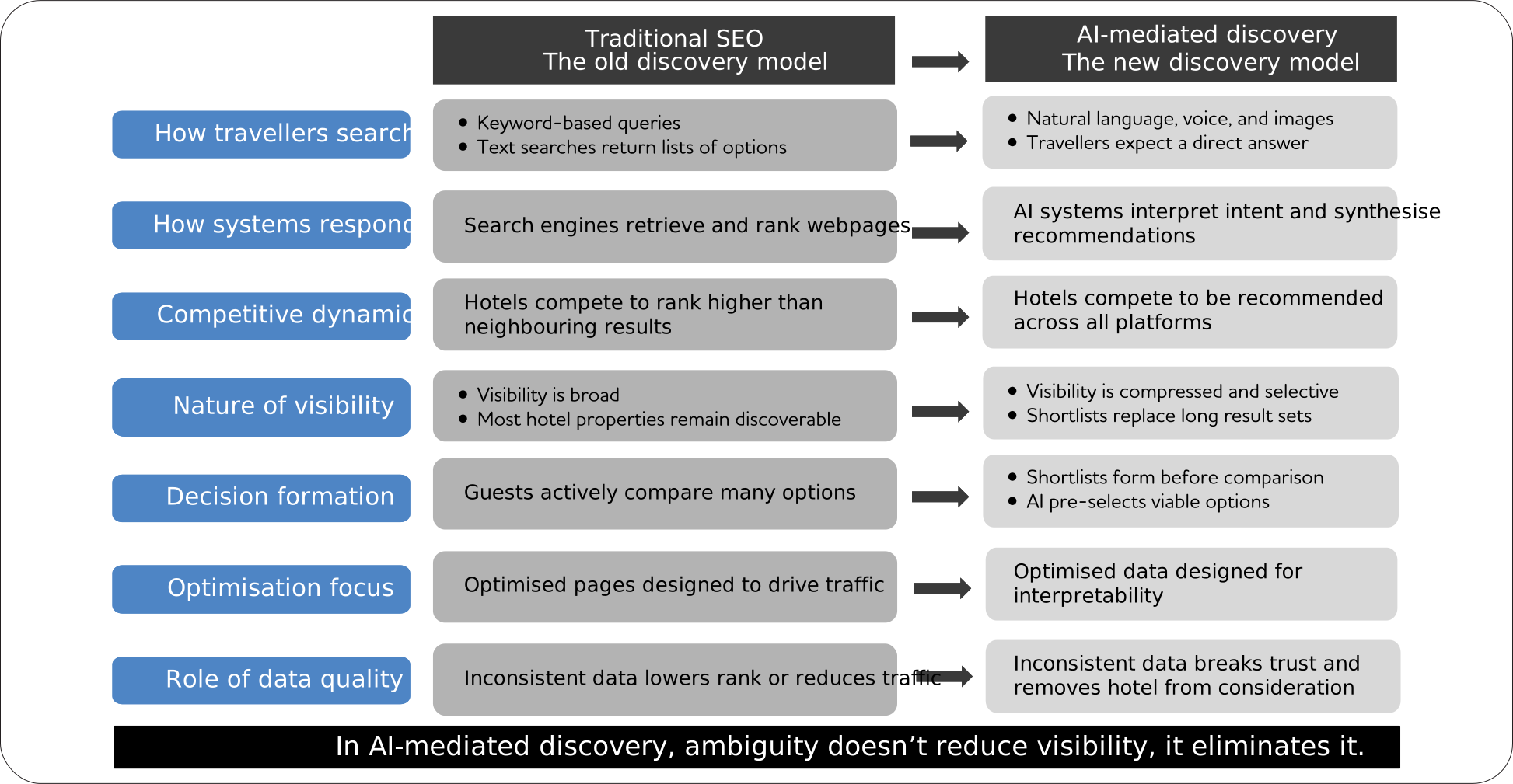
Figure 2
From search results to AI recommendations
Figure 2
Together, these issues help explain why visibility can grow while profitability lags.
Structured commercial data, consistent policies, and clear articulation of suitability materially improve how hotels are interpreted and recommended.
Content must be treated as a governed system rather than a series of campaigns. Question and answer formats play an outsized role in AI interpretation, particularly for policies, eligibility, and edge cases. Content distribution consistency across owned and third-party environments reduces interpretive friction and increases inclusion at the answer layer.
Responsiveness across reviews and listings has also shifted from reputation management to discoverability hygiene. These interactions reinforce trust and reliability signals that influence AI confidence and recommendation formation.
Improving discoverability does not require speculative technology bets. It requires strengthening the signals AI systems already rely on.
AI-driven discovery
As AI reshapes travel decision-making, hospitality brands must move beyond channel optimisation to actively manage how they are interpreted, compared, and shortlisted across AI-driven discovery. Three strategic focus areas will enable this shift:
- Enable visibility into how properties and offers appear in AI-powered trip planning and recommendations
- Identify inclusion in AI shortlists, attribute emphasis, and competitive positioning vs intermediaries
- Move from reactive reporting to proactive control of AI representation
- Improve inclusion, positioning, and share of consideration before demand reaches booking channels
- Transform guest reviews from passive reputation into active authority signals
- Strengthen clear, consistent, and defensible property narratives across guest interactions
- Improve how AI systems assess trust, relevance, and suitability
- Increase likelihood of being surfaced, trusted, and selected in AI-generated recommendations
- Standardise definition, structure, and updates of core product attributes (rooms, amenities, policies, schedules, fares, ancillaries, loyalty benefits)
- Ensure consistency across brand channels, intermediaries, and AI ecosystems
- Align surfaced content with traveller intent and real-time availability
- Reduce reliance on third parties to define product narratives
- Improve accuracy and consistency in AI-driven representation and recommendations
A perspective
AI is no longer a downstream influence on hotel discovery. It is becoming the environment where hotels are first considered, where value is interpreted, and where trust is formed. In this landscape, success is defined less by storytelling and more by signal clarity.
Discoverability has become a governed, enterprise-level capability with direct implications for revenue quality, brand control, and long-term competitiveness.
Hotels that are easy to understand earn inclusion naturally. Those that are not easy to understand are quietly excluded.
As the rules of discovery continue to evolve, the advantage will belong to organisations that align commercial, digital, and operational truth around how hotels are selected, not just how they are marketed. Hospitality leaders must act now to audit, standardise, and govern the signals that determine AI-driven selection.