Industry
Manufacturing
Future-Ready Manufacturing: Partnering in your journey to a sustainable manufacturing enterprise
Highlights
- Human domain knowledge remains the real differentiator between an AI pilot that works and one that gets quietly shelved.
- Keeping a human in the loop is what actually earns trust from the people who have to act on the model’s recommendation.
- The biggest gains in manufacturing, logistics, and commodities come from AI and domain expertise working together.
On this page
On this pageinpage
Why "Data-First" fails
Industrial AI works best when it is guided by people who understand how operations really work. AI can identify patterns in large volumes of data, but it does not naturally understand cause and effect, equipment limits, safety rules or the practical knowledge built through years on the shop floor. For example, a model may link rising motor temperature to an impending failure, while a maintenance engineer knows that the same rise is normal during a particular product changeover. Domain knowledge provides the context, guardrails, and feedback that make AI recommendations reliable, explainable, and usable.
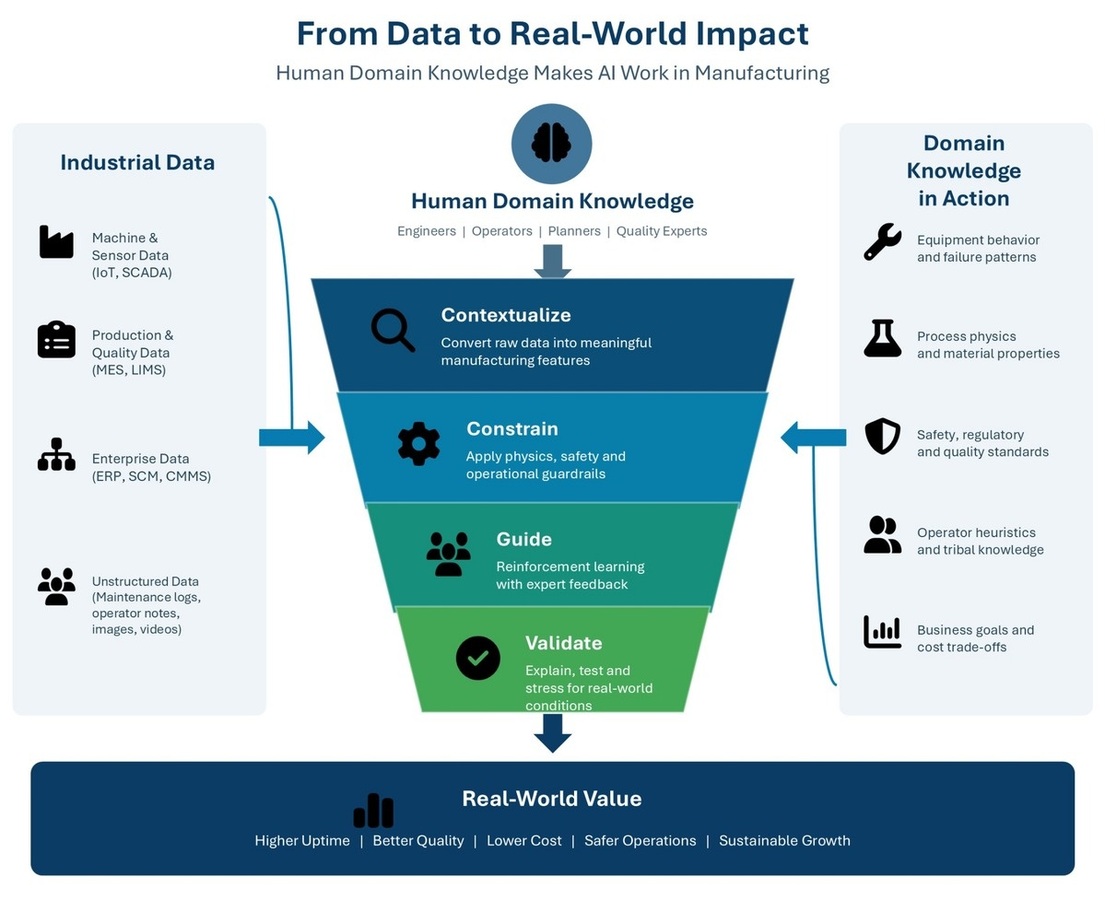
Combining Human Expertise and Industrial AI
Combining Human Expertise and Industrial AI
Why AI needs context
Data-first AI strategies often struggle in industrial environments because models learn patterns, not the physical and operational reasons behind them. Rare events may be missing from historical data, apparently logical recommendations may be unsafe or impractical, and black-box outputs may not provide enough explanation for an operator to act with confidence.
Consider a scenario where a paper mill leverages AI to predict pulp-digester failures from temperature, pressure and chemical-dosing data. After a change in pulp supplier, the raw-materials chemistry shifted and the AI model began generating false alarms. An experienced operator recognised that the new grade normally ran hotter during the first two hours. Once this operating insight was added as contextual logic, the model could distinguish a normal transition from a genuine anomaly.
The same issue appears in discrete manufacturing. A vision system may classify a surface mark as a defect, while a quality engineer knows that it is acceptable for a specific product grade and customer specification. Human expertise helps prevent unnecessary scrap, unsafe decisions, and erosion of trust as AI evolves from pilot initiatives to mission-critical operations.
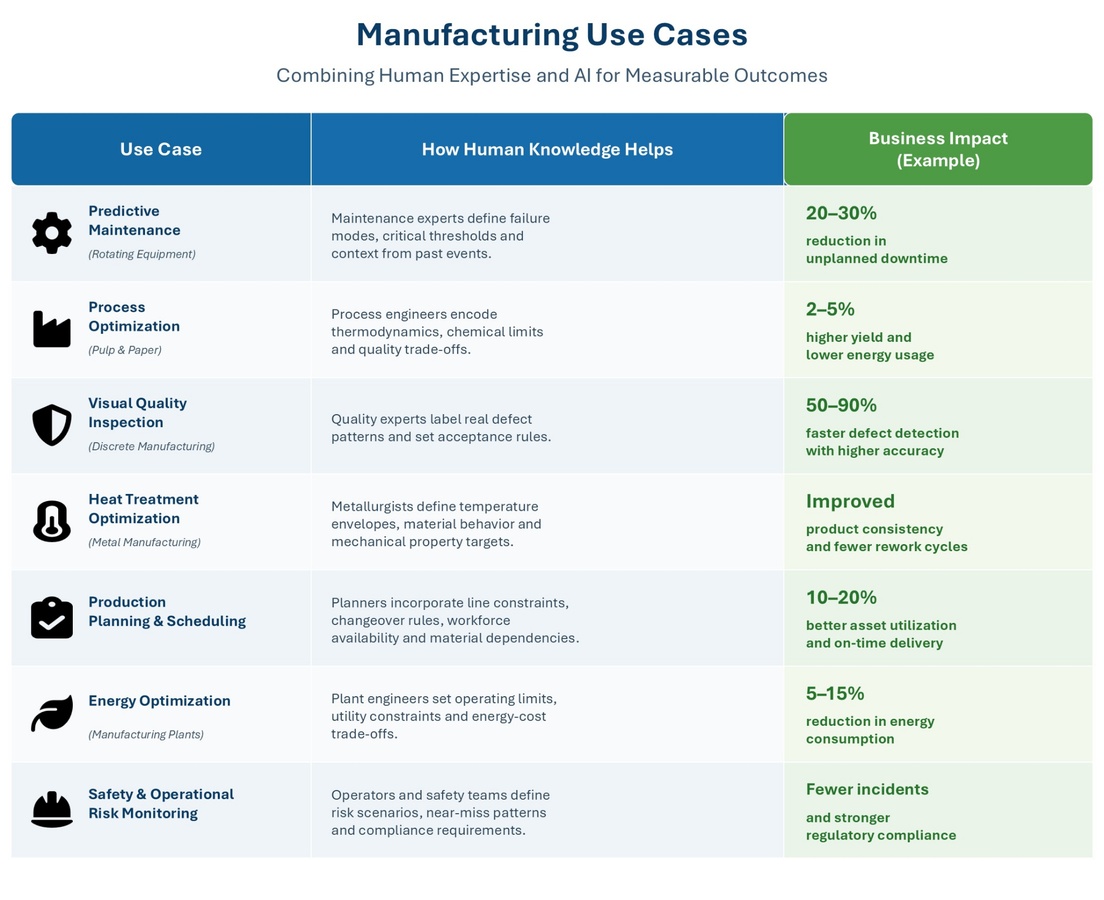
Human Expertise Meets Industrial AI
Human Expertise Meets Industrial AI
Human-centric AI
Dependable industrial AI is created when domain expertise is embedded throughout the model lifecycle rather than added only during final validation. Expert knowledge can be captured through ontologies, knowledge graphs and documented operating rules, while contextual features can combine raw sensor signals with information such as product grade, machine state, maintenance history, and environmental conditions. Physics-based and rule-based guardrails can then prevent recommendations that exceed equipment, quality or safety limits.
In a heat-treatment operation, for example, an optimisation model may identify a temperature profile that reduces cycle time. Experienced professionals can guide the AI so it recommends faster and more efficient ways of working without compromising product quality. The system improves over time through expert input, while major exceptions remain under human oversight. Cross-functional teams comprising operators, engineers, quality specialists, and AI practitioners ensure that model performance is assessed against real production outcomes, not statistical accuracy alone. This human-centric approach allows AI to learn continuously while remaining aligned with plant priorities and operating realities.
The AI trust factor
When AI recommendations are grounded in domain expertise, organisations can improve prediction accuracy, reduce operational risk, and enhance operator confidence. In the case of predictive maintenance, engineers can separate genuine degradation signals from normal changes caused by product mix, speed or operating model, helping maintenance teams focus on the right equipment. In quality control, process and quality specialists can connect vision-system findings with tolerance limits, product grades and customer specifications, reducing false rejections and avoidable scrap.
In continuous manufacturing, expert-defined safety envelopes allow AI to optimise yield, energy use, and throughput without exceeding limits for temperature, pressure, vibration or asset life. With regard to production planning, planners can add constraints such as tooling availability, changeover sequence, shelf life, and maintenance windows, making schedules executable on the shop floor. The result is AI that supports faster decisions while preserving safety, quality, compliance, and human accountability.
TCS AI Advantage
TCS brings together manufacturing domain consulting, operational knowledge, AI engineering, and governance to help enterprises move from promising pilots to dependable industrial solutions. The approach connects plant processes, enterprise resource planning and manufacturing data, engineering rules and human expertise in a way that models reflect how production is actually planned, executed, and controlled.
By combining cross-functional teams with explainability, guardrails, and continuous feedback, TCS can help clients create scalable AI solutions for asset reliability, quality, planning, energy optimisation, and supply-chain execution while prioritising safety, compliance, and business accountability.
AI meets expertise
As foundation models become more widely accessible, competitive advantage will increasingly depend on how effectively manufacturers convert operational knowledge into AI-ready rules, context, and decision frameworks. The strongest industrial AI ecosystems will connect machine intelligence with the judgement of operators, engineers, planners, and quality specialists. This partnership will enable plants to respond faster to disruptions, improve asset and process performance, and scale innovation without weakening safety or control. The future of industrial AI is, therefore, not human versus machine, but human expertise amplified by algorithms that understand the boundaries of real manufacturing operations.