Industry
Travel and Logistics

Data and AI in Travel Industry for a Memorable Passenger Experience
Highlights
- Commercial strategy in hospitality and travel is evolving into a fully integrated, artificial intelligence (AI)‑driven model that unifies revenue management, sales, marketing, loyalty and distribution to better manage complex, non‑linear traveller journeys.
- Organisations are shifting focus from individual transactions to total traveller value, enabled by data‑driven pricing, real‑time demand signals and holistic revenue optimisation across the entire booking process.
- Loyalty programmes are becoming central identity platforms, allowing companies to recognise customers across touchpoints, deliver personalised offers and replace broad discounting with targeted, margin‑enhancing incentives.
- The future lies in a single AI-powered commercial platform that automates decision-making, orchestrates pricing and marketing in real time, and enables predictive, personalised traveller experiences.
- As organisations advance through AI maturity, commercial operations transform into autonomous growth engines, improving efficiency, reducing acquisition costs and strengthening customer relationships for sustained competitive advantage.
On this page
On this pageinpage
Unified engine
In the travel and hospitality industry, commercial strategy is evolving into a fully integrated model where the traditional silos that once separated revenue management, sales, marketing, loyalty, digital and distribution are dissolving. Instead, a fully integrated, enterprise wide commercial organisation designed for a more complex, non linear traveller journey, is emerging.
This shift reflects a broader industry reality: today’s travellers move fluidly across a wide range of touchpoints, from social media ads to online search, to loyalty apps and, increasingly, through artificial intelligence (AI) assistants and large language model (LLM)-powered conversational search, engaging wherever it is most convenient.
To remain competitive, organisations must align every commercial discipline around a shared objective: shaping demand, delivering personalised experiences, and maximising long-term traveller value.
Model pillars
Three foundational pillars lie at the heart of this transformation and define the new commercial playbook:
Traditional revenue management has evolved from ‘heads in beds’ or ‘suits in seats’ into a broader concept: Total revenue optimisation, where value (and profit margin contribution) is no longer derived from a single product but from the total spend across the traveller journey.
- Airlines bundle seat pricing with ancillary services such as baggage, seat selection, and lounge access, driven by new distribution capabilities and modern airlines retailing.
- Cruise lines maximise total cruise value beyond cabin pricing, optimising onboard and offshore revenue streams such as dining, activities, shore excursions, and entertainment.
- Hotels and resorts focus on total revenue per available room / hotel asset (TRevPAR / TRevPHA), incorporating revenue from food and beverage, spa, ancillary services, and other amenities.
- Casinos represent the highest level of sophistication, balancing gaming and non gaming revenue through highly targeted, ‘segment of one’ incentives designed to influence behaviour and drive incremental spend.
By leveraging large scale data from competitor pricing and weather patterns to local events and macroeconomic shifts, organisations can move beyond rules-based pricing to dynamically adjust pricing and offers with data-driven precision. This could be a unified decision layer that enables real-time, context-aware pricing and offers optimisation on a bigger scale, continuously adapting to changing conditions and customer intent.
Loyalty programmes have evolved from transactional ‘points-and-perks’ systems into strategic assets that anchor the commercial ecosystem. Today, they function as centralised identity systems that allow brands to recognise, understand, and engage travellers across all interactions. This shift is especially clear in the airline industry, with its loyalty led platforms. All this operates within a transparent, consent-based framework that complies with privacy regulations and data governance standards.
For a hospitality and travel brand, loyalty programmes convert autonomous travellers into identifiable, high value customers and allow targeted, long term engagement. The industry-leading loyalty programmes enable:
- Airlines to drive fare premiums, lucrative co-branded credit card revenues and repeat travel
- Hotels and cruise lines to unlock targeted offers, upsell opportunities, and ancillary revenue optimisation.
- Casinos to implement real-time recognition across gaming, dining, entertainment, and rooms.
By centring commercial strategy on a unified traveller identity, brands can replace ad-hoc discounting with personalised incentives that protect margins, increase brand contribution, and improve guest satisfaction.
The relationship between travel brands and third-party intermediaries is being redefined. While these channels remain critical for reach and new customer acquisition, the focus is shifting towards strengthening direct customer relationships and optimising channel mix.
Customer data platforms (CDPs) and predictive analytics enable brands to identify direct bookers, tailor communications based on traveller intent, optimise marketing spend and channel performance, and deliver personalised, consistent experiences across all channels. This capability extends to the traveller experience itself. Digital innovations such as mobile wallets, seamless check-in, and onboard or in-property messaging apps create a connected and friction-less journey.
AI commerce hub
Looking ahead, organisations will operate on a single, AI-driven commercial platform that unifies analytics, revenue management, sales, marketing, loyalty and distribution across all travel verticals. In this model:
- AI orchestrates pricing, offers, content, and messaging across the entire journey
- Decisions are optimised for total traveller value, not individual transactions
- Real-time demand signals (capacity utilisation, weather, and events) continuously optimise decision-making across the entire commercial platform.
This unified platform represents a fundamental shift from reactive and siloed process to proactive, predictive, and automated decision-making.
Reshaping traveller experience
AI is becoming embedded across the commercial stack and starting to fundamentally reshape the traveller experience. Travellers will benefit from:
- Autonomous journey management, where intelligent agents handle planning, booking, and real-time modifications
- Predictive disruption management, with issues resolved before they impact the traveller
- Real-time personalisation, driven by an integrated understanding of preferences, behaviours, and context
Service delivery will become anticipatory, with airlines proactively rebooking passengers, hotels preparing rooms based on arrival patterns, and cruise lines dynamically optimising boarding and onboard experiences. AI will drive hyper-personalisation across every touchpoint, tailoring services and offers to ensure consistent and relevant experiences throughout the journey.
Commercial impact
On the business side, AI is starting to transform commercial operations into autonomous growth engines. Key changes include:
- Marketing automation, aligned with demand, availability and customer preferences, across dynamically generated campaigns, segmentation and messaging in real time
- AI-augmented sales, where leads are evaluated and proposals are automatically created and prioritised based on revenue potential, displacement or perishable inventory elimination.
- Next-generation loyalty, evolving into cross-brand identity systems that unify recognition, earning, and redemption
- AI-mediated distribution, where travellers interact through conversational platforms that curate personalised itineraries and connect directly with suppliers
These advancements reduce distribution and customer acquisition costs, improve conversion rates, enhance customer experience, and ultimately increase profitability and brand control (see Figure 1).
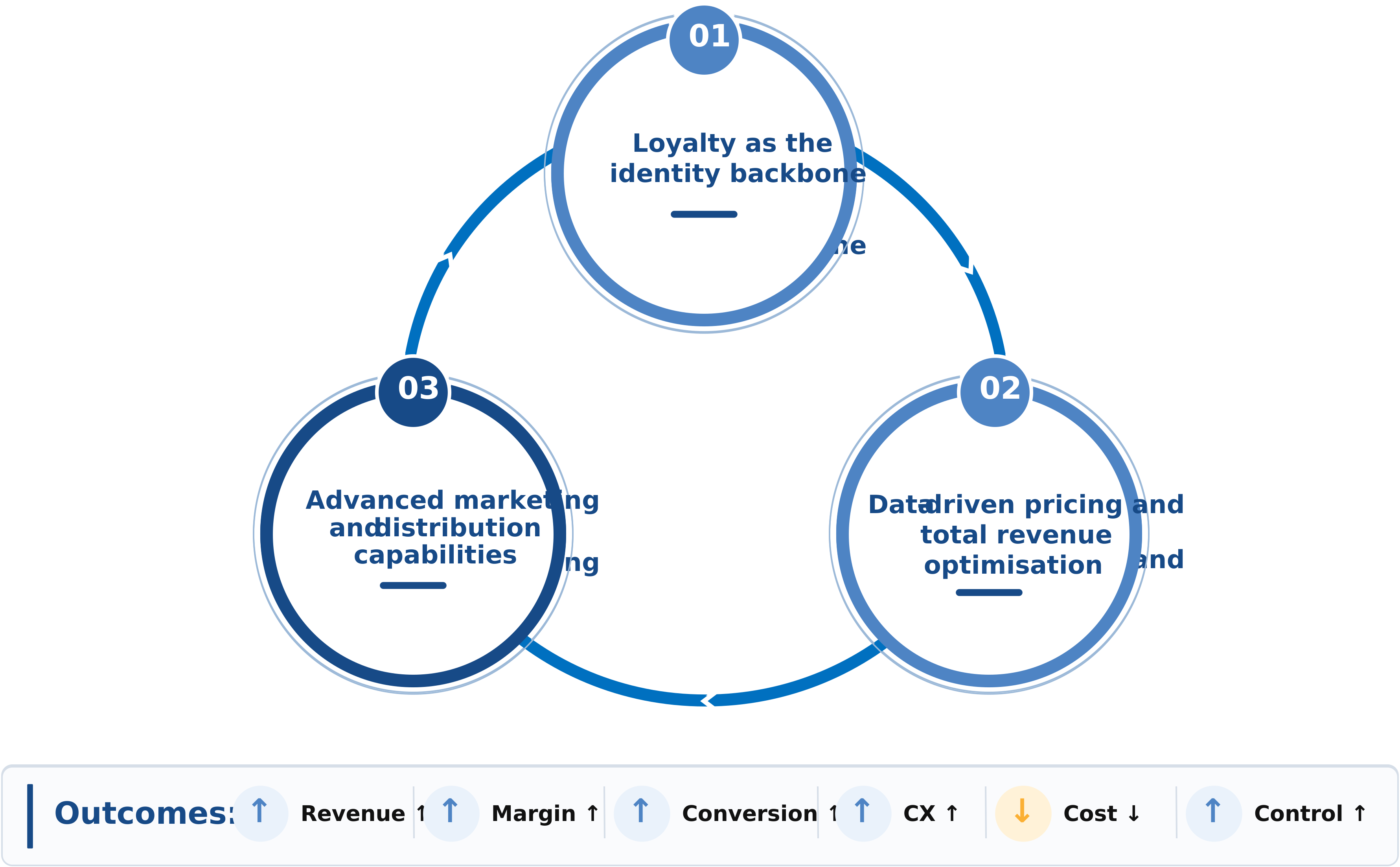
Figure 1
AI-driven integrated commercial engine
Figure 1
AI maturity path
To reach this autonomous future, organisations must progress through a structured five level maturity model that provides a clear road map for assessing capabilities and accelerating transformation.
Pre-AI fragmented commercial environment: Organisations operate with siloed and disconnected commercial systems. Operations are largely manual, with heavy reliance on data cleansing, rule-based pricing, fixed marketing cycles and inconsistent sales execution. Dependence on intermediaries limits control over distribution and customer relationships, resulting in a slow, reactive, and costly commercial engine, with significant revenue leakage and limited ability to optimise performance.
To guide this transformation, a five-level commercial AI maturity model provides a structured framework for assessing current capabilities and defining the path toward a fully integrated, AI-driven commercial engine (see Figure 2). It outlines the progression from fragmented, manual operations to orchestrated and ultimately autonomous systems optimised for total traveller value.
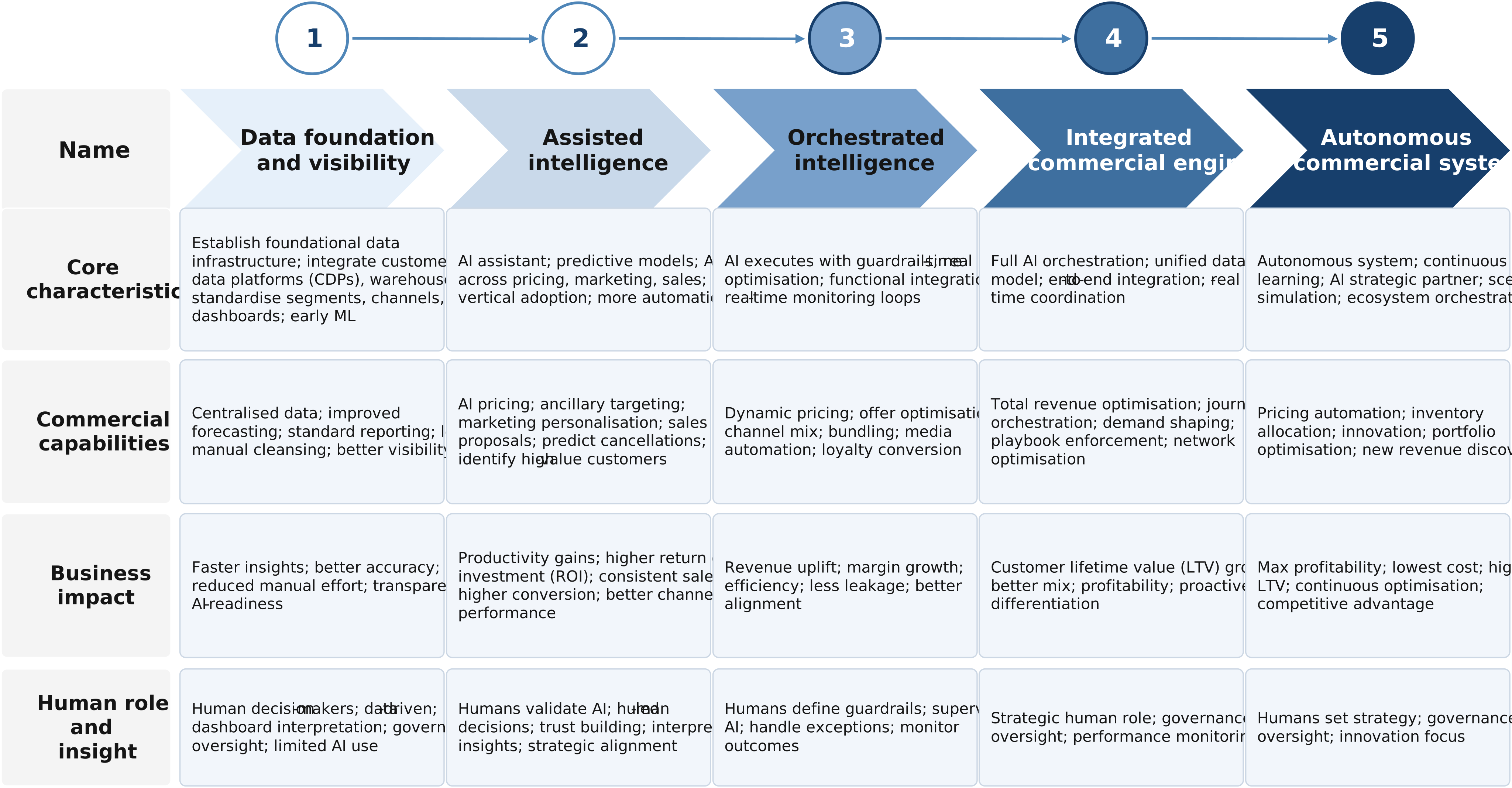
Figure 2
The five-level maturity path
Figure 2
Through each level, organisations evolve from generating basic insights to leveraging AI-driven recommendations, advancing to orchestrated decision-making, and ultimately achieving fully autonomous, self-optimising systems. This transformation also marks a shift from manual execution to AI-assisted, AI-driven, and eventually AI-operated models, enabling a move from reactive decision-making to predictive, proactive, and continuously adaptive operations. In parallel, the role of humans undergoes a fundamental transition, too, from executing tasks and interpreting data to validating AI outputs, supervising automated systems, and ultimately focusing on strategy, governance and long-term value creation.
What this requires
TCS can help travel and hospitality organisations accelerate this transformation by supporting the entire commercial evolution from data foundations to AI-driven operations.
Design and implement enterprise data architecture that integrates all commercial systems and customer data platforms (CDPs), creating a single source of truth for real-time demand, inventory, and traveler intelligence.
Deploy advanced models for dynamic pricing, forecasting, and ancillary revenue intelligence, tailored to the specific needs of airlines, hotels and cruise lines.
Transform legacy loyalty programmes into modern identity systems, enabling real-time recognition and next-best offer engines.
Beyond the commercial, enable predictive rebooking, automated check-in, housekeeping dispatch, ticketing, reissues, refunds, and quality control while freeing teams to focus on high-touch guest interactions.
Deliver transformation at scale, supported by global engineering capabilities and partnerships.
AI-powered modern strategy Future excellence
The future of travel and hospitality is not defined by better products alone but by stronger, more intelligent connections with travellers. The industry is moving towards a unified, AI-driven commercial ecosystem where data, intelligence, and automation converge to deliver seamless, personalised experiences and optimised profitability.
Organisations that successfully navigate this transformation will unlock new revenue opportunities, reduce reliance on intermediaries, strengthen customer relationships, and achieve sustainable competitive advantage.
The vision is clear and the road map defined. In this context, AI is not just a supporting tool, but the operating system of modern commercial strategy.